


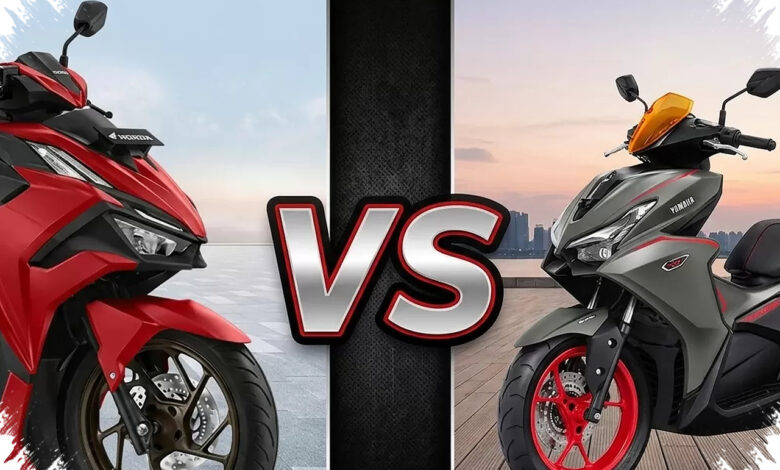
The premium scooter market in Indonesia has entered a more intense phase after PT Astra Honda Motor introduced the New Honda Vario Evo 160 in Cikarang on 24 June 2026. The model moves directly into the same space long occupied by Yamaha’s MAXi 155 line, especially Aerox and Lexi.
Its appeal is not limited to the engine update. Honda is also backing the Vario Evo 160 with an aggressive price strategy, a move that could matter even more as riders look for scooters that combine performance with everyday practicality.
Design becomes the first point of pressure
The “Evo” name signals a clear visual shift on the latest model. Honda has reshaped the front section to look sharper and more aerodynamic, with stronger body lines that give it a more assertive stance.
That direction is aimed at younger buyers who want a sporty look without giving up a sense of refinement. In the premium scooter segment, visual identity often plays a major role in the final purchase decision.
Honda has also kept daily use in mind. The Vario Evo 160 comes with an 18-liter storage compartment, a modern digital instrument panel, and a USB Type-C charger.
Those features show how competition in this class has expanded beyond pure engine output. Buyers now expect a package that supports commuting as well as riding enjoyment.
Performance stays close to the main rivals
Under the bodywork, the Vario Evo 160 uses a 160cc eSP+ four-valve engine. Honda lists output at 11.3 kW at 8,500 rpm and torque at 14.0 Nm.
The company also states a 0–200 meter acceleration time of 11.9 seconds and a top speed of 109 km/h. On paper, those numbers place it very close to Yamaha’s key challengers.
| Model | Engine | Torque | Notable Detail |
|---|---|---|---|
| Honda Vario Evo 160 | 160cc eSP+ 4-valve | 14.0 Nm | 0–200 m in 11.9 seconds, top speed 109 km/h |
| Yamaha Aerox Alpha | 155cc Blue Core VVA | 14.2 Nm | Higher-tech positioning with YECVT and Google Maps on TFT |
| Yamaha Aerox Connected | 155cc Blue Core VVA | 14.2 Nm | Competes in the same premium scooter space |
| Yamaha Lexi LX 155 | 155cc Blue Core VVA | 14.2 Nm | Comfort-focused city riding setup |
Yamaha’s Aerox Alpha, Aerox Connected, and Lexi LX 155 all use a 155cc Blue Core VVA engine. Their peak power is described as identical, while some variants have a slightly higher torque figure of 14.2 Nm.
That narrow gap means the decision is likely to depend more on engine character and how each scooter feels in daily use. For many buyers, responsiveness and riding comfort may matter more than small differences in technical specifications.
Pricing becomes the sharpest comparison
Honda has priced the Vario Evo 160 from Rp28.5 million to Rp31.4 million. That range places it very close to Yamaha’s core offerings.
The Lexi LX 155 standard model is listed at Rp27.55 million, while the standard Aerox Connected sits at Rp28.88 million. At the top end, the Aerox Alpha “TURBO” reaches Rp41.93 million.
Those figures put the Vario Evo 160 in the most crowded part of the premium scooter market. In this bracket, even a small price difference can influence buyers once they begin comparing features in detail.
Different strategies, different buyer profiles
Honda and Yamaha are clearly taking different routes to attract riders. Honda is emphasizing practical value, including the large storage space and the convenience of USB Type-C charging.
Yamaha is leaning harder into technology, especially through the Aerox Alpha. Its YECVT system and Google Maps navigation on the TFT display are positioned as key selling points.
Lexi LX 155 takes a more urban-friendly approach. Its flat footboard and lighter weight are designed to support easier city riding and more relaxed everyday mobility.
The result is a sharper and more varied premium scooter contest. The Vario Evo 160 offers a balance of performance and function, Aerox pushes a technology-led image, and Lexi focuses on comfort for daily urban use.
For consumers, that creates a stronger set of options with clearer identities. For the manufacturers, it raises the standard for what a premium scooter must deliver on the road, not just on paper.