


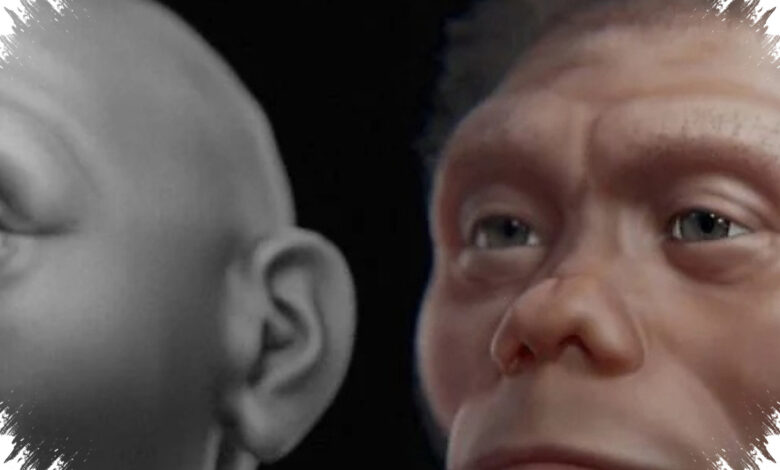
A new study is forcing a rethink of one of the most familiar stories about Homo floresiensis, the tiny ancient human often nicknamed the “Hobbit.” The latest analysis suggests that the traces on Stegodon bones are not strong enough to prove that the species actively hunted large animals.
That matters because the Flores fossils have long been used to support a much bigger claim about the species’ abilities. For years, bones found alongside stone tools were taken as evidence that Homo floresiensis could hunt, make complex tools, and perhaps even use fire.
Komodo May Have Reached the Carcass First
Researchers compared Komodo dragon bite marks with wounds on Stegodon fossils recovered from Liang Bua. The pattern pointed to bite damage concentrated in meat-rich areas such as the shoulder and hip.
That detail suggests Komodo dragons may have reached the carcass first and fed on the best parts. The cut marks linked to Homo floresiensis, by contrast, appeared in less meaty areas such as the legs and ribs.
| Trace Type | Likely Source | Body Areas Affected |
|---|---|---|
| Dragon bite marks | Komodo dragons | Shoulder, hip |
| Stone tool cut marks | Homo floresiensis | Legs, ribs |
Because the marks appear in different parts of the animal, the bones now read differently. If Komodo dragons arrived first, Homo floresiensis may have been eating leftovers rather than bringing down Stegodon itself.
A More Cautious View of Hunting
On that basis, the researchers argue that Homo floresiensis was more likely engaged in passive scavenging. In other words, the species may have taken advantage of carcasses without needing to hunt large animals directly.
The new interpretation lowers confidence in the idea that the Hobbit had hunting skills comparable to modern humans or Neanderthals. Tracking and killing large prey usually requires planning, cooperation, and a higher level of cognitive complexity.
Even so, the findings do not reduce the importance of Homo floresiensis as an evolutionary success story. Survival on an isolated island for a very long time still points to strong adaptability in a small-bodied hominin.
Fire Evidence Also Reconsidered
The study also revisits another long-standing assumption: that Homo floresiensis controlled fire. Earlier, charcoal and burned bones from Liang Bua were often treated as signs of domestic fire use.
However, a re-examination of the cave stratigraphy suggests that those fire traces came from a younger layer. That layer is associated with a later period, when Homo sapiens had already occupied the cave and Stegodon were no longer present.
This makes the burned material harder to connect to the Hobbit. In the updated reading of the site, the fire evidence fits better with later occupants than with Homo floresiensis itself.
Small Body, Large Adaptation
Elizabeth Grace Veatch, a paleoanthropologist at the University of Tübingen, said that surviving in such conditions still represents a remarkable adaptation. Living on a remote island for tens of thousands of years without relying on fire or large-game hunting is no small feat for a species with a small brain.
That is why the new picture matters beyond one fossil site. Homo floresiensis now appears less like a sophisticated big-game hunter and more like a human ancestor able to make the best of limited resources.
In evolutionary terms, that kind of flexibility may be just as significant as the dramatic hunting abilities once attributed to the species. The Liang Bua evidence now points to a more restrained, but still impressive, survival strategy on Flores.