


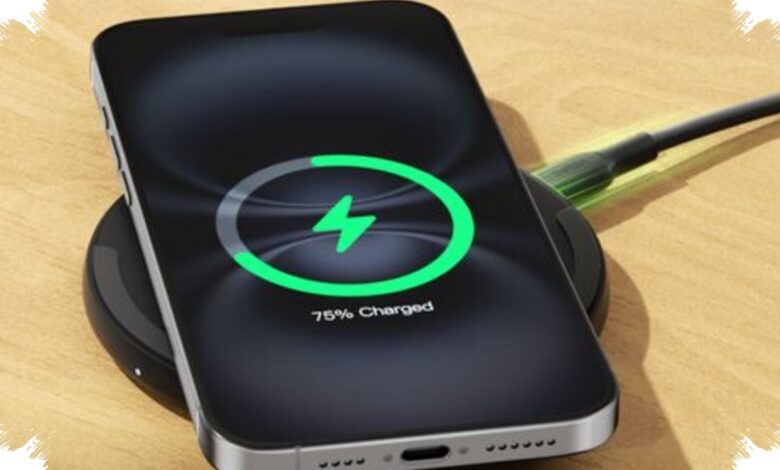
Wireless charging is convenient, but it is not always the smarter choice. In many everyday situations, a USB cable still delivers better efficiency, faster charging, and lower power waste.
That difference matters most when users care about speed and electricity use at the same time. A tidy desk and the ease of dropping a phone onto a pad are useful, but they come with trade-offs that are easy to overlook.
Why wireless charging loses energy along the way
Wireless charging works through induction. An alternating current in the charger coil creates a magnetic field, then the receiving coil inside the device captures that energy and converts it back into direct current for the battery.
Each step in that chain creates losses, which means the process is never fully efficient. The conversion from AC to DC, then to magnetic flux, and back again inside the device, always wastes some energy.
The problem becomes more visible at high frequencies, around 140KHz. At that point, skin effect reduces the effective conduction area in the copper coil and turns part of the energy into heat.
That is one reason phones often feel warm after wireless charging. The temperature rise is not just a side effect; it is evidence that some electricity is being lost as heat instead of reaching the battery.
Placement also affects performance. If the phone is not aligned properly on the pad, charging slows down and energy loss increases.
MagSafe and Qi2 improve alignment with magnets. Even so, the setup is still less ideal when barriers are involved, including thin cases that add extra resistance.
Even when the charger is idle, it still draws power. iFixit found that wireless chargers average about 0.2W in standby, while many wired chargers can shut off completely when not in use.
How much power a cable saves
The gap in efficiency is not small. In an ideal scenario, Qi2 and MagSafe-like pads still lose around 12 to 20 percent of energy, while standard Qi charging can lose 25 to 40 percent.
By comparison, common USB-C wired charging typically loses only about 5 to 10 percent. For the same task, the cable path usually wastes far less electricity.
The difference may seem minor during a single charge. Over repeated use, however, the losses accumulate, especially in homes that charge multiple devices every day.
iFixit says a 15W MagSafe or Qi2 charger consumes electricity equivalent to keeping a 10W LED lamp on for 24 straight days. As more devices are added, the total demand rises as well.
That is why cable charging makes more sense when the priority is keeping power costs down. It is also better for the grid because it reduces unnecessary energy waste.
When speed still favors the wire
Wireless charging is also slower in general. Qi2 and the latest MagSafe sit at a peak of 25W, while speeds up to 100W usually require a proprietary charger with aggressive cooling that tends to be noisy.
Wired charging is much easier to find at higher output levels. The Google Pixel 10 Pro supports up to 30W with a compatible adapter, the Samsung Galaxy S26 Ultra supports 60W, and devices such as the OnePlus 15 can reach 80W to 100W with highly proprietary chargers.
The time difference is clear when the battery is nearly empty. The Galaxy S26 Ultra can reach 50 percent in 15 minutes at 60W, while a Qi2 pad needs about 33 minutes.
When a phone was left unplugged overnight, that gap can decide whether it lasts through the workday. In that situation, a cable is the safer choice because it gets the job done faster.
Where wireless charging still makes sense
Wireless charging still has a place, despite its drawbacks. In a car, it can save time when the user is rushing and can free up a USB port for a passenger.
It is also useful for multi-device charging setups where cable management is tight. Some people simply prefer the convenience of placing a phone on a pad instead of dealing with a cord that can snag or pull the device down.
For everyday charging focused on efficiency, though, the cable remains the stronger option. When lower power use, faster charging, and better value matter most, plugging in for a few seconds makes more sense than relying on a wireless pad.