In the AI PC era, laptop makers are running into a problem that raw computing power cannot solve on its own: heat. As chips get faster and machines get thinner, the fan remains one of the biggest obstacles to radical redesign.
Ventiva believes that constraint is no longer inevitable. The Fremont, California-based company is promoting a solid-state cooling module with no moving parts, and it says the approach could change both the sound of laptops and the layout of their motherboards.
A fan takes up more than noise
For Ventiva chairman, president, and CEO Carl Schlachte, the real cost of a laptop fan goes far beyond acoustics. He says a typical laptop motherboard can devote about 40% to 45% of its area to the fan alone.
In practical terms, that can translate into nearly 8,000 square millimeters of premium board space. It also forces engineers to accept a motherboard shape built around a fan cutout, rather than around the most efficient placement of other components.
| Cooling Approach | Main Hardware | Design Impact | Noise |
|---|---|---|---|
| Conventional fan cooling | Impeller, motor, moving parts | Takes up major motherboard space | Produces audible noise |
| Ventiva solid-state cooling | EHD-based ionic airflow | Frees board space for layout changes | Eliminates fan noise and vibration |
How the ion-based system works
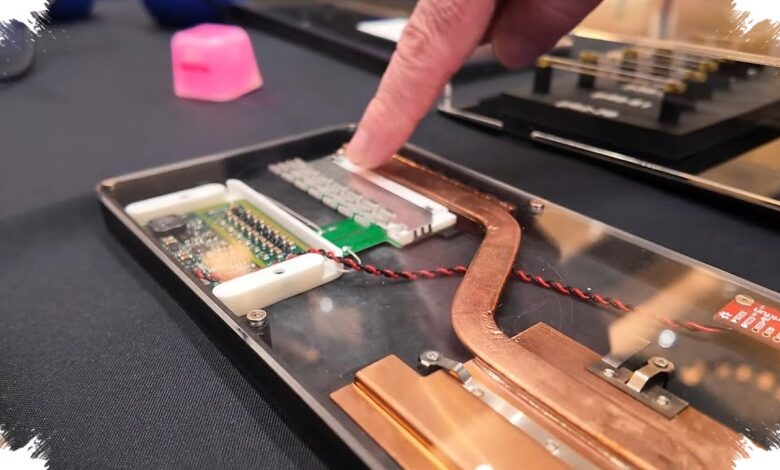
Ventiva’s technology uses electrohydrodynamic, or EHD, cooling. It relies on a small plasma field to move air without an impeller, motor, or any rotating component.
Inside the module, thin wires are charged. Positive ions are drawn toward a negatively charged collector, and that movement pulls surrounding air molecules along to create airflow.
The company describes the result as solid-state ionic cooling. Because there are no moving parts, the system also removes the vibration and noise that usually come with a fan.
What the extra room could unlock
Ventiva argues that the main value of a fanless design is not only quieter operation. Removing the fan can also open up the motherboard for denser component placement and new layout options that are difficult to achieve in current laptops.
Schlachte says local AI inference requires high memory bandwidth, which means memory must be soldered very close to the CPU. That arrangement keeps traces short and fast, but it also consumes valuable space, especially in compact laptops.
Without a fan in the way, Ventiva says that space can be repurposed for larger memory configurations around the processor. The company also says the CPU no longer has to sit in the center of the board.
That shift could allow manufacturers to split the motherboard into two sections: a premium, multilayer board for high-speed components and a second board that is cheaper and can vary by SKU. Schlachte also says some customers see enough freed-up room to move from a 65-watt-hour battery to a 90-watt-hour battery.
Shorter signal paths, lower cost
Ventiva says the benefits extend into electrical design as well. Fan cutouts create physical bottlenecks that force high-speed I/O signals to detour before reaching the CPU.
According to Schlachte, those detours make traces longer than necessary and require more board isolation in tight areas. In some cases, he says, that is one reason a design ends up using a 12-layer board.
He also points to a repeater costing about $3, which is used to strengthen signals when the path becomes too long. If the trace can run more directly and avoid those pinch points, that part may no longer be needed.
Ventiva acknowledges that its module is more expensive than a conventional fan. Even so, the company says the total bill of materials can come out lower once motherboard savings are included, and it says some major customers have already reached that conclusion in their own analysis.
Where Ventiva is showing up
At Computex 2026, Ventiva announced a strategic partnership with Asus. The company showed its module in the Asus NUC Pro 16, a business and AI mini PC configured as a 45-watt-TDP prototype.
Ventiva also displayed an AMD Ryzen-based laptop prototype configured at 28-watt-TDP. In that model, the cooling strip sits along the rear edge of the laptop and exhausts air toward the back.
The company says it also has another prototype using Intel Panther Lake Core 3 Series chips, along with a Dell sample labeled “Silent Thermal Solution.” Schlachte says designs with four of the five largest laptop makers are now at different stages of development.
Not just for laptops
Ventiva is not the only company pursuing fanless cooling. Frore Systems has AirJet, a piezoelectric module with vibrating elements that push air through the body of the unit.
Schlachte says Ventiva’s approach is different because it is designed to cool an entire laptop rather than sit on top of a single hot chip. He says the company’s module bank is intended to move air across the whole chassis, including narrow areas that are difficult to reach.
Ventiva is also looking at servers, though not for the kind of 1,400-watt GPU cooling that would grab headlines. Schlachte says the more realistic use case is in the back end of servers, including NIC cards and MOSFETs that are prone to heat.
With an automated factory in Malaysia ready to scale production to millions of modules, Ventiva is positioning itself for a period when AI laptops need more power, closer memory, and denser layouts. The company expects laptops shipping with the technology to begin appearing within 18 months.