


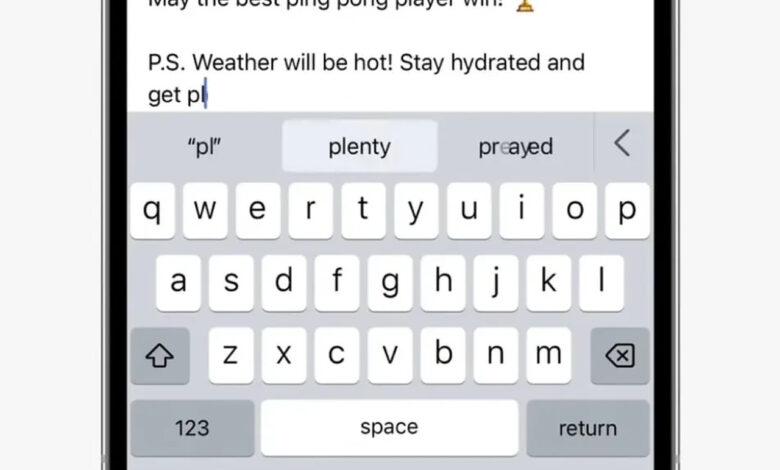
Phone keyboards often seem unnervingly good at predicting the next word. That impression comes from a system that does far more than guess at random, because it analyzes language patterns, stored vocabulary, and the user’s own typing history.
What appears to be a quick read of the user’s mind is actually the result of rapid calculations. The keyboard compares likely word sequences, then surfaces the options it believes are most probable in that exact moment.
How the prediction engine works
Modern keyboards are built to recognize patterns in everyday language. They know that certain words frequently appear together, so their suggestions are shaped by probability rather than chance.
When a person types a phrase such as “good morning,” the system can prioritize words that commonly follow that opening. Less likely options are pushed lower, which is why the suggestions often feel unusually accurate.
| What the keyboard uses | What it does | Result for the user |
|---|---|---|
| Language patterns | Checks which words often appear together | Suggests the most likely next word |
| Built-in dictionary | Scans a large list of common words and phrases | Matches partial typing in seconds |
| Typing history | Learns from repeated personal usage | Makes suggestions feel customized |
The dictionary works in real time
Alongside language patterns, the keyboard relies on a built-in digital dictionary with millions of common words and phrases. Once a user types only part of a word, the system searches that list and offers the closest matches almost instantly.
If someone begins with “ter,” for example, the keyboard can quickly surface “terima.” When the next letters point toward “terima k,” the suggestion engine may advance to “kasih” because that combination is highly probable.
It also learns individual habits
What makes the feature feel personal is the way it adapts to each phone owner. Frequently used names, work-related terms, slang, and family references can all become part of the system’s memory.
The more often a word appears, the more likely it is to return as a suggestion. That is why two people typing the same letters may see very different results, depending on their habits and vocabulary.
Machine learning sharpens the result
Older keyboards often depended on simpler rules based on word frequency and short patterns. Modern keyboards use machine learning to understand broader context and better recognize a user’s writing style.
That is why predictions have become noticeably more relevant over time. As the keyboard keeps being used, its suggestions usually become better aligned with the way the owner actually writes.
Why it feels like a mind reader
The speed of the process is what creates the illusion. By the time a user notices the suggestion bar, the keyboard has already run through language models, probability checks, and personal usage patterns.
For that reason, the keyboard can seem to anticipate a thought before the sentence is even complete. In reality, it is simply combining common language behavior with the user’s own typing footprint at very high speed.
This mix of statistics, vocabulary matching, and machine learning explains why suggestions can feel so precise. The keyboard is not making a lucky guess; it is continuously learning which words are most likely to come next.