


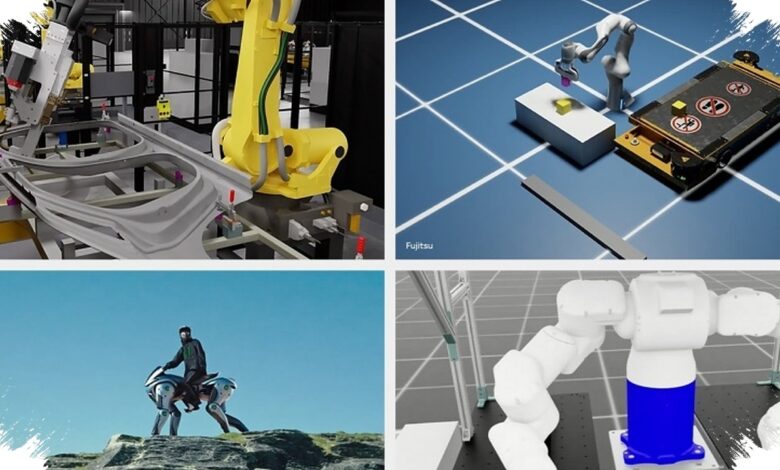
Japan is positioning its manufacturing and robotics base for a new phase of artificial intelligence that operates in the physical world. NVIDIA’s collaboration with Japanese companies focuses on systems that can observe real environments, process visual information, and decide what to do next.
The initiative extends beyond conversational AI by targeting robots, autonomous vehicles, industrial equipment, and smart infrastructure. Its central challenge is not simply making models capable of generating content, but enabling machines to work safely and accurately under changing real-world conditions.
A broad industrial coalition
NVIDIA has expanded its Cosmos Coalition to Japan as an open collaboration framework for technology firms, manufacturers, and AI model developers. Participants can develop world models, open AI libraries, datasets, and training frameworks before deploying machines in physical settings.
The companies named in the effort include FANUC, Fujitsu, Hitachi, Kawasaki Heavy Industries, Kubota, NEC, SoftBank, Sony Group, Yaskawa Electric, Honda R&D, Mitsubishi Corporation, Preferred Networks, TIER IV, Mujin, Telexistence, and OMRON. Their involvement spans automotive development, industrial robotics, electronics, retail automation, agriculture, and smart-city technologies.
Fujitsu is exploring a collaborative control platform based on physical AI with FANUC, Yaskawa Electric, and Kawasaki Heavy Industries, according to Suara.com. The platform is expected to use Cosmos, Isaac, Omniverse NuRec, and Newton Physics Engine for digital twins, simulation, machine learning, and system validation.
That approach relies on simulation-to-reality development, where robot behavior is tested in simulated environments before it is used in the field. Companies can use this process to accelerate implementation while reducing development costs.
| Platform | Main role | Example use |
|---|---|---|
| NVIDIA Cosmos | World models, simulation, and visual reasoning | Robots, autonomous vehicles, agriculture |
| NVIDIA Isaac and Jetson | Computing and robot development | Retail automation and companion robots |
| NVIDIA Metropolis | Computer vision for physical environments | Smart buildings, inspection, construction |
Visual reasoning moves to edge devices
A key component is Cosmos 3 Edge, a four-billion-parameter AI model designed for edge devices. It is intended to let robots and AI systems perform real-time visual reasoning without always relying on cloud data centers.
Cosmos 3 Edge is built on NVIDIA Nemotron architecture and can run on RTX GPUs, DGX systems, and Jetson T2000 and T3000 modules. NVIDIA’s open Cosmos framework is also intended to help developers adapt models for robots, sensors, autonomous vehicles, and industrial environments in about one day.
NVIDIA has also introduced new libraries for its Metropolis platform, which supports computer-vision systems in physical spaces. The company says the approach can make system development up to six times faster than conventional methods.
Uses range from farms to hospitals
Kubota is exploring Cosmos for autonomous agriculture, while Kawasaki Heavy Industries is examining applications in healthcare, energy, transport, shipbuilding, and aerospace. Telexistence is using Isaac to speed up retail automation, showing how the initiative also reaches service-sector operations.
GROOVE X is developing its LOVOT companion robot with the Jetson platform. Hitachi, OMRON, and Shimizu Corporation are adopting Metropolis for smart-building management, automated industrial inspection, and improved safety at construction projects.
These deployments put computer vision at the center of physical AI, allowing systems to interpret surrounding conditions rather than only produce text or images. The planned applications also demonstrate why Japanese manufacturers are seeking common platforms that can be adapted across different industries.
NVIDIA founder and CEO Jensen Huang said Japan has a major opportunity because of its manufacturing heritage, precision engineering, and robotics capabilities. He described the physical world as AI’s next frontier in an official statement.
The outcome will depend on how effectively companies can validate robot behavior before deployment and maintain accuracy in varied operating conditions. Japan’s combination of industrial expertise and NVIDIA’s AI platforms is now being directed toward that practical test.