


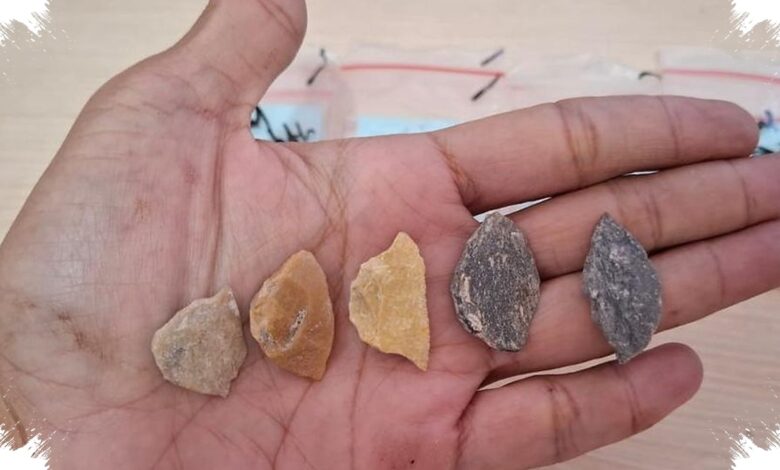
The distinctive stone technology associated with South Sulawesi’s Toalean culture did not appear suddenly. Artefacts from Leang Panninge in Maros indicate that its technological foundations developed locally over roughly 40,000 years.
The evidence traces a long shift from simply used stone flakes to smaller, more standardised implements. It also places the development of tools alongside ochre processing and the rock-art tradition of the Maros-Pangkep region.
A Long Record Beneath Leang Panninge
Researchers examined stone artefacts recovered from several archaeological layers at Leang Panninge. Those layers span approximately 40,000 to 3,500 years ago, providing an unusually long record of technological change.
The study involved researchers from Hasanuddin University, the National Research and Innovation Agency, Griffith University, and archaeological institutions. Their findings show that changes in toolmaking were gradual rather than the result of a sudden break.
| Period | Technology Found | Archaeological Significance |
|---|---|---|
| Early period | Simple stone flakes used with little modification | Evidence of a local technological base |
| Late Pleistocene | Bipolar technique used to process ochre | Links stone tools with rock-art practices |
| About 8,000 years ago and later | Maros Point and backing technology | Marks more organised tool production |
In the earliest phase, prehistoric communities used simple flakes directly as tools. Although these implements received limited modification, they formed part of a tradition that continued to evolve over millennia.
Suryatman of Hasanuddin University’s Department of Archaeology said Toalean culture was rooted in earlier local experience. “Toalean culture did not emerge from an empty space. Various innovations that became characteristic of Toalean developed on the foundation of local technology used by South Sulawesi communities for tens of thousands of years,” he said.
Ochre Processing Adds a Cultural Dimension
The bipolar technique is among the most significant elements identified in the Late Pleistocene layers. It is thought to have been used to process ochre, a material associated with the making of rock paintings.
BRIN researcher Adhi Agus Oktaviana described the evidence as archaeologically crucial. The technique provides a tangible connection between stone-tool strategies and artistic expression in Maros-Pangkep.
This connection broadens the meaning of the artefacts beyond their practical use for daily activities. Stone-working knowledge may also have supported cultural practices linked to the region’s celebrated cave art.
Maros Point Marks a Later Transformation
Maros Point emerged around 8,000 years ago as a key marker of Toalean Culture. In later phases, tool production became more organised, producing artefacts that were smaller and more uniform.
Backing technology was also used in making these stone tools. Its appearance supports the view that Toalean innovation grew through a sequence of developments based on earlier local practices.
Professor Akin Duli of Hasanuddin University has described Leang Panninge as one of Indonesia’s most important prehistoric sites. He said the site preserves evidence of people and cultural development across an extensive period.
The site also adds to perspectives opened by the earlier discovery of Bessé’ in Sulawesi. Together, the evidence from Maros Point, ochre processing, and stone artefacts illustrates the depth of the region’s prehistoric cultural tradition.