


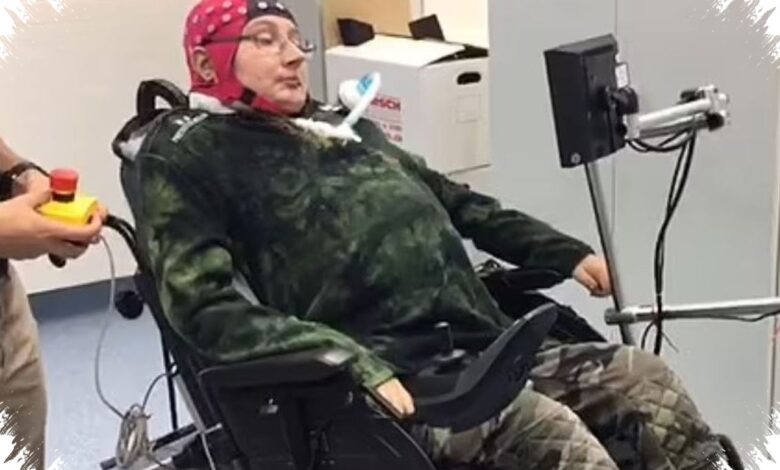
A robot arm demonstrated in Shanghai picked up a glass and collected an apple without buttons, voice commands, or body movements from its user. BrainCo said the path from detecting intent to robot movement can take less than 200 milliseconds, or about 0.2 seconds.
The demonstration points to a different way of directing machines in physical spaces. Instead of manually controlling each motion, a user wears a headset while software interprets brain activity and sends an instruction to the robot.
An AI system between thought and action
The system relies on a brain-computer interface, or BCI, to translate brain activity into digital instructions. An electroencephalography, or EEG, headset captures electrical signals from the user’s brain.
AI algorithms then analyze the collected signals to identify the user’s intended action. If the system recognizes an intention to pick up an object, it passes a corresponding command to the robot.
BrainCo presented the technology at the World Artificial Intelligence Conference 2026 in Shanghai. The Chinese technology company calls the approach Neuro-Embodied AI because it brings together BCI, AI, and robotics.
| System element | Role |
|---|---|
| EEG headset | Captures electrical brain signals from the user. |
| AI algorithm | Analyzes signals to recognize the user’s intent. |
| Robot | Performs the physical action linked to the instruction. |
More than a robot arm demonstration
BrainCo said its Neuro-Embodied AI platform is designed to work with several forms of commercial robots. The scope is not limited to the robot arm used during the demonstration.
The company identified industrial robot arms, humanoid robots, and four-legged robot dogs as compatible categories. This suggests the platform is intended as an integration system rather than a single-purpose robot controller.
| Robot category | Stated capability |
|---|---|
| Industrial robot arm | Can receive commands translated from brain signals. |
| Humanoid robot | Included among commercial robots described as compatible. |
| Four-legged robot dog | Also included in the platform’s integration scope. |
Training robots with movement and intent data
BrainCo also introduced its Embodied AI Data Collection Solution, a platform intended to gather training data for AI robots. It uses a dual-arm robot and specialized gloves to record people performing tasks.
The gloves record the operator’s movements while EEG signals are collected at the same time. The resulting dataset is meant to show not only what the hands did, but also the intention associated with the movement.
According to BrainCo, this approach can provide richer data for robot AI development. Rather than learning solely from the visible result of an action, the system can receive added context about the operator’s intended task.
Broader work in prosthetics and robotics
Other products shown by the company included the Revo 3 Dexterous Hand and the Intelligent Bionic Hand, a smart prosthetic hand. BrainCo also displayed the Intelligent Bionic Leg, which it said can automatically adjust a user’s movement using real-time sensor data.
Together, the demonstrations place BrainCo’s work across robotics, prosthetics, and the interpretation of human biological signals. The under-0.2-second intent-to-action claim stood out as a key element of its brain-controlled robot system.