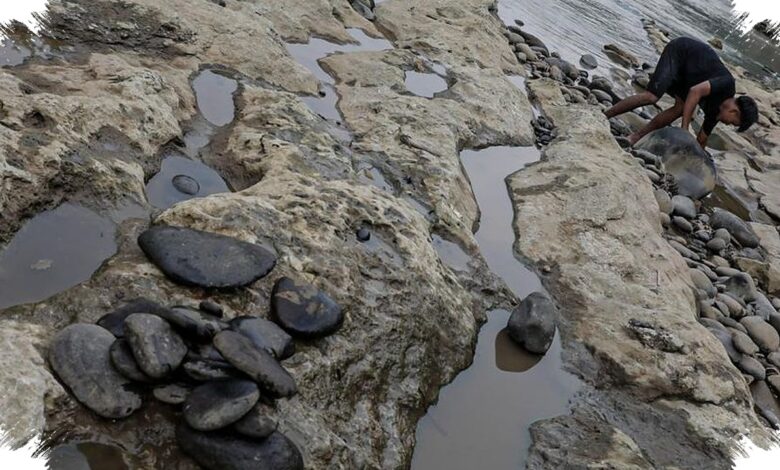
Six observation sites on Java have gone without rain for more than 60 consecutive days, placing them in the extreme-long dry category. The development comes as Indonesia approaches the peak of its dry season in a growing number of areas.
The sites are located across Central Java, the Special Region of Yogyakarta, and East Java. Central Java has one site in the category, while Yogyakarta has two and East Java has three.
The Meteorology, Climatology, and Geophysics Agency, known as BMKG, defines a rainless-day period as consecutive days with no rainfall or with very low rainfall. The threshold used is rainfall below 1 mm.
A period of 31 to 60 rainless days is classified as very long. A location that remains without rain for more than 60 days is placed in the extreme-long category.
Dry Conditions Spread Beyond Java
BMKG recorded 331 observation points in the very-long category, with dry spells lasting from 31 to 60 days. Most of those points are concentrated across Java, Bali, and Nusa Tenggara.
| Classification | Duration | Number of Sites | Main Areas |
|---|---|---|---|
| Very long | 31-60 days | 331 sites | Java, Bali, Nusa Tenggara |
| Extreme long | More than 60 days | 6 sites | Central Java, Yogyakarta, East Java |
Similar dry conditions have also been observed in parts of the Bangka Belitung Islands, South Sulawesi, Gorontalo, and North Sulawesi. However, only the six Java sites have recorded dry spells exceeding 60 days.
The wider pattern is linked to the approaching peak dry season. BMKG expects 83 seasonal zones, equivalent to 12.26 percent of Indonesia, to reach their dry-season peak in July.
Peak Dry Season Expected to Expand
The peak is forecast to spread more broadly in August, when 369 seasonal zones or 48.84 percent of Indonesia are expected to reach that phase. Another 169 seasonal zones, representing 25.41 percent of the country, are projected to reach the peak in September 2026.
El Niño remains active and is among the global conditions being monitored by BMKG. The sea surface temperature anomaly in the Niño 3.4 region was recorded at +1.47.
In its rainfall outlook for July 21-27, 2026, BMKG said El Niño strengthens the dry atmospheric conditions that commonly occur during Indonesia’s dry season. Even so, the dry pattern does not mean rainfall has stopped completely across the country.
Heavy Rainfall Still Recorded Elsewhere
Regional atmospheric activity continues to support rain cloud development in several areas. Kelvin waves and Equatorial Rossby waves were reported over northern to central Sumatra and Kalimantan, increasing moisture flow toward northern and western Indonesia.
This contrast was evident in daily rainfall figures recorded from July 15 to 19. CNN Indonesia reported 152.0 mm of daily rainfall in West Sumatra, 137.0 mm in North Sumatra, and 91.0 mm in West Java.
Other recorded rainfall totals included 90.5 mm per day in Aceh, 75.0 mm per day in North Kalimantan, and 73.0 mm per day in Riau. The figures underline how prolonged dryness in parts of Java is occurring alongside substantial rainfall in other Indonesian regions.