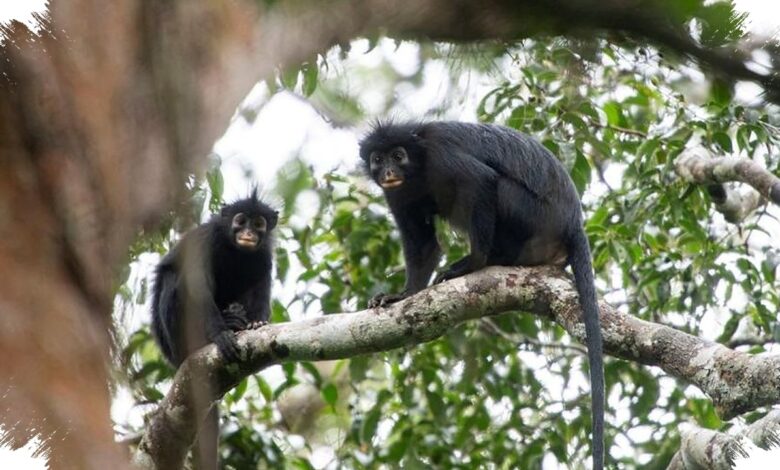
A newly identified monkey in the Democratic Republic of Congo produces a booming call compared with a frog or a pig’s snore. Known locally as Likweli, the primate is thought to occupy only about 1,700 square kilometres of central Congo.
Its unusually narrow range places the species at risk from hunting and land-use change around its forest habitat. Scientists have given the animal the scientific name Colobus congoensis.
A call unlike that of other monkeys
Likweli lives high in dense rainforest canopy and generally moves in small groups of about six animals. Researchers described the monkeys as calm but alert when people enter the area where they are present.
“When we encountered this group, they did not immediately flee like other primate species,” the researchers said. Instead, they climbed higher into the forest canopy and watched the people below.
The monkey has thick black fur, orange-cream skin around its mouth, and white patches on its hips. It weighs about 7 kilograms and measures roughly 1.2 metres from nose to tail tip.
| Characteristic | Recorded detail |
|---|---|
| Scientific name | Colobus congoensis |
| Estimated range | About 1,700 square kilometres |
| Body weight | About 7 kilograms |
| Length from nose to tail | About 1.2 metres |
| Typical group size | About six animals |
Genetic and anatomical evidence
Scientists examined skin, skeletal, and tissue samples from three individuals that died after being confiscated from poachers. Comparisons with museum collections, including skull shape and fur patterns, supported the conclusion that Likweli is a distinct species.
DNA testing also found that Likweli differs genetically from other primates. Its closest relative is a black colobus living more than 1,100 kilometres away in west-central Africa.
The two species are believed to have diverged from a common ancestor about five million years ago. Likweli belongs to the Colobus genus, a group of West and Central African monkeys with four fingers on each hand.
The research was published in PLOS under the title Likweli: A remarkable new species of Colobus monkey from the Lomami National Park, Democratic Republic of Congo. The name congoensis honours the Congo Basin, a region noted for its biodiversity.
From a partial photograph to repeated sightings
The first indication of the monkey emerged in 2008, when an expedition team travelled along the Lomami River. A photograph captured only part of an animal’s body, yet it raised the possibility that an unfamiliar primate was present.
The animal was not seen again until November 2018, when field researcher Jean Pierre Kapale photographed it. Kapale and the Lukuru Wildlife Research Foundation team then conducted 10 months of monitoring patrols and recorded seven additional sightings.
Researchers documented 114 field observations between 2018 and 2022. Even so, Likweli’s feeding habits and broader behaviour remain incompletely understood.
Protection inside Lomami, pressure beyond it
Most of the known Likweli population occurs inside Lomami National Park, a protected area covering 8,800 square kilometres. The park was established after the discovery of the Lesula monkey in 2012.
Hunting is prohibited within the national park, but its surrounding buffer areas remain a conservation concern. Hunting activity and conversion of land outside the protected area could affect a primate confined to such a limited range.
Interviews in 52 villages bordering Likweli’s range found that residents in only eight villages recognised the monkey, according to CNN Indonesia. Further genomic research is expected to clarify the species’ evolutionary history and ecological role among African primates.