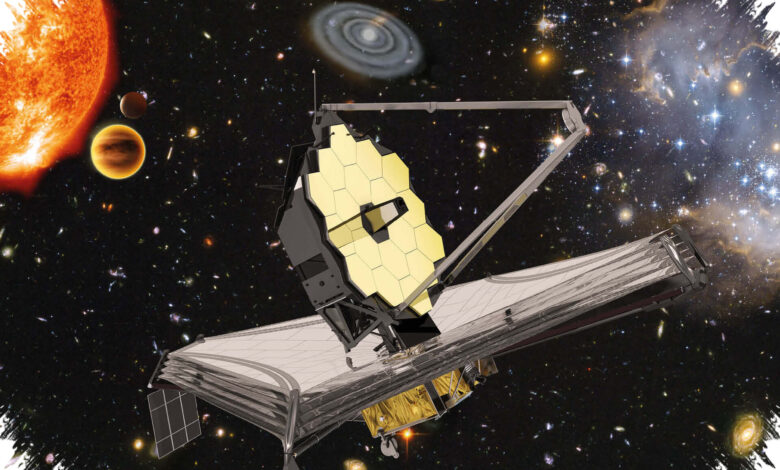
A small group of old stars in the dwarf galaxy Sextans A is producing large amounts of cosmic dust despite living in an environment with very few heavy elements. The James Webb Space Telescope findings offer a closer look at a process that may have shaped the earliest galaxies.
Only about 20 dust-shrouded stars were identified among the observed population, while roughly 90 percent showed no surrounding dust. That contrast makes the minority of dusty stars especially important for understanding how material enters interstellar space.
A Nearby Stand-In for Ancient Galaxies
Sextans A lies about 4.6 million light-years from Earth, close enough for detailed observations of individual stellar populations. Its chemical makeup is the more significant feature, because its abundance of heavy elements is only about 1 percent to 7 percent of the Sun’s level.
In astronomy, elements heavier than helium are commonly described as metals. Sextans A’s low-metal environment resembles the chemical conditions thought to have existed in the first generations of galaxies.
| Feature | Sextans A Data | Research Relevance |
|---|---|---|
| Distance from Earth | About 4.6 million light-years | Allows detailed study of a metal-poor galaxy |
| Heavy-element abundance | About 1% to 7% of the Sun’s level | Resembles early galactic chemistry |
| Dusty stars | About 20 stars | Primary detected dust producers |
| Formation age | About 2 to 3 billion years ago | Traces low-mass stellar evolution |
The early universe was dominated by hydrogen and smaller amounts of helium. Heavier elements became more widespread after early stars died in supernova explosions and released their material into the interstellar medium.
Those earliest stars are known as Population III stars and were extremely metal-poor. Their deaths helped supply material for later stellar generations and gradually changed the chemical composition of galaxies.
Dust from Aging Stars
The dust-producing objects in Sextans A are in the asymptotic red giant branch phase of stellar evolution. They are estimated to have formed from stars with initial masses of about 1.5 times the mass of the Sun.
Cosmic dust is not simply leftover material from aging stars. It is a significant component of the interstellar medium and is linked to the raw material involved in the formation of new stars.
The discovery addresses a difficult question in studies of ancient galaxies: how dust can form where heavy elements are scarce. Direct observations of galaxies from the early universe remain challenging, making nearby systems such as Sextans A valuable observational laboratories.
Two JWST Instruments Reveal the Dust
The research team used NIRCam, the Near-Infrared Camera, together with MIRI, the Mid-Infrared Instrument, on JWST. The combination of near- and mid-infrared observations made the dust layers around the stars easier to identify.
Flavia Dell’Agli of Italy’s National Institute for Astrophysics, or INAF, said the telescope has made these environments accessible in unprecedented detail. “JWST allows us to observe environments with a level of detail never seen before, which until a few years ago was beyond our reach,” Dell’Agli said.
The observations can also be tested against theoretical models of stellar evolution and dust formation. This comparison can show how accurately existing models describe dust production in metal-poor environments.
Claudio Gavetti of INAF said nearby galaxies with similar chemical conditions create important opportunities for this work. “Studying directly the galaxies that inhabited the early universe is still very difficult,” Gavetti said.
The study was published in The Astrophysical Journal. Its results indicate that old stars in metal-poor galaxies can still enrich their surroundings with dust, offering a useful bridge between nearby observations and the young universe.