


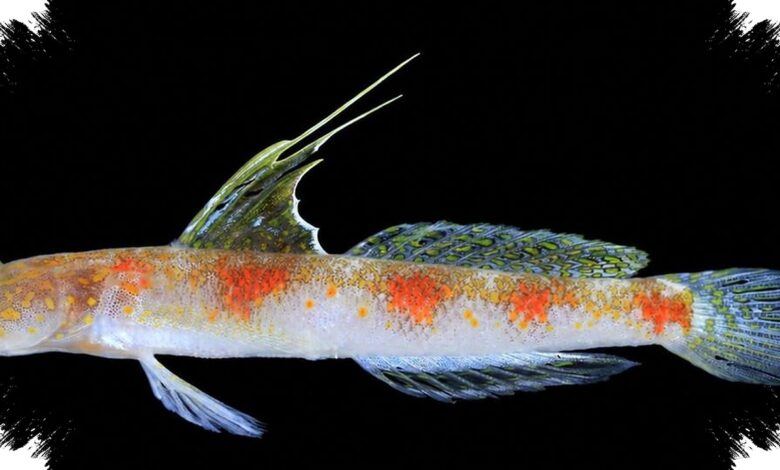
A small shrimpgoby marked by five large bright orange spots has been identified as a new species from the coast of Banyuwangi, East Java. The species, Tomiyamichthys oriens sp. nov., expands the record of fishes formally described from Indonesian waters.
Its scientific name carries a direct connection to its appearance and place of origin. The Latin word oriens means east or sunrise, reflecting the fish’s orange coloration and Banyuwangi’s nickname, The Sunrise of Java.
A Distinctive Fish from a Sandy Seabed
T. oriens is currently known only from coastal waters off Banyuwangi. It inhabits sandy bottoms, while information from local fishers indicates that it occurs in shallow water.
The orange spots are not its only visible feature. The fish also has small yellow spots on its head, and males possess two elongated filaments on the first dorsal fin.
| Feature | Recorded detail |
|---|---|
| Body markings | Five large bright orange spots along the body |
| Head markings | Small yellow spots |
| Male characteristic | Two elongated filaments on the first dorsal fin |
| Known habitat | Sandy seabed in Banyuwangi coastal waters |
The elongated dorsal-fin filaments in males distinguish this fish from other species in the genus Tomiyamichthys. These physical traits formed part of the evidence used to establish it as a separate species.
DNA Analysis Confirmed the Discovery
BRIN researchers did not rely solely on external appearance to identify the fish. The determination used integrative taxonomy, combining morphological observations with DNA analysis.
Kunto Wibowo of BRIN’s Research Center for Biosystematics and Evolution said the combined approach produced more comprehensive evidence. The findings showed that T. oriens has consistent characters that differ from its closest relatives.
Shrimpgobies are generally known for ecological associations with shrimp partners. However, the ecological relationship between T. oriens and shrimp has not yet been established and requires further study.
Further research is also needed to clarify the species’ distribution, behavior, and relationship with the Banyuwangi coastal environment. These questions are important because the known record currently remains limited to the area where the fish was discovered.
Scientific Description Published Internationally
The finding was published in the international journal ZooKeys, Volume 1283 of 2026. The scientific paper is titled Tomiyamichthys oriens, a new species of shrimpgoby (Teleostei, Gobiidae) from the coast of Banyuwangi, East Java, Indonesia.
The publication provides a formal scientific record for the species and supports its inclusion among fishes described from Indonesian waters. CNN Indonesia also reported the discovery, citing the BRIN researchers involved in the study.
BRIN continues to strengthen biosystematics research as a scientific basis for conservation, management, and the use of Indonesia’s biological diversity. The discovery from Banyuwangi underlines how much of the country’s coastal marine life remains to be documented.