


Corn is a staple crop for many farmers and plays a vital role in daily food security as well as national food strategies. In Indonesia, corn serves as both a primary carbohydrate source and an important commodity for livestock feed and bioenergy industries. Maximizing yield and crop quality depends heavily on adequate fertilization, which gives the plant essential nutrients throughout all growth stages.
Fertilizer supports strong root, stalk, leaf growth, and optimal cob development for corn crops. Without proper fertilization, corn plants may become stunted, are more susceptible to pests and diseases, and may produce disappointing yields. The act of spreading fertilizer, however, is demanding work—especially for those working large fields. Farmers are often forced to repeatedly bend or squat by each plant, a process that is not only time-consuming but can also lead to fatigue and back pain.
Smart Farming: How Used Bottles Revolutionize Corn Fertilization
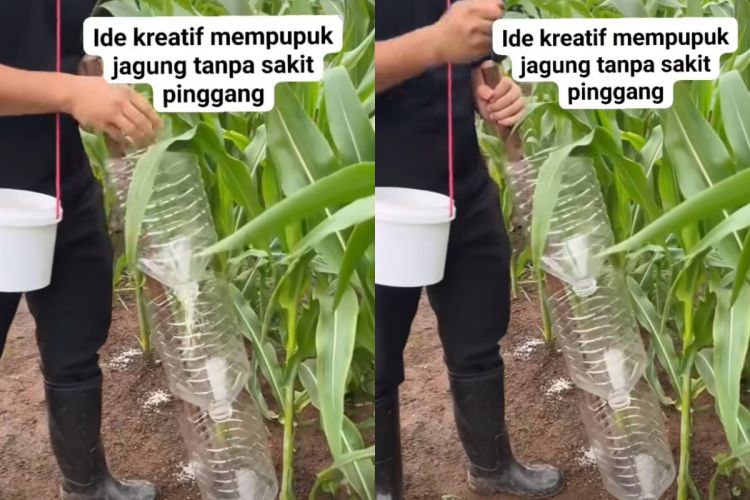
Resourcefulness among farmers continues to drive practical solutions in the face of physical challenges. Recently, a video showing a clever yet simple hand-made tool captured attention online. This farming hack uses used jumbo-sized plastic drinking bottles and allows farmers to fertilize maize crops easily while standing upright, reducing strain on their back and knees.
The video, which has garnered attention on social media, features a farmer using an innovative tool crafted from three large empty water bottles. Instead of discarding these bottles, the farmer cuts off their bases and stacks them mouth-to-base to form a long funnel, creating a direct channel for pouring granular fertilizer to the plant’s base. The assembly is fixed with a wooden handle for easy maneuvering around the cornfield while the farmer stands straight.
Step-by-Step: Crafting and Using the Bottle Fertilizer Tool
- Prepare three clean, jumbo-sized plastic bottles.
- Cut the bottom off each bottle cleanly using a sharp knife or scissors.
- Stack the bottles so that each mouth fits firmly into the next base, creating a long tube or funnel.
- Fasten a sturdy wooden handle (about one meter in length) to the side of the bottle stack using strong tape or string for easy grip and control.
This simple construction transforms common waste material into a functional, ergonomic fertilizer dispenser:
| Step | Tools or Materials Needed | Main Function |
|---|---|---|
| Bottle Preparation | 3 large plastic bottles, cutting tool | Forms the main fertilizer funnel |
| Assembly | Hand, strong tape/string | Secure bottle sections and create handle |
| Operation | Fertilizer, farmer can stand upright | Direct and even fertilizer application |
How To Use The Tool Efficiently
Farmers load granular or powdered fertilizer into the top opening. Standing upright, they position the funnel’s tip at the base of a corn plant. The fertilizer quickly slides through the funnel and lands accurately at the plant base, where it is most readily absorbed by the roots. This method significantly reduces the need for repetitive bending and squatting, conserving energy and reducing the risk of injury.
A farmer in the video demonstrated the effectiveness of the tool, completing fertilization rounds on tall, healthy corn plants without ever having to crouch. By adapting used materials, this innovation optimizes time, reduces physical labor, and even promotes recycling by repurposing what would otherwise become waste.
Frequently Asked Questions about Corn Fertilization
-
Why is corn fertilizer usually white?
Most corn farmers use urea, a fertilizer that appears white because of its nitrogen content. Nitrogen is essential for robust leaf and stalk growth. -
Is the bottle-funnel tool suitable for all fertilizer types?
The tool works best for granular or powdered dry fertilizers. Liquid fertilizers may require design modification for practical use. -
How frequently should corn be fertilized in the field?
Frequency depends on soil condition, corn variety, and crop stage. Fertilization commonly occurs at early growth (one to two weeks after planting) and again during intensive vegetative growth (about one month into the cycle). -
Should fertilizer always be placed right at the plant base?
For best results, apply fertilizer close to the corn stalk base. Applying it too far may reduce nutrient uptake, while direct contact with leaves can burn the plant. - How can I ensure the bottle funnel is durable?
Use bottles made from thick plastic and secure all joints and the handle firmly with strong adhesives or ties to prevent breakage during prolonged use.
Best Corn Planting Practices for Health and Productivity
Selecting suitable planting locations and providing adequate nutrition are key to optimal corn yield. Corn prefers full sunlight for at least six hours daily and thrives in fertile, well-drained soils with a neutral pH.
-
How do you know if corn lacks nutrients?
Nutrient-deficient corn typically develops yellowing leaves, slowed growth, or discolored leaf tips. Each deficiency (like low nitrogen, phosphorus, or potassium) appears differently. -
What makes a site suitable for corn cultivation?
The crop grows best in locations with ample sunlight, non-waterlogged soils, and a pH between mildly acidic and neutral. -
Can corn be grown in pots or containers?
Yes, choose wide and deep containers to provide ample root space. Dwarf or mini sweet corn varieties are especially suitable for container gardening. -
What are natural ways to manage common corn pests?
To control armyworms and stem borers organically, use soapy water sprays, plant pest-deterring flowers such as marigold nearby, and manually remove visible pests. - How long does corn take to mature from seed to harvest?
Sweet corn generally takes sixty to ninety days, while field corn (used in animal feed or processed foods) may need up to one hundred twenty days.
Innovation in everyday farming tasks, like this bottle-based fertilizer applicator, demonstrates how small changes can make farming more sustainable. This approach does not only preserve physical health but also encourages smarter resource use. Farmers, gardeners, and even home-scale vegetable growers can apply such cost-effective, eco-friendly hacks to boost productivity and efficiency. The technique proves that creativity and simplicity remain vital in agricultural progress, delivering solutions that are practical, replicable, and beneficial for the long-term sustainability of the food chain.