


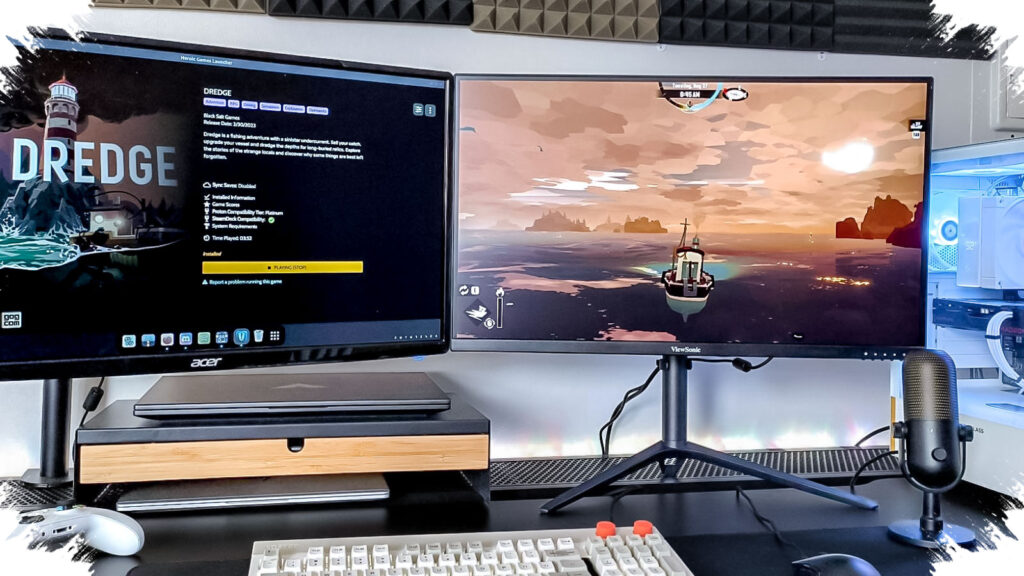
Linux is no longer a fringe choice for gaming, and by 2026 that shift is becoming hard to ignore. The old assumption that Windows always delivers better game support is now being challenged by a mix of better compatibility layers, stronger graphics drivers, and a more mature Linux gaming ecosystem.
The change is not driven by a single breakthrough, but by several technical improvements arriving at the same time. As a result, Linux is moving from “possible for gaming” to “practical for gaming” for a much wider group of players.
Proton is the main engine behind the shift
Valve’s Proton has become the most important reason Linux gaming has improved so quickly. It translates Windows game instructions into something Linux can handle, which allows many Windows titles to run without requiring a second operating system.
Recent Proton updates have improved DirectX 12 translation, which matters because many modern games rely on it. Better shader compilation has also reduced stuttering and made gameplay feel smoother in titles that used to struggle during asset loading.
This matters because Linux users no longer need to depend as much on dual-boot setups or virtual machines. For many players, that removes one of the biggest barriers that once kept Linux from being a serious gaming option.
The performance gap with Windows is getting smaller
Linux still does not win every benchmark, but the performance gap has narrowed in a noticeable way. Much of that progress comes from long-term work on GPU drivers, graphics stacks, and open-source tools such as Mesa.
Nvidia has improved support through proprietary driver updates and its open-source kernel module work. That has helped frame pacing and made performance more consistent in a growing number of games.
AMD remains especially strong on Linux because of its open-source driver ecosystem. In some cases, games already run as well as, or even better than, on Windows, particularly when they use Vulkan or benefit from well-optimized DirectX 12 translation.
Anti-cheat support is opening multiplayer access
For years, anti-cheat systems were one of Linux gaming’s biggest weak points. Many competitive multiplayer games either refused to launch or blocked Linux users from joining matches.
That situation has started to improve as support for Easy Anti-Cheat and BattlEye becomes more common. Hardware Overview noted that this expansion has increased the number of multiplayer games Linux players can access.
The support is not yet universal, so compatibility still depends on each developer’s implementation. Even so, the direction is clear, and it makes Linux more relevant for online gaming than it was only a few years ago.
- Competitive online games are becoming more accessible.
- Playing with friends on different systems is less complicated.
- Linux is no longer limited mostly to single-player titles.
Steam Deck changed how the industry sees Linux
Steam Deck has played a major role in pushing Linux gaming into the mainstream conversation. The handheld device uses SteamOS, which is based on Linux, and it forced the industry to take Linux compatibility more seriously.
Valve’s success with Steam Deck has created a strong incentive for developers to check whether their games run well on Linux. That pressure has helped improve the experience not only on handheld hardware, but also on desktop Linux systems.
It has also given Valve a strong reason to keep improving SteamOS and Proton at a faster pace. When those updates arrive, the benefit reaches far beyond Steam Deck owners.
More games now run well on Linux
The library of playable games on Linux keeps growing, especially through Steam. Many titles now run smoothly enough that the difference from native performance is less visible than before.
Games built on Vulkan usually deliver the best results. DirectX 12 titles have also improved significantly as Proton’s compatibility has become more refined.
Some problems remain, especially with games that depend heavily on DirectX 11 or Windows-specific proprietary features. Even so, the trend is moving in one direction, and that direction is clearly favorable for Linux.
A simpler user experience is helping adoption
Linux gaming is becoming easier not only because of the technology, but also because of the user experience around it. Steam now makes Proton management far more straightforward, which reduces the amount of technical setup new users need to do.
The Linux community also continues to play a major role. Documentation, forums, and troubleshooting guides are widely available, making the switch from Windows feel much less intimidating than it once did.
| Factor | Main impact |
|---|---|
| Proton | Runs many Windows games on Linux |
| AMD and Nvidia drivers | Reduces the performance gap with Windows |
| Anti-cheat support | Opens access to more multiplayer games |
| Steam Deck | Pushes developers to improve Linux compatibility |
| Steam interface | Simplifies the experience for new users |
In 2026, Linux has not fully replaced Windows as the dominant gaming platform. But with Proton maturing, drivers improving, multiplayer support expanding, and Steam Deck continuing to influence the industry, Linux is quietly becoming one of the most important platforms to watch in modern PC gaming.