


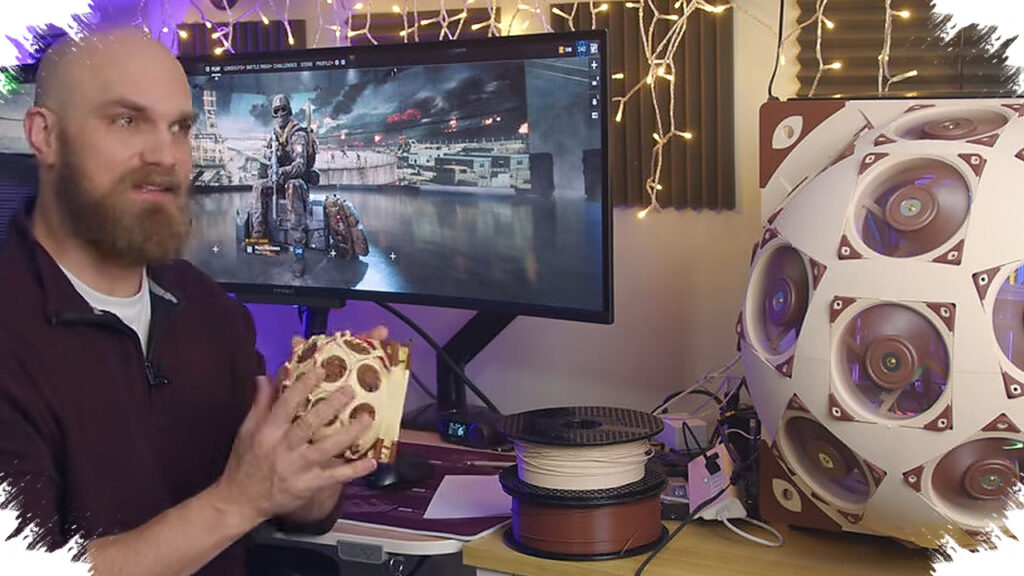
A recent PC cooling experiment has drawn attention for one simple reason: it replaced a standard glass side panel with a 3D-printed dome packed with 15 Noctua fans. The result was not just unusual to look at, but also effective enough to cut CPU temperatures by roughly 20 degrees Celsius in gaming tests.
The project comes from YouTube creator Major Hardware and continues an idea first explored in the earlier Fanhattan Project. Instead of relying on a single large fan or a more conventional airflow setup, the build pushes a large number of 120 mm fans to force air into the case in a far more aggressive way.
What the Superdome build changes
The Superdome design uses 15 Noctua NF-A12x25 fans, all set as intake fans. They are arranged to create positive pressure inside the case and drive fresh air straight toward the main components.
The layout is also part of what makes the build stand out. Five fans wrap around a single fan at the top of the dome, while nine more are placed near the base around the PC. That setup turns the side panel area into a dedicated airflow system rather than a transparent showcase panel.
Cooling results from the test
The clearest difference appeared during a Battlefield 6 test. With the standard glass panel installed, Ryzen Master showed the CPU peaking at about 86 degrees Celsius.
After swapping in the Superdome panel and repeating the same test, the CPU temperature dropped to around 67 degrees Celsius. That means the custom dome lowered the peak temperature by about 20 degrees Celsius simply by changing the side panel design.
Why the project stood out to PC builders
For many PC enthusiasts, the experiment is a reminder that cooling is not always about adding liquid hardware or chasing flashy aesthetics. Air volume and airflow direction still matter, and this build shows that a carefully directed intake setup can make a major difference.
The project also challenges the idea that a standard glass panel is always the better choice. In this case, the glass panel looked cleaner, but it did not help temperatures nearly as much as the fan-heavy replacement.
Build details and practical limits
The dome itself was not quick or simple to make. Major Hardware said the structure took several days to print and was produced through 3D printing in multiple parts to keep the result clean.
Cable management became one of the hardest parts of the process. Even after the exterior was finished, the internal wiring was still messy, although the system reportedly stayed relatively quiet as long as the cables did not touch the fan blades.
Key facts about Superdome
- Uses 15 Noctua NF-A12x25 120 mm fans.
- Each fan costs about $40.
- Total value of the fan setup is around $600.
- The main structure is 3D-printed.
- CPU temperature dropped from about 86°C to 67°C in a Battlefield 6 test.
- All fans are configured as intake.
Noctua also supplied the fans and sent custom-colored 3D printing filament to match the project’s theme, which helped bring the build together visually and technically.
Major Hardware has also shared the 3D printing files on Thingiverse, allowing users with a Lian Li O11 case and enough spare fans to try their own version. That makes Superdome more than a one-off experiment, since it also gives the modding community a new example of how far PC airflow design can be pushed.