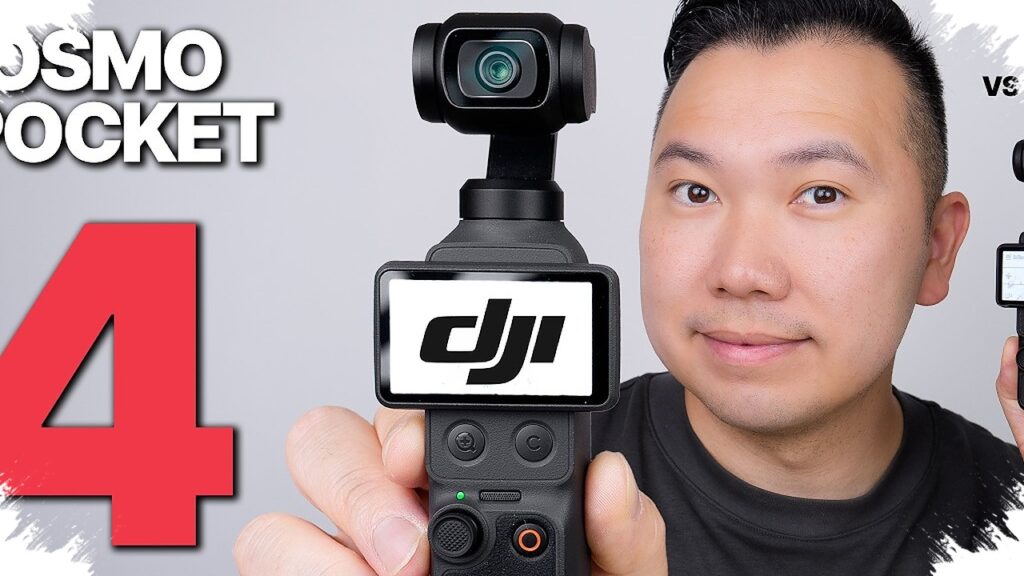
DJI Osmo Pocket 4 is shaping up to be more than a routine successor to the Pocket 3. The new pocket camera is positioned with features that push it closer to a creator-focused workflow, especially through 4K/240fps slow motion, true 10-bit D-Log, and 107GB of internal storage.
That combination changes the way the device can be used in both shooting and editing. Notebookcheck describes it as a meaningful shift toward a more professional production flow, and the specification changes support that view.
A larger jump in image capture capability
The most significant upgrade sits in the imaging hardware. Osmo Pocket 4 uses a 1-inch stacked sensor with 37MP resolution, an f/2.0 aperture, a 20mm lens, and 14 stops of dynamic range.
Pocket 3, by comparison, relies on a 1-inch 9.4MP sensor with 12 stops of dynamic range. The newer model also raises the ceiling for stills and video sensitivity, reaching ISO 12,800 for photos and ISO 26,600 for video.
That difference matters in scenes with strong contrast. With more headroom in shadows and highlights, Pocket 4 has more room to preserve detail where Pocket 3 would be working with less latitude.
Slow motion gets a major leap
The slow-motion spec is another area where DJI makes a clear statement. Pocket 3 tops out at 4K/120fps, while Pocket 4 doubles that limit to 4K/240fps.
For creators, that opens the door to more dramatic motion capture without giving up resolution. It also makes the new model more relevant for content that depends on fluid, highly detailed slow-motion playback rather than compromise settings.
True D-Log changes the editing workflow
Another major shift is the move to true 10-bit D-Log with 14 stops of dynamic range. Pocket 3 used D-Log M and HLG, but Pocket 4 takes a different route with a flatter log profile.
Notebookcheck notes that the new D-Log is not gamma-assisted like D-Log M, which means it behaves more like a genuine flat recording profile. That gives editors more room for color grading, although the files are also more demanding in post-production.
Storage and connectivity are easier to work with
Workflow improvements continue beyond image quality. Pocket 4 includes 107GB of internal storage, while Pocket 3 depends fully on microSD cards because it has no built-in memory.
Both models support cards up to 1TB, but the internal storage on Pocket 4 adds a practical buffer for users who want a quicker start without immediately relying on removable media. DJI also upgrades the connection options, with Wi‑Fi 6 and USB 3.1 on the new model compared with Wi‑Fi 5 and USB 2.0 on Pocket 3.
More direct control on the body
The physical controls also receive attention. Pocket 4 adds a zoom button and a custom button next to the record key, which gives users quicker access to key actions.
DJI also replaces the standard joystick from Pocket 3 with an analog joystick that responds more naturally to movement speed. That addresses one of the earlier complaints about the series, where manual control still leaned heavily on the touchscreen.
Battery, tracking, and accessory changes
Battery capacity remains at 1,545mAh on both devices, but runtime improves noticeably on Pocket 4. DJI rates the newer model at 240 minutes at 1080p/24fps, compared with 166 minutes on Pocket 3.
Tracking also moves forward, with ActiveTrack 7.0 replacing ActiveTrack 6.0. The newer system supports tracking at 2x and 4x zoom, including for pets and vehicles.
DJI also adds a magnetic fill light on top of the gimbal and a protective gimbal head cover for storage. In the Creator Combo, Pocket 4 comes with DJI Mic 3, a Magnetic Mini Fill Light, a battery handle, a mini tripod, a wide-angle lens adapter, a soft pouch, and a carrying bag.
That package marks a clear step up from the Pocket 3 Creator Combo, which uses Mic 2 and does not include the magnetic fill light.