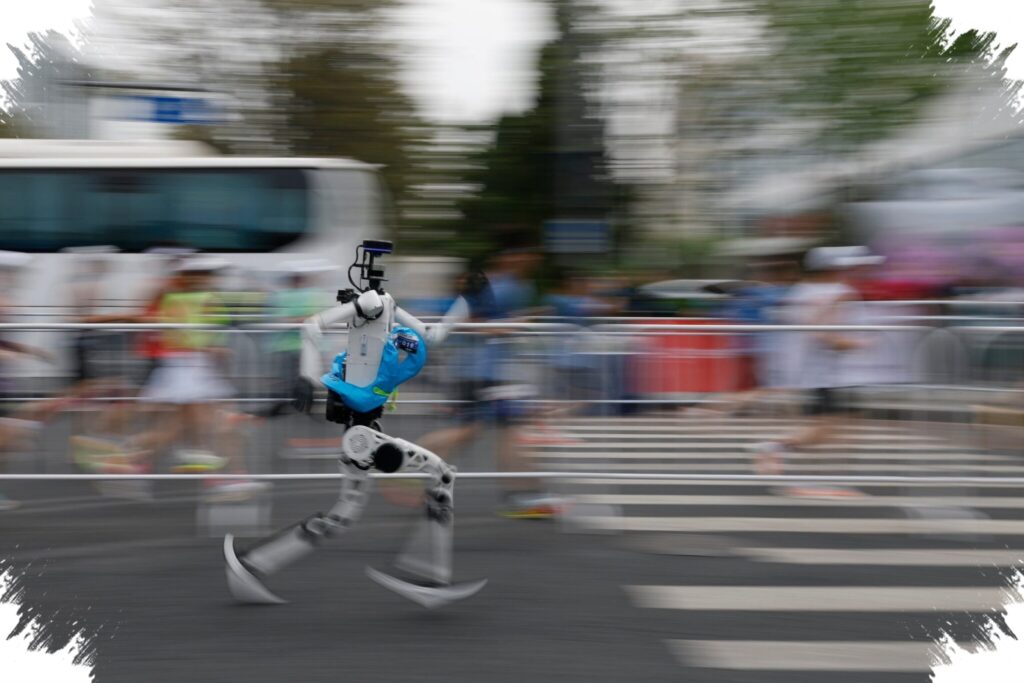
Beijing’s latest half marathon did more than draw crowds to a 21-kilometer course. It also turned humanoid robots into live test subjects, placing them on the same route as human runners in a public demonstration of how far embodied intelligence has come.
At the Beijing E-Town event, about 12,000 runners and more than 300 humanoid robots from over 100 teams took part in a race that combined sport, research, and technology showcase. Organizers framed the event not only as a spectacle, but also as a practical way to push robot development and accelerate the growth of embodied intelligence-related industries.
One of the clearest signs of progress was how some robots handled the course on their own. In previous editions, many machines still relied heavily on operators, but this time a number of entries were able to run autonomously and navigate the route without direct human control.
The organizers split the robot field into two categories: autonomous navigation and remote control. Autonomous navigation accounted for nearly 40 percent of the robot participants, a figure that suggests humanoid robots are becoming more capable of independent movement in real-world settings.
A course designed to test more than endurance
The race was not built as a simple distance challenge. The 21-kilometer route included more than 10 types of terrain, ranging from flat roads and inclines to turns and narrow sections.
It also featured 12 left turns, 10 right turns, and several near-90-degree bends. Five narrowed passages and one road-island obstacle were added to simulate the unpredictability of urban environments.
That setup forced robots to rely on precise path planning, dynamic balance, and efficient energy management. It also tested how well they could perceive their surroundings and make autonomous decisions while moving through a complex route.
Different machines, different outcomes
At the starting area, attention fell on the robots as they launched one by one under blooming paulownia trees. Some teams added protective sun hats to their machines, while others highlighted eye-catching designs that stood out along the course.
The field showed wide variation in size and movement style. Some robots moved quickly, others slower; some appeared tall and agile, while others were small and visually distinctive.
Not every machine completed the challenge. A number of robots fell, needed help from their teams, or suffered damage that forced parts to come loose and ended their run.
In some cases, teams had to replace batteries on the spot or cool overheated machines with water spray. Those moments underscored that energy endurance and system stability remain major hurdles in humanoid robot development.
From laboratory work to real-world conditions
Zhao Mingguo, a researcher at Tsinghua University’s Department of Automation, said a race like this creates a major test for robot mobility and agility. He added that such formats help move development beyond laboratory conditions and toward practical use in real scenarios.
According to Zhao, the data gathered from the competition can help speed up breakthroughs in embodied intelligence and motion control. That makes the event more than a sporting contest, since it also serves as a technical learning ground for industry.
The Robot Era team shared a similar view after entering Xingdong L7, its latest full-size bipedal humanoid robot. The team described the half marathon as an important setting for testing robot stability in extreme scenarios and complex road conditions.
A broader push for China’s robotics industry
Beijing E-Town officials said the event was intended to support research, strengthen industry, and expand robot applications. They also noted that this was the first time humanoid robot autonomous navigation had been applied on a large scale.
Outside the race, Chinese humanoid robots are already appearing in a growing range of settings. They have shown up in dance performances, martial arts displays, and marathons, and are now starting to move into factories, retail stores, eldercare centers, parks, and shopping malls.
China’s government work report has identified embodied intelligence as one of the future industries that should be developed. The 15th Five-Year Plan outline also highlighted the mapping of future industries, while the China Electronics Association projected that the country’s humanoid robot market could reach about 870 billion yuan by 2030.
China Electronics Association chair Xu Xiaolan said humanoid robot development in China has moved from technological breakthrough to global industrial leadership. The Beijing race showed that this evolution is no longer confined to labs, but is now being tested directly on real roads under conditions that challenge machines, software, and industrial readiness at the same time.