A filament 3D printer can work smoothly for long periods, but print quality can drop quickly when the material has absorbed moisture. That hidden problem often appears only after the job has already started, when rough surfaces, weak layers, or even a failed print begin to show.
The issue is not limited to appearance. Moist filament can also contribute to clogging inside the extruder, turning a routine print into a stoppage that wastes time and material.
Why moisture changes the print result
Filament that sits in a humid environment can slowly absorb water from the air. Once that material moves through the nozzle and extruder, the trapped moisture enters the printing process and the filament no longer behaves under ideal conditions.
That change can show up in several ways. The printed surface may become uneven, while the layers may fail to bond as cleanly as they should. In more serious cases, the extra moisture can trigger blockages in the extruder and interrupt printing before the job is finished.
How a filament dryer helps
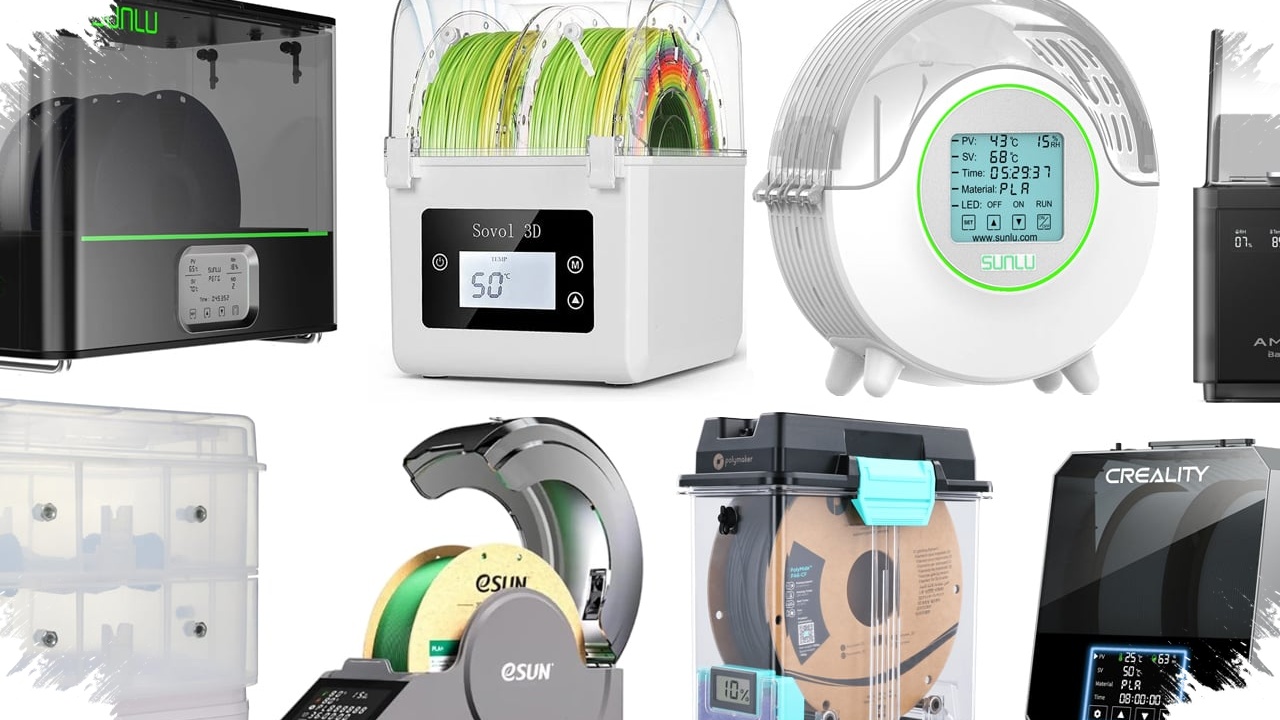
A filament dryer, also known as a dry box for filament, is built to keep spools in a controlled, sealed environment. It uses temperature control and humidity sensors to limit the amount of moisture around the material.
The purpose is not simply storage. The device is designed to keep the surrounding conditions stable so the filament remains usable for longer and is less likely to degrade before printing begins.
Some models also include filtration, which helps keep the storage space cleaner. Compared with ordinary storage methods, that controlled setup gives the material a more precise layer of protection.
When quick fixes fall short
Some users try household solutions such as an oven, a food dehydrator, rice, or desiccant packs. These methods may help for a while, but they are not tuned as carefully as equipment made specifically for 3D printing filament.
The limitation is control. Temperature and humidity management in these workarounds are not built around the needs of filament storage, so the protection is usually less reliable than what a dedicated filament dryer can provide.
Where the benefit becomes most visible
The value of a dry box becomes clearer when print consistency matters. It is especially useful for users who want to reduce the risk of failure caused by improperly stored material.
The benefit can also be more noticeable with multicolor printers, where spools are used or moved more often and are therefore exposed to ambient air more frequently. In humid environments, or when filament must be stored for a long period, the risk of material changes becomes even greater without controlled storage.
Price is part of the decision
A filament dryer is not a cheap accessory, so buyers usually need to match the product to real usage needs. Basic models such as the Sovol SH01 are listed at $59, while more advanced options like the SUNLU FilaDryer E2 reach $399.99.
The gap usually reflects size and features. Larger capacity and more complete functions generally mean a higher price, which makes the purchase more of a practical investment than a casual add-on.
What matters most at the printer
The main advantage of a filament dryer comes before the filament ever enters the machine. When the material stays in a more stable state, it is less vulnerable to the kinds of moisture-related problems that often ruin print quality.
That stability can support cleaner surfaces, stronger layer adhesion, and a lower risk of nozzle or extruder clogs. For users aiming to keep prints consistent with fewer retries, a filament dryer serves as a protective step that helps keep 3D printing material ready for use.
-
-
-
-