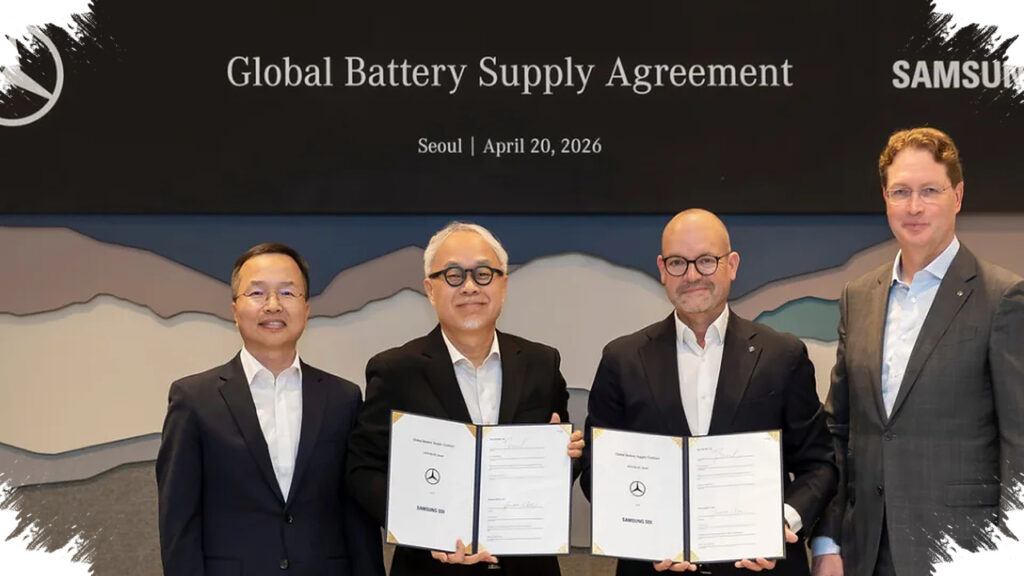
Mercedes-Benz has turned to Samsung SDI for batteries that will power its next generation of electric vehicles, marking the first EV battery supply contract between the two companies. The agreement will support new electric SUV and coupe models and centers on high-performance NCM, or nickel-cobalt-manganese, battery cells.
The partnership places battery technology at the center of Mercedes-Benz’s electrification strategy. Samsung SDI’s NCM cells are favored for their high energy density, which makes them suitable for premium EVs that need longer driving range, strong durability, and strict safety performance.
A premium EV push built around NCM
For Mercedes-Benz, the choice of battery chemistry is not a minor technical decision. NCM batteries are widely associated with better range potential, and that matters for larger vehicles and luxury models where driving distance and overall performance remain critical.
Samsung SDI said its battery technology is designed to support longer service life, while also addressing safety requirements that are especially important in the premium segment. That combination makes the supply deal relevant not only as a sourcing arrangement but also as a product-development move.
SUVs and coupes are the first focus
The batteries will be used in Mercedes-Benz’s next-generation electric lineup, with SUVs and coupes singled out as the main vehicle types. Those segments remain significant in the global EV market because many automakers continue to rely on premium electric models to preserve brand appeal.
Mercedes-Benz’s focus on SUVs and coupes suggests that the company still wants to balance design, performance, and range in its future electric offerings. For vehicles in these categories, battery energy density is one of the most important engineering priorities.
The Seoul signing signals a deeper relationship
The agreement was signed in Seoul, South Korea, and attended by Samsung SDI CEO Choi Joo-Sun and Mercedes-Benz CEO Ola Kallenius. Their presence highlighted the strategic importance of the deal for both companies.
The partnership also points to a broader shift. It is no longer just a simple buyer-supplier arrangement, but a more strategic collaboration between a South Korean battery maker and a German luxury car manufacturer.
Joint development goes beyond supply
The two companies have also agreed to co-develop next-generation batteries. That means the relationship is moving beyond delivery of components and into shared technology development for future models.
This step gives Mercedes-Benz a way to accelerate preparation for upcoming EV programs. At the same time, it gives Samsung SDI a stronger position in the premium electric-vehicle supply chain.
The cooperation is also said to extend to other areas of e-mobility, although the source did not provide technical details. Even so, the direction of the agreement makes clear that batteries are now a core part of both companies’ long-term strategy.
Mercedes-Benz is keeping multiple battery options open
Despite awarding this contract to Samsung SDI, Mercedes-Benz is not relying on a single battery partner. Yonhap News Agency, as cited in the reference article, said the carmaker has also met with other South Korean EV battery makers, including LG Energy Solution.
That approach aligns with common practice in the EV industry, where automakers often work with several suppliers at once. It helps protect supply chains and allows battery technologies to be matched to different vehicle needs.
Mercedes-Benz already has a history with LG. The reference says the two companies have previously cooperated in display and battery businesses. It also noted that in October 2025, LG Energy Solution agreed to ship lithium iron phosphate, or LFP, battery packs to Germany.
What the deal means for the market
For Samsung SDI, the Mercedes-Benz contract strengthens its standing in the global battery race. Supplying a premium automaker with NCM batteries adds credibility in a competitive market where performance, safety, and reliability matter as much as production scale.
For Mercedes-Benz, the deal secures access to a battery type that fits the demands of its next electric SUVs and coupes. The agreement made in Seoul also underlines South Korea’s role as a major hub in the global EV battery ecosystem.