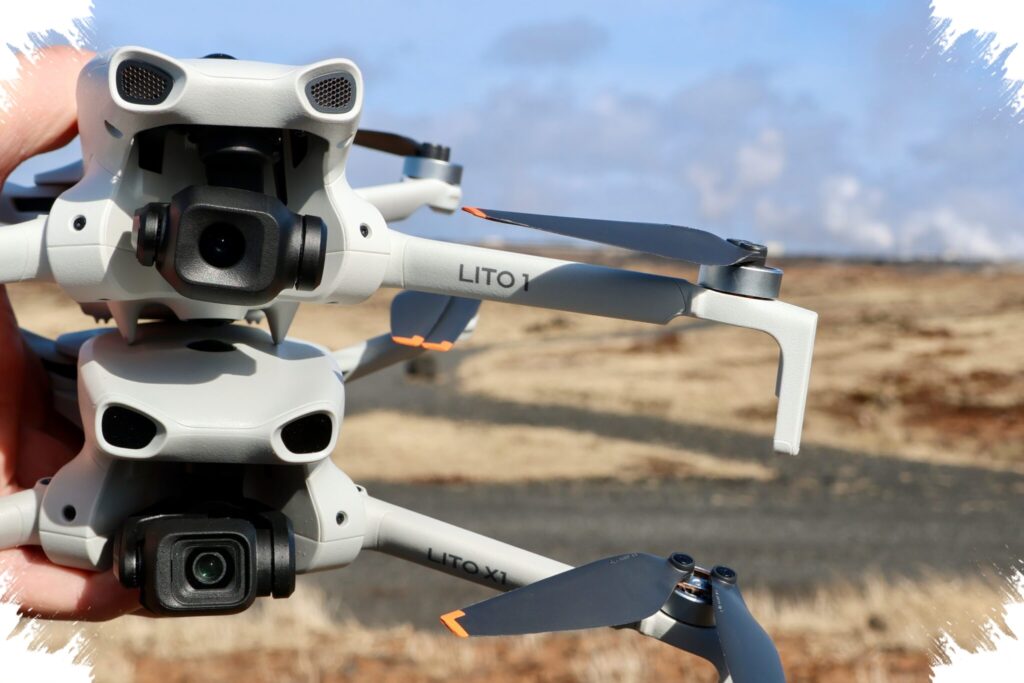
DJI’s new Lito 1 and Lito X1 are aimed squarely at first-time drone users, combining 4K video capture with omnidirectional obstacle detection. The pair is positioned as an easier way to start flying without giving up important safety features or image quality.
That approach also reflects DJI’s broader focus on automation. Instead of relying only on manual control, both drones include tools that are meant to reduce complexity and help new users get comfortable more quickly.
Two entry-level drones with a strong safety focus
The most notable feature on both models is 360-degree obstacle detection. DJI designed the system to recognize objects from multiple directions, which can help lower the chance of collisions in tight or crowded flying areas.
For beginner pilots, that matters as much as camera performance. A drone is not only expected to record footage, but also to remain manageable and safer to operate in different flying conditions.
Cameras that share 4K support, but not the same hardware
Although both drones record video in 4K, DJI uses different camera setups to separate the two models. Lito 1 comes with a 1/2-inch CMOS sensor and an f/1.8 aperture, along with support for photos up to 8K resolution.
Lito X1 steps up with a 1/1.3-inch CMOS sensor and an f/1.7 aperture. DJI says this model is better suited for improved light capture and tonal range, and it also supports HDR video with up to 14 stops of dynamic range.
That HDR capability is especially relevant when scenes contain both bright and dark areas in a single frame. It gives Lito X1 a clearer advantage on the imaging side, even though both drones share the same 4K headline feature.
Features designed to simplify flying
Beyond the camera system, DJI has added several automatic functions that should make the drones more approachable for new users. ActiveTrack is one of the main highlights, allowing the drone to follow fast-moving subjects at speeds of up to 12 m/s.
There is also a one-tap panorama mode. Features like this reduce the need for manual adjustments and make it easier to produce polished content with less effort during the flight.
Battery life and storage options
DJI claims both Lito 1 and Lito X1 can fly for up to 36 minutes using the standard Intelligent Flight Battery. For many users, that kind of runtime is likely to be one of the key selling points, especially for longer shooting sessions.
Lito X1 receives an additional advantage with 42 GB of internal storage. DJI also includes QuickTransfer over WiFi, which speeds up file transfer after a flight and makes it easier to move photos and videos for sharing.
Pricing and the main difference between the two models
The company lists Lito 1 at €339 and Lito X1 at €419. Fly More Combo versions are priced at €479 for Lito 1 and €579 for Lito X1.
At a glance, the key differences come down to the camera hardware, the 14-stop HDR support on Lito X1, and its built-in 42 GB storage. DJI has not made either model available in the US market yet.
With Lito 1 and Lito X1, DJI is broadening its entry-level drone lineup by pairing 4K recording with automated flight assistance and 360-degree safety detection. For new users looking for a compact drone that is easier to handle from the first flight, the two models arrive with a clear focus on practicality and control.