AGIBOT is pushing embodied AI beyond the stage of impressive movement demos and into a more demanding phase: real deployment. The company’s message is that robots are no longer judged only by whether they can see, move, and interact, but by whether they can deliver stable results inside actual workflows.
That shift changes the standard entirely. Instead of asking whether a robot can perform a task in a controlled setting, the more important question is whether it can operate reliably in industrial environments without disrupting day-to-day operations.
From demonstration to deployment
At its partner conference, AGIBOT framed embodied AI as a technology that has entered the deployment phase. The company’s view is that the field must now prove repeatable performance, consistency, and operational value.
This is a notable change in emphasis. Earlier stages centered on basic capability, but AGIBOT now treats field readiness as the real benchmark. In practical terms, that means embodied AI has to work outside the lab and remain dependable under the pressure of real-world use.
Three foundations inside the robot
AGIBOT’s technical approach rests on three connected pillars: locomotion, interaction, and manipulation. Each one supports a different part of the robot’s role in the physical world, and the company treats them as inseparable.
Locomotion lets the robot move efficiently to the worksite. Interaction helps it coordinate with people and its surroundings, while manipulation remains central because it is tied directly to the task being performed.
AGIBOT combines those elements into a single stack that includes hardware, perception, control systems, operating systems, and embodied AI models. The company’s position is that a robot cannot be useful in industrial workflows if those layers are developed in isolation.
A broader product and model lineup
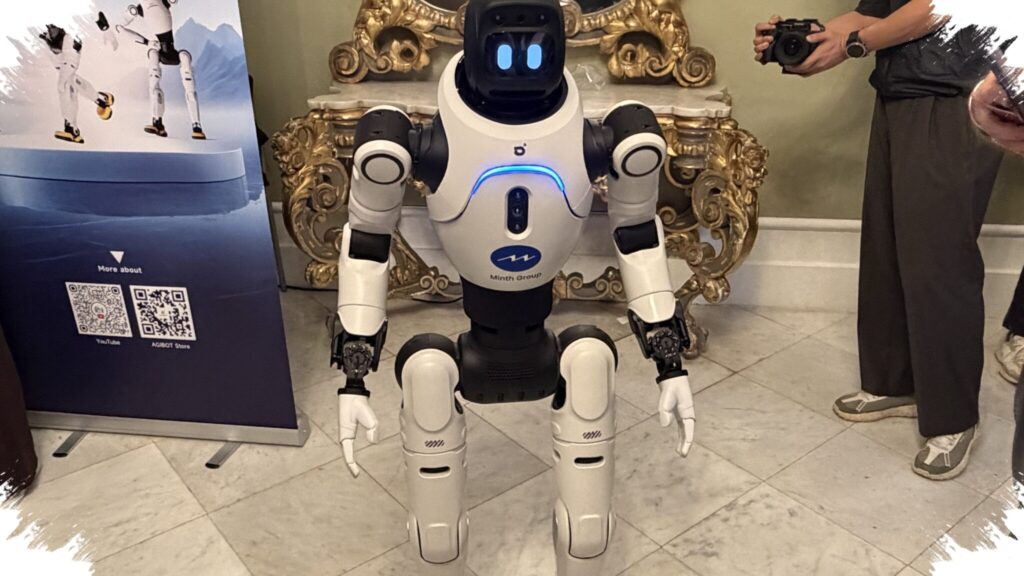
That strategy is visible in AGIBOT’s third-generation product lineup. The company is preparing multiple robot form factors, including humanoid, wheeled, and quadruped designs, so the machines can match different operational needs.
Form factor is treated as a functional choice, not just a design detail. AGIBOT suggests that the environment and the task should determine which type of robot is deployed, since effectiveness depends heavily on fit.
The same logic applies to the AI layer. AGIBOT introduced six AI models aligned with three intelligence tiers in its system, covering motion control, multimodal interaction, and task-oriented models for longer and more complex jobs.
Real-world solutions already in place
Beyond product development, AGIBOT presented seven production solutions covering manufacturing, logistics, commercial services, inspection, and cleaning. The company highlighted that these solutions are already positioned in real environments rather than remaining as concept demonstrations.
That distinction matters because it separates a proof of concept from a system intended for repeated use. AGIBOT describes these deployments as standards that can be extended to similar use cases across different sites.
In that framework, deployment becomes the main measure of progress. A robot is no longer seen only as an experimental platform, but as a system that can be applied again and again in comparable operational settings.
Building the ecosystem around the robot
To support wider adoption, AGIBOT has also built AIMA, short for AI Machine Architecture, as a full-stack development ecosystem. The platform is designed to reduce the barriers to deployment and customization in embodied AI.
The company also introduced Sharebot, a global robot rental network. Through this model, partners can access robots as a service instead of buying them outright, which is intended to lower upfront costs and speed up adoption.
AGIBOT links this approach to a feedback loop: robots generate new data in the field, that data improves the models, and better models then support the next round of deployment. The company also uses the XYZ curve framework to describe how embodied AI evolves from basic movement capabilities toward dependable, value-generating work.
The core message is straightforward. Embodied AI is no longer being measured only by technical possibility, but by whether robots can be deployed, maintained, and scaled in the physical world in a way that supports real operational needs.