


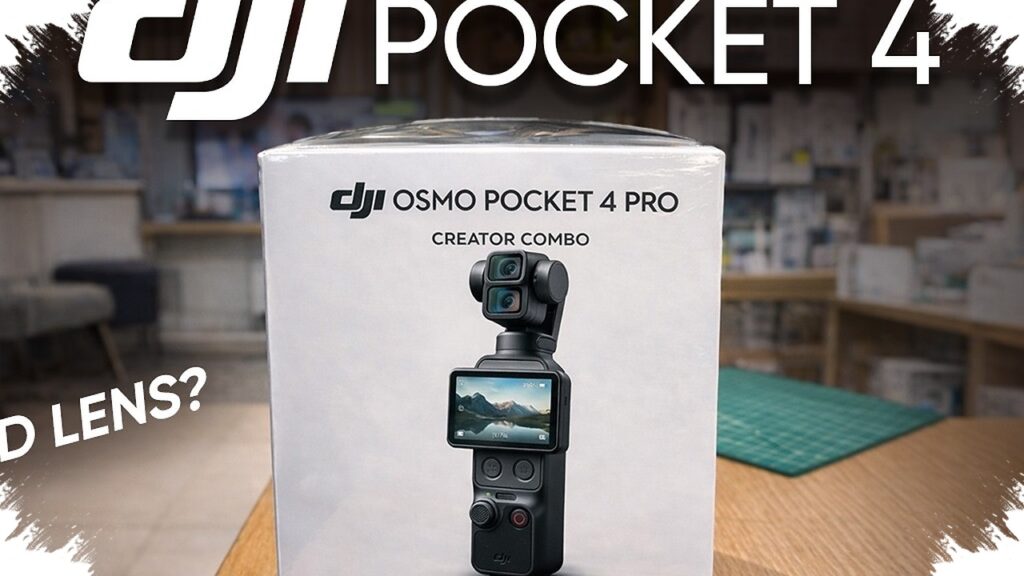
DJI has positioned the Osmo Pocket 4 as more than a minor refresh of its pocket-sized gimbal camera. The latest model keeps the compact format that made the series popular, but it now adds stronger imaging hardware, smarter subject tracking, and upgraded audio tools for creators who want cleaner results without carrying a larger setup.
At its core, the device is still built for quick everyday shooting, travel use, and spontaneous moments. The difference this time is that DJI is pushing the Osmo Pocket line closer to a more serious content-making tool, especially for users who care about image depth, stable tracking, and more flexible sound capture.
A larger sensor leads the upgrade
The most notable change is the updated 1-inch CMOS sensor. DJI pairs it with an f/2.0 lens and says the camera can reach up to 14 stops of dynamic range, which is meant to preserve detail in both bright and dark areas of a scene.
That combination gives the Osmo Pocket 4 a stronger foundation for shooting in difficult lighting conditions. For creators who record indoors, outdoors, or in fast-changing environments, the extra sensor size is expected to help produce footage that looks more balanced and carries more visual information.
Slow motion becomes more capable
The camera also expands what it can do in motion-heavy scenes. The Osmo Pocket 4 supports 4K slow-motion video at up to 240fps, giving users more room to create smooth and dramatic movement effects.
This matters for creators who often film sports, action clips, or other fast activity. With a device that still fits in a pocket, DJI is not only preserving portability but also giving users a tool that can handle more demanding visual styles.
Tracking gets a smarter system
DJI has also updated its subject-tracking technology with Intelligent Follow 7.0. The system is designed to keep the camera locked on a subject more steadily, including when zooming up to 4x.
For solo users, the camera includes Lock Subject Tracking and Priority Subject Registration. These features are meant to simplify control when the main subject needs to stay in focus without constant menu adjustments.
Audio is treated as a bigger part of the package
The Osmo Pocket 4 is not focused on visuals alone. DJI has also improved the audio side with spatial audio and zoom audio pickup, both of which are intended to make sound feel more directed and more immersive.
Through OsmoAudio, the device can connect directly to DJI Mic 3 transmitters without extra cables. DJI also says the setup supports up to four audio channels, which gives users more flexibility in situations where several sound sources need to be handled at once.
Support for darker shooting conditions
To help in low-light situations, DJI has also prepared support for an external fill light. This is especially useful for indoor recording or night shooting, where extra illumination can make the footage easier to watch and more polished.
That accessory support means the Osmo Pocket 4 is not relying only on the new sensor. DJI is also shaping the wider ecosystem so the camera can adapt to more environments without becoming bulky.
Pre-orders are already open
The Osmo Pocket 4 is now available for pre-order, with first shipments scheduled to begin on 22 April 2026 for the European market. DJI is offering three bundles to match different user needs.
The Essential Combo starts at €479, the Standard Combo starts at €499, and the Creator Combo starts at €619. Each package includes a different set of accessories depending on how complete the expected shooting setup should be.
The Essential Combo includes the camera unit, a USB-C cable, a 1/4-inch thread handle, and a carrying pouch. The Standard Combo adds a gimbal clamp, a wrist strap, and other standard accessories, while the Creator Combo goes further with a wide-angle lens, DJI Mic 3, a fill light, a mini tripod, and a dedicated bag.
With the new 1-inch sensor, 4K slow-motion up to 240fps, improved AI-based tracking, and more serious audio support, the Osmo Pocket 4 is being positioned as a compact camera for creators who want a pocketable device without giving up important professional features.