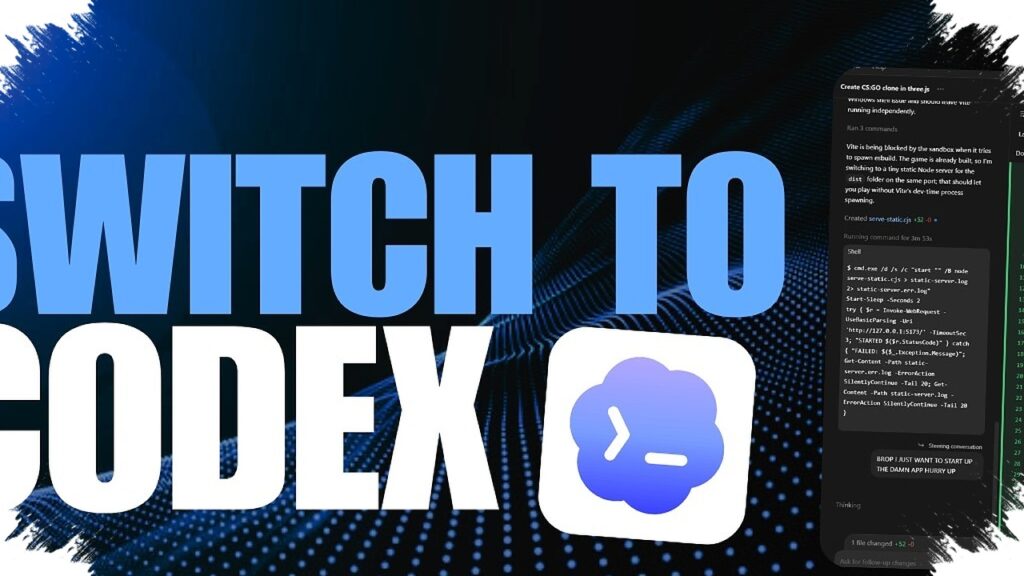
What is drawing attention is not just that ChatGPT 5.5 Codex can write code, but that it brings much of the full-stack workflow into one place. For developers working under tighter deadlines, that kind of consolidation can reduce the constant switching between tools and make the path from build to test more direct.
The appeal grows as modern development demands speed and consistency. In a single environment, teams can move from coding to testing and fixing with a smoother flow, which is part of why the platform is attracting interest across different kinds of projects.
A broader workspace for full-stack tasks
Alex Finn says ChatGPT 5.5 Codex is designed to support full-stack development more smoothly. The idea is to connect multiple layers of an application so developers do not need to split work across too many separate platforms.
That approach matters because the platform is not limited to code generation. Debugging, documentation, and testing are also part of the workflow, with automation and multitasking helping to keep the process more structured.
Integration that reduces friction
One of the strongest examples is its support for services such as Convex. That integration makes database management easier and is seen as efficient, especially because Convex offers an intuitive interface and a generous free tier.
Real-time API integration adds another layer of usefulness. With APIs such as Alpha Vantage, developers can build dynamic applications more easily, including stock trackers that update live data as it changes.
Design and development in the same environment
ChatGPT 5.5 Codex also stands out because it does not stop at code. UI and UX design tools are built into the same workspace, allowing visual and technical work to move forward together.
The integrated Image Gen 2 model makes it possible to create design elements directly inside the platform. That reduces reliance on external tools and helps teams iterate faster from the earliest stages of development.
There is also real-time annotation and direct editing through a built-in browser. Together, those features let developers review, adjust, and refine interfaces without leaving the main workflow.
Automation and parallel work
A major advantage of the platform is support for multiple AI agents running at the same time. One agent can focus on coding and debugging while another handles research or marketing materials.
That parallel structure allows work that would usually happen one step at a time to be processed simultaneously. Repetitive tasks also benefit from automation, including code quality checks, data analysis, and documentation drafting.
The result is not only time saved. Consistency and accuracy can improve as routine processes follow the same standard across projects.
From build to launch
The platform also reaches beyond the technical side of development. Tools such as Remotion make it possible to create motion graphics and promotional videos in the same environment.
It can also support banner creation and social media content, which simplifies the launch stage for teams that want to move quickly from build to release. Developers do not need to switch to many separate software tools just to prepare promotional assets.
Live deployment support through Vercel reinforces that workflow. Teams can test, fix, and launch with fewer obstacles than in a fragmented setup.
Built for different skill levels
ChatGPT 5.5 Codex is also positioned for both beginners and experienced developers. A user-friendly interface and features such as reverse prompting can guide newcomers step by step as they build projects.
Experienced developers still get a deep and flexible workspace, along with high usage limits that matter for larger projects and longer work sessions. Built-in browser testing and real-time debugging further strengthen its position as a practical tool for full-stack work.
In a crowded field of AI development tools, ChatGPT 5.5 Codex is gaining attention for the way it combines model intelligence, smoother integration, and higher usage limits in one environment.