


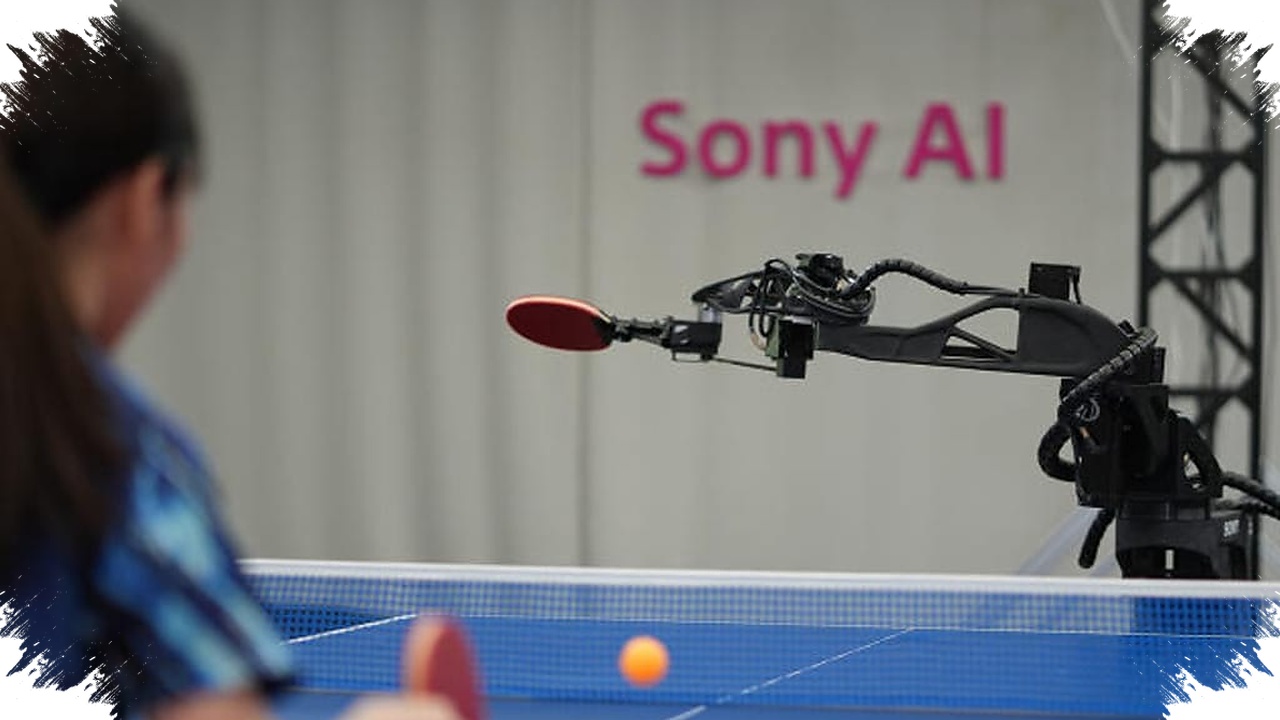
Sony’s Ace is pushing table tennis robotics into territory that has long belonged to human athletes. The AI-powered robot is designed to compete under official International Table Tennis Federation rules, and it does more than move quickly across the rally.
What sets Ace apart is its ability to read the ball in real time. It can identify direction, estimate speed, understand spin, and answer with a return in a fraction of a second.
That level of response matters in a sport where tiny delays can decide the point. Table tennis is far more complex than digital games such as chess or Go because the ball can change direction through spin, travel at high speed, and bounce in ways that are hard to predict.
In tests reported in Nature, Ace delivered a strong showing in April 2025. The robot won three of five matches against elite players with more than 10 years of training, although it lost two matches when facing active professional athletes in a competitive league.
A vision system built for live play
Ace relies on 12 smart cameras to track the match as it unfolds. Nine of those cameras are positioned around the table to detect the ball in three-dimensional space, while three others read movement angle, spin speed, and trajectory.
That setup gives the robot a detailed picture of what is happening on the table at any moment. The goal is not only to see the ball, but to understand how the ball will behave next.
The mechanical side is just as specialized. Ace uses eight mechanical joints to control its arm and racket, including two joints for racket position, two more for adjusting strike angle, and three additional joints that help produce smash shots or other high-powered fast hits.
This combination allows Ace to respond to sharp spin and rapid rally exchanges. In a sport built on split-second decisions, that precision is central to the robot’s performance.
Why this matters beyond one robot
Sony’s project is being seen as a major step in modern robotics. AI has often made headlines for defeating humans in strategy-based games, but physical sports demand body coordination, timing, and reflexes that are much more difficult to reproduce.
Ace may also be useful as a training tool for professional athletes. A player can practice against fast balls with unpredictable patterns without depending on a human partner every time.
Its potential is not limited to table tennis. Similar technology could be adapted for tennis, badminton, baseball, and even soccer, where it could serve as a training partner, match analyst, or sparring partner available at any time.
Even so, the robot is not expected to replace human athletes. Emotion, creativity, spontaneous strategy, and competitive mental strength remain areas where people still hold an advantage that machines have not easily matched.
Ace shows how close AI and physical sport are becoming. With its ability to read the ball, process visual data in real time, and move its racket with high precision, Sony’s robot is bringing machines into a field long defined by human skill.