


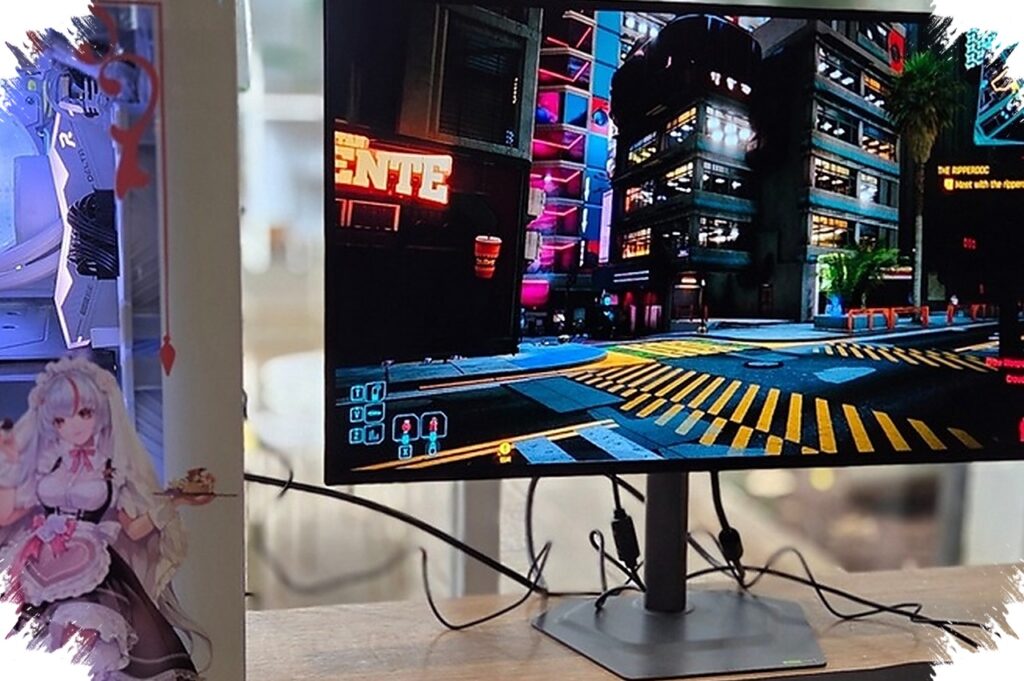
A gaming monitor is no longer judged only by how sharp it looks on a desk. As modern games push ray tracing, higher resolutions, and fluctuating frame rates, the display has become one of the most important parts of the experience.
That shift has raised the bar for what players now expect from a monitor. Features such as VRR, QHD with high refresh rates, accurate color, OLED with HDR, and smarter OSD controls are increasingly treated as essential rather than optional.
Why VRR has become a basic requirement
Variable Refresh Rate, or VRR, helps the monitor match its refresh rate to the GPU’s frame rate in real time. This reduces screen tearing and stuttering when game performance rises and falls.
Support for NVIDIA G-Sync Compatible and AMD FreeSync Premium has also become more desirable because it improves smoothness without adding significant latency. For both competitive and casual players, that makes VRR a core feature rather than a bonus.
QHD and high refresh rates now make more sense together
A 2560 x 1440, or QHD, display is increasingly seen as the new balanced choice for gaming. It delivers more detail than Full HD while remaining less demanding on the GPU than 4K.
High refresh rates, including 240Hz and 280Hz, matter more than ever for FPS, racing, and esports titles. When combined with QHD, they create a sharper image and more responsive motion during fast-paced gameplay.
Color accuracy matters more in today’s visual-heavy games
Modern games are not only about speed, but also about image quality. Titles such as Cyberpunk 2077 Overdrive use path tracing to create more realistic lighting and shadow behavior.
That is why wide color coverage and HDR support have become increasingly important in gaming monitors. They help lighting, contrast, and visual detail appear closer to the developer’s intended presentation.
OLED and HDR are pushing the premium segment
OLED panels continue to gain traction in high-end gaming monitors because they offer extremely low response times, richer color, and much stronger contrast than traditional LCD panels. Those qualities appeal to players who want speed without giving up visual quality.
Modern OLED displays are also being paired with anti-reflection features and HDR certifications such as VESA DisplayHDR True Black. That combination helps the screen remain comfortable for gaming and media viewing alike.
OSD features are becoming more practical
Monitor software and OSD, or On-Screen Display, controls are also evolving. Users can now find tools such as crosshair overlays, refresh rate monitoring, game-specific modes, and HDR controls.
Some newer monitors even let users adjust settings directly from a PC through USB connectivity. For players who frequently switch display profiles by game genre, that makes day-to-day use much easier.
Gigabyte MO27Q28G brings the features together
Gigabyte MO27Q28G is positioned as a monitor that brings these priorities into one package. It uses a 27-inch WOLED panel with QHD 2560 x 1440 resolution, a refresh rate of up to 280Hz, and a 0.03ms GTG response time.
The panel also offers contrast of up to 1.5 million:1 and VESA DisplayHDR True Black 500 support. In certain HDR modes, brightness can reach 1500 nits.
On the color side, Gigabyte lists 99.5 percent DCI-P3 and 84 percent BT2020 coverage, along with 10-bit reproduction or around 1.07 billion colors. The company also says the panel has undergone factory calibration with △E accuracy.
Source: www.medcom.id