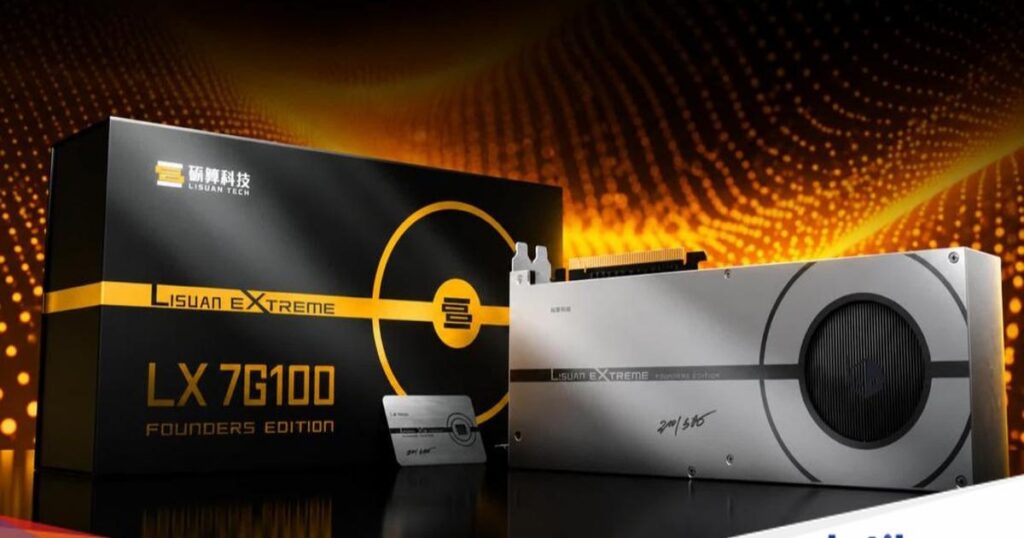
Lisuan Technology’s LX 7G100 is drawing attention for a reason that is hard to ignore: its price sits close to premium midrange territory, yet its real gaming performance still lands much nearer to RTX 3060 levels. That mismatch makes the card one of the clearest examples of how far China’s homegrown GPU ambitions have come, and how far they still have to go.
Priced at around 3,300 Yuan, the LX 7G100 is being positioned in a range where many buyers would expect something much closer to RTX 5060 Ti-class output. Instead, the card’s behavior in games suggests a product that is still trying to prove it belongs in the mainstream.
Modern specifications, but not a full gaming breakthrough
The LX 7G100 arrives as a Founder Edition model with 12GB of GDDR6 memory. It also includes four DisplayPort 1.4a outputs, with support for HDR 8K 60Hz, which gives it a fairly up-to-date display configuration.
On the software side, Lisuan has put broad API support into place. The card supports DirectX 12, Vulkan 1.3, OpenGL 4.6, and OpenCL 3.0, which shows that the company is aiming at a modern graphics stack rather than a bare-bones launch.
Even so, the hardware list does not translate into class-leading gaming numbers. The gap between technical readiness and actual game performance is still wide, especially at the price the card is asking.
Synthetic scores look better than game results
In 3DMark testing, the LX 7G100 performs around the RTX 3060 level or slightly above it. For a first-generation retail GPU from a company that had to build its hardware, architecture, drivers, and software stack from scratch, that is a meaningful step forward.
The improvement is also notable when compared with Lisuan’s earlier prototype sample from last year, which was only on par with the GTX 660 Ti. That kind of jump suggests the company has made real progress in a relatively short time.
But synthetic benchmarks only tell part of the story. Once actual games enter the picture, the card’s limits become much easier to see.
Game performance stays well behind the price tier
In Cyberpunk 2077 at 1080p with FSR3 Quality, the LX 7G100 reaches an average of 88 fps. That is far below the RTX 4060, which posts 232 fps, and also trails the Intel Arc B580 at 243 fps.
The same pattern appears in other games. In Black Myth: Wukong, the card manages 56 fps, while Forza Horizon 5 comes in at 48 fps even with the graphics preset lowered to Low.
Those numbers make the pricing hard to justify for buyers who are looking only at gaming value. A card selling for 3,300 Yuan but performing like an older mainstream GPU sits in an awkward position, especially when direct rivals in the market are much faster in the same kind of use case.
Software is more stable, but features still lag
One of the more encouraging signs is that many modern games are said to launch and run without frequent crashes. That alone gives the LX 7G100 a more mature debut than earlier attempts from China’s GPU sector.
The comparison with Moore Threads MTT S80 is telling, since that card reportedly needed dozens of driver updates before it became reasonably usable for gaming. Lisuan’s entry appears more stable out of the gate, even if it is not yet polished.
The remaining weaknesses are still obvious. The driver panel is described as very basic, overclocking stability is not consistent, and system monitoring features remain limited. Hardware ray tracing is also absent, with Lisuan saying the feature will arrive on its second-generation GPU instead.
A visible step forward, but not a clear purchase choice
The LX 7G100 shows that China’s local GPU industry is moving beyond experimental hardware and into real retail products. It has broad API support, a stable enough software foundation for many games, and a clear improvement over earlier prototype performance.
Still, the combination of a 3,300 Yuan price tag, RTX 3060-like gaming results, and unfinished feature support leaves it in a difficult spot. For now, the LX 7G100 looks more like proof of progress than a convincing buy for mainstream gamers.
Source: telset.id