
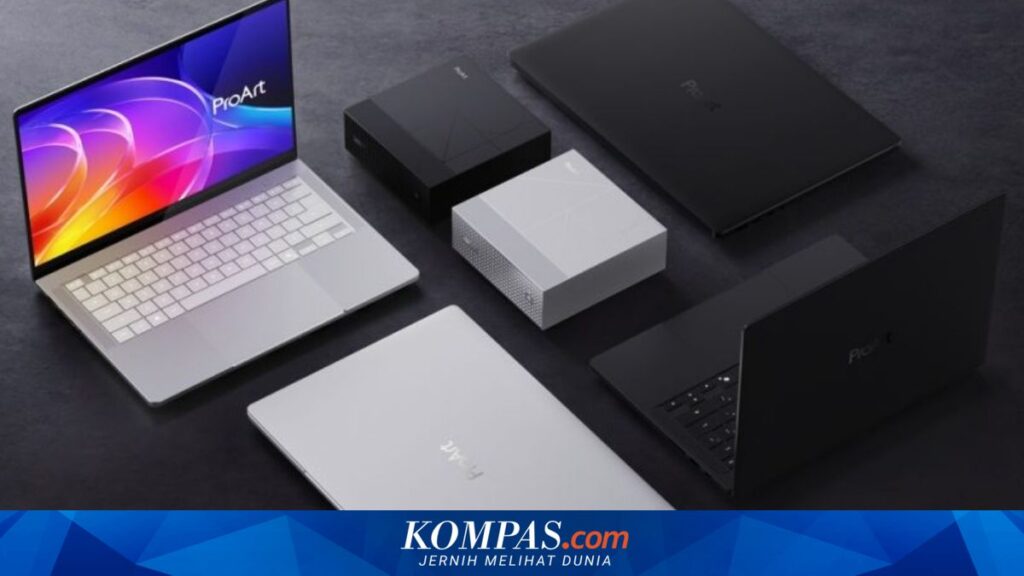
Asus is pushing its ProArt lineup into a new category of creative computing with the ProArt P16 and ProArt P14. Both laptops are the company’s first creator machines to use Nvidia RTX Spark, with local AI processing as the main attraction instead of cloud dependence.
That shift matters because Asus is positioning the ProArt series for more than design and editing work. The new models are also aimed at content creators, AI developers, and professionals who need high-performance computing directly on the device.
Local AI becomes the headline feature
RTX Spark is built to bring AI performance up to 1 petaflop, while also supporting unified memory of up to 128 GB. Asus says that combination makes it possible to run large AI models locally, without relying on external cloud services.
The company also highlights workloads such as 4K AI video generation, 12K video editing, and large language model processing with context lengths of up to one million tokens. That focus fits users who want faster responses and more stable workflows without constant internet dependence.
Inside the chip, Nvidia combines a 20-core Grace CPU with a Blackwell RTX GPU carrying 6,144 CUDA cores. Asus presents that setup as the foundation for heavy creative and AI tasks on a premium laptop.
ProArt P16 gets a slimmer build
The ProArt P16 is said to be 13 percent thinner and 16 percent lighter than its predecessor. Even with the reduced size, Asus still describes it as ready for demanding creative work and the next wave of AI-driven tasks.
That direction shows how the ProArt line is evolving. Asus is no longer framing it only as a graphics-focused laptop family, but also as hardware prepared for personal AI agent use on next-generation Windows PCs.
For creators, that means more room for local workflows that can run quickly and consistently. It also makes the laptops more relevant for users who want AI tools to stay on the machine rather than on remote servers.
OLED panels tuned for professional use
The ProArt P16 comes with a 16-inch Asus Lumina Pro OLED panel with up to 4K resolution, a 120 Hz refresh rate, and Nvidia G-Sync support. Asus is aiming those specifications at users who need detailed visuals and smooth motion for demanding content work.
The ProArt P14 uses an OLED display with up to 3K resolution. Both models are designed for professionals who care about color accuracy, and Asus says their color precision reaches Delta E less than 1.
The display setup is intended to support creative work that depends on accurate reproduction. That includes users who need reliable color performance across visual editing and production tasks.
Software support adds another layer
Asus is not relying on hardware alone for the ProArt refresh. The company is also adding AI-focused software tools to help creators manage and optimize their workflow.
ProArt Creator Hub is included to help optimize device resources. MuseTree is positioned as an AI-assisted creative tool, while StoryCube is designed for digital content management.
Those additions show that Asus is building a broader ecosystem around the new laptops. The goal is to support creative workflows directly on the device, not just raise the hardware ceiling.
ProArt Mini PC joins the same direction
Alongside the two laptops, Asus also introduced the ProArt Mini PC. The compact desktop uses RTX Spark as well, with the same 1 petaflop AI performance target and up to 128 GB of unified memory.
It is aimed at creators and developers who need strong AI performance in a small desktop format. The chassis measures around 150 x 150 x 51 mm, making it a compact option for users who want substantial power without a full-size tower.
Despite its size, the Mini PC supports 10GbE networking, an M.2 PCIe Gen 5 x4 storage slot, and cooling designed for workloads of up to 140 watts. Asus has not announced pricing for the ProArt P16, ProArt P14, or ProArt Mini PC, while availability is scheduled to begin in select markets in the fall of 2026.