


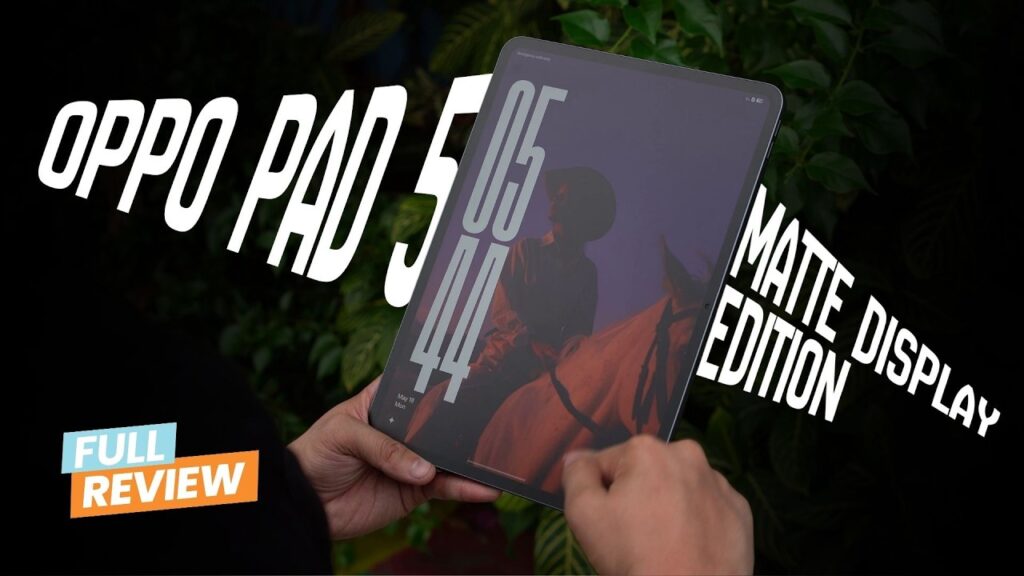
Oppo Pad 5 Matte Display takes a clear side in the tablet market: it prioritizes visual comfort over raw speed. That choice shows up immediately in the benchmark results, where the tablet lands in respectable territory but not at the front of its class.
The model tested comes with 8GB of LPDDR5X RAM and 256GB of UFS 3.1 storage. That hardware combination keeps it in the mid-range, where the most noticeable appeal comes from the screen rather than peak performance.
A display built for reading and writing
The main attraction is the 12.1-inch IPS LCD panel with a 2800 x 1980 resolution and 120Hz refresh rate. Oppo also gives it a 12-bit color panel and a matte finish, which is meant to make reading, studying, and note-taking more comfortable.
That matte surface is not just a design touch. TÜV Rheinland certification says the display can reduce reflections by up to 97 percent and cut harmful blue light by 70 percent. The focus on eye comfort is obvious, and it is also the reason the tablet does not chase the most aggressive performance tuning.
Benchmark results show the trade-off
In GeekBench 6, Oppo Pad 5 Matte Display scores 1014 in single-core and 3040 in multi-core. That places it slightly ahead of OnePlus Pad Go 2, which scores 907 and 2939, but still behind Poco Pad M1 and well below Xiaomi Pad 7.
The gap becomes clearer when looking at Xiaomi Pad 7’s 1873 single-core score and 5126 multi-core score. Poco Pad M1 records 1244 and 3285, showing how Oppo sits in the middle rather than at the top of this comparison.
AnTuTu v10 tells a similar story. Oppo reaches 780553, which is ahead of OnePlus Pad Go 2 at 719742, but behind Poco Pad M1 at 817549 and far short of Xiaomi Pad 7 at 1446677.
In AnTuTu v11, the difference between Oppo and OnePlus narrows further. Oppo scores 996187, while OnePlus Pad Go 2 posts 1022818 and Poco Pad M1 posts 1042295.
Graphics performance is adequate, not class-leading
On 3DMark Wild Life Extreme, Oppo Pad 5 Matte Display posts 865 at best and 861 at the lower result. That is almost identical to OnePlus Pad Go 2, which scores 877 and 874, and it is comfortably ahead of Redmi Pad 2 at 347.
Even so, the tablet still trails Poco Pad M1 at 1103 and remains far behind Xiaomi Pad 7 at 3031. The numbers suggest the tablet can handle everyday graphics tasks, but not heavy gaming.
Dimensity 7300 Ultra keeps it in the middle ground
Oppo uses the Dimensity 7300 Ultra, built on TSMC’s 4nm N4 process. The chip pairs four Cortex-A78 cores at 2.8GHz with four Cortex-A55 cores, which explains why the tablet lands in the middle of the pack for both single-core and multi-core performance.
The GPU is Mali-G615 MC2, a modern unit but one with limited core count. That helps explain why the tablet still falls behind even some older or stronger Snapdragon-based rivals in graphics-heavy tests.
Pricing puts it in a tight fight
In Malaysia, the Wi-Fi 8/256GB version is priced at MYR 2,100. In Singapore, the same model costs SGD 570.
That pricing places it in a crowded segment. Xiaomi Pad 7 is listed at MYR 1,500 or SGD 500, while OnePlus Pad Go 2 costs SGD 370 for its 8/128GB version.
Poco Pad M1 is cheaper still at MYR 1,000 or SGD 350 for the 8/256GB variant. It uses a 12.1-inch 120Hz IPS LCD with 2560 x 1600 resolution and Snapdragon 7s Gen 4, while Xiaomi Pad 7 pairs a 3200 x 2136 display with Snapdragon 7+ Gen 3 and UFS 4.0 storage.
Against that backdrop, Oppo Pad 5 Matte Display stands out less for speed than for the way its screen changes everyday use. It is shaped for document work, reading, school tasks, and note-taking, while heavier gaming, video editing, and other demanding workloads still belong to faster alternatives in a similar price range.
Source: www.gsmarena.com