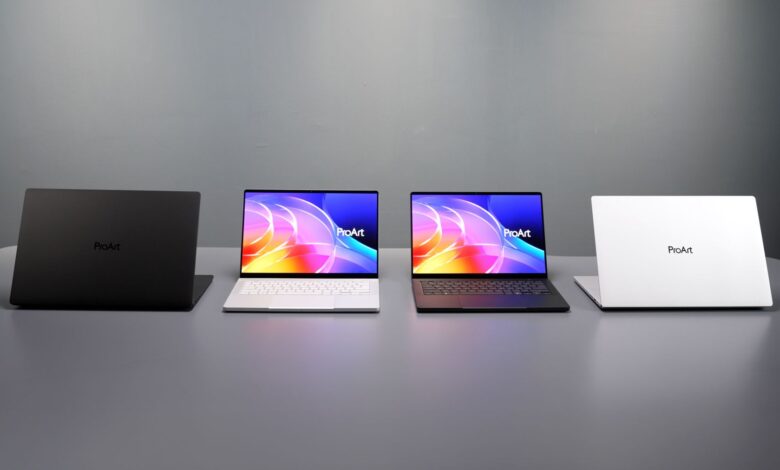
ASUS is pushing its ProArt line into a new category where creative work and local AI computing overlap. At Computex 2026, the company introduced new ProArt systems powered by NVIDIA RTX Spark, positioning them not just as content-making devices but as Windows machines built for on-device AI without relying on the cloud.
That shift expands the audience for ProArt beyond designers and video editors. ASUS is now also aiming at AI developers and users who want personal AI agents running directly on their own hardware.
Local AI becomes the main selling point
The new ProArt lineup includes the ProArt P16, ProArt P14, and ProArt Mini PC, and all of them use NVIDIA RTX Spark. ASUS says this setup is meant to deliver more advanced on-device AI performance so generative applications can run locally instead of depending on cloud services.
NVIDIA RTX Spark combines CUDA, RTX, DLSS, TensorRT, OptiX, Reflex, and G-SYNC in a single AI computing platform. ASUS says the platform can reach up to 1 petaflop of AI performance while maintaining high power efficiency and support for up to 128GB of unified memory.
The company is clearly aiming beyond ordinary creative workloads. ASUS says the new ProArt devices can handle 3D scene rendering above 90GB, professional video editing up to 12K 4:2:2, 4K AI video creation, and Large Language Models with up to 120 billion parameters.
They are also designed for very large local AI contexts, with support for processing up to 1 million tokens on-device. ASUS further highlights the possibility of running AAA games at 1440p with frame rates above 100 fps.
More compact laptops, same premium focus
The ProArt P16 and ProArt P14 are presented as slimmer premium creator laptops. ASUS says both are up to 13 percent thinner and 16 percent lighter than the previous generation.
Despite the reduced size, the company says the two laptops still use a premium CNC construction that balances portability, performance, and cooling. They also come with ASUS Lumina Pro OLED displays tuned for professional visual work, with Delta E < 1 color accuracy.
The ProArt P16 offers a panel of up to 4K 120Hz VRR with NVIDIA G-SYNC support. The ProArt P14 reaches up to 3K resolution, and both models offer brightness up to 1,600 nits along with anti-reflection coating.
ASUS also equips both laptops with up to 99.9Wh battery capacity, a haptic touchpad with precise response, the latest generation of Windows AI support, and color options in Nano Black and Neo White. A high-performance ultra-thin cooling system is also part of the package.
A small mini PC built like a workstation
The ProArt Mini PC takes the same AI-first direction into a much smaller form factor. Measuring only 150 x 150 x 51 mm, it still targets workstation-class AI performance with up to 1 petaflop of AI power and up to 128GB of unified memory.
ASUS says the memory allocation is flexible between graphics and system use, helping generative AI workloads reach their full potential. To keep the machine stable during rendering and other heavy tasks, the Mini PC uses a cooling system rated up to 140W.
Connectivity is also aimed at professional environments. The system includes 10GbE networking, an M.2 PCIe Gen 5 x4 expansion slot, fast storage support, and scalability for professional workstation needs.
ASUS positions the Mini PC for creative studios, professional workstations, and edge AI deployment. That makes it the smallest device in the lineup, but also one of the most ambitious in terms of workload support.
Software support is part of the strategy
ASUS is pairing the hardware with a broader software ecosystem. ProArt Creator Hub is designed to automatically optimize resources when handling complex creative workflows, while MuseTree and StoryCube add generative AI features to speed up content production.
The ecosystem has also been optimized for Adobe Creative Cloud, Blender, Blackmagic Design, CapCut, ComfyUI, OTOY, Goodnotes, and GoPro Cloud. ASUS says more than 1,000 apps and games are already accelerated by AI within this environment.
For creative users, ASUS is also including three months of Adobe Creative Cloud with the new ProArt devices. The ProArt P16, ProArt P14, and ProArt Mini PC will be shown during Computex 2026, before rolling out gradually to selected global regions in autumn 2026.