Realme is drawing attention with a new smartphone built around one major promise: battery life that can last up to three days on a single charge. In a market where flagship and mid-range phones often compete on cameras and chipsets, that kind of endurance has become a powerful selling point.
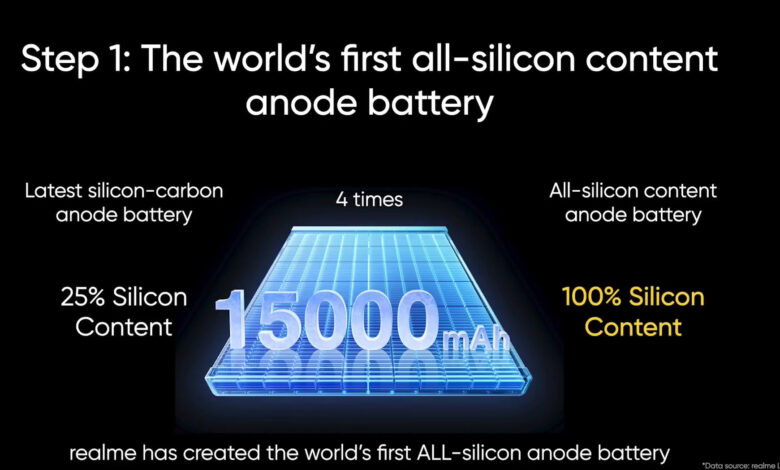
The move also highlights a broader shift in the Android industry, where energy efficiency is becoming just as important as raw performance. Realme is leaning on silicon-carbon battery technology, a newer approach that offers higher energy density than conventional lithium-ion batteries.
Why silicon-carbon matters
Silicon-carbon batteries allow manufacturers to fit in larger capacity cells without making devices excessively thick. That is one reason the technology is becoming more common among Chinese brands, including Honor, Xiaomi, Vivo, and OnePlus.
The result has been a wave of smartphones carrying batteries above 6,000mAh while still aiming to stay practical for everyday use. Realme appears to be following the same direction by combining a large battery with system-level power optimization.
More than just a bigger battery
The company is said to be pairing the battery hardware with software and device-level efficiency improvements. That combination forms the basis of the three-day battery claim attached to the upcoming device.
This focus arrives as smartphone usage becomes more demanding across the board. Video streaming, online gaming, navigation, virtual meetings, and AI-powered features all increase power consumption more aggressively than before.
A response to daily power pressure
For users in markets such as Indonesia, India, and Southeast Asia, long battery life is especially relevant. High mobility and uneven access to charging throughout the day make a large battery more than a convenience.
Realme has not yet revealed the full name of the device, but the battery capacity is reported to sit above current mainstream smartphone standards. The company also has not announced a global launch schedule or complete specifications.
Even so, the product direction is clear. Realme wants a phone that stays comfortable to use for long stretches without forcing users to trade away design or performance.
Fast charging remains part of the plan
Large batteries are only useful if recharging is manageable, and Realme is expected to keep fast charging support in place. That matters for a device targeting heavy daily use, where long charging times would reduce the advantage of the larger cell.
The brand has already built a reputation for pushing battery and charging innovation in the mid-range segment. It previously introduced 240W charging technology and multiple GT Series models focused on performance and efficiency.
That strategy fits a larger industry trend. Smartphone competition is no longer limited to processor speed or camera quality, but also includes power efficiency and the growing role of AI.
China’s battery race is reshaping Android
The biggest momentum for jumbo-battery phones is still coming from China, especially in the mid-range category that drives much of the global smartphone market. Brands in that segment are racing to deliver longer-lasting devices for users with heavier usage patterns.
At the same time, on-device and cloud-based AI processing is adding more strain on battery life. That has made next-generation power solutions increasingly important for Android manufacturers looking to balance endurance, thickness, and usability.
Realme is one of the brands expanding aggressively for younger users and mobile gaming fans. A phone with stronger endurance fits that audience well, especially as smartphones continue to serve as the main device for entertainment, work, and everyday digital tasks.