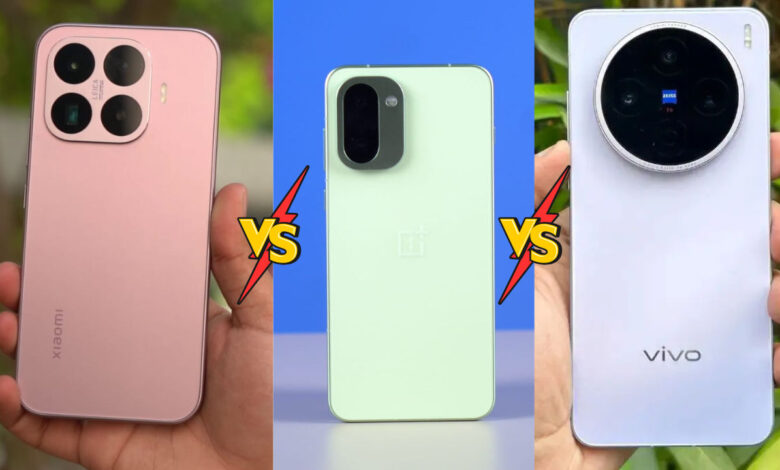
In a premium phone matchup that now leans heavily on value, the OnePlus 15R comes across as the more difficult device to dismiss. It asks for a lower price while delivering a larger battery, a faster chipset, and a more aggressive overall package.
Xiaomi 17T, however, keeps one clear advantage that matters to a specific group of buyers: imaging. Its Leica-tuned camera setup gives it a sharper identity than the OnePlus model, even if the rest of the comparison often tilts the other way.
Value is where OnePlus makes its case
OnePlus 15R is priced at around $650 or ₹55,000, undercutting Xiaomi 17T, which sits at around $700 or ₹60,000. That gap is not huge, but it becomes meaningful once the hardware differences are laid out.
For many buyers, the lower asking price is paired with stronger everyday hardware. The OnePlus 15R brings Snapdragon 8 Gen 5, a 7400mAh battery, 80W charging, a 165Hz display, an aluminum frame, and IP68/IP69K protection.
Performance puts the two phones on different tracks
The biggest technical split comes from the chipset choice. Xiaomi 17T uses the MediaTek Dimensity 8500 Ultra, while OnePlus 15R is powered by Snapdragon 8 Gen 5, which sits in a more flagship-oriented position.
That difference should matter most to users who play games, push heavy apps, or want stronger long-term performance consistency. The Adreno 829 GPU also gives OnePlus a clear graphics advantage over the Mali-G720 MC8 in Xiaomi’s phone.
Memory and storage are much closer. Both phones go up to 12GB of RAM and 512GB of UFS 4.1 storage, so multitasking and modern storage speeds are well covered on both sides.
Battery life and charging favor the OnePlus model
Battery capacity is another area where OnePlus pulls ahead with 7400mAh, compared with 6500mAh on Xiaomi 17T. It is a sizable difference for users who spend long hours away from a charger.
Charging also moves in OnePlus’ favor at 80W, while Xiaomi offers 67W. Xiaomi does add 22.5W reverse wired charging, a feature that is not available on the OnePlus phone.
For active users, the combination of a larger battery and faster charging makes the OnePlus 15R easier to recommend as an everyday device. Xiaomi 17T still has a useful edge for those who occasionally want to top up another device.
Xiaomi 17T keeps the camera advantage
This is where Xiaomi 17T clearly separates itself from its rival. It includes a 50MP main camera with OIS, a 50MP periscope telephoto camera with 5x optical zoom, and a 12MP ultrawide lens.
OnePlus 15R keeps things simpler with a 50MP main camera with OIS and an 8MP ultrawide lens, but no telephoto camera. That makes Xiaomi the more flexible option for distance shots, portraits, and zoom-heavy use.
Both phones use a 32MP front camera, although OnePlus adds autofocus for the selfie camera. In practice, that should help keep self-portraits and video calls sharper.
Video recording is another distinction. OnePlus 15R supports up to 4K 120fps on the rear camera, while Xiaomi 17T tops out at 4K 60fps.
Display, build, and daily use tips the balance back again
OnePlus 15R also looks more premium in materials and protection. It uses glass on the front and back, an aluminum frame, and carries IP68/IP69K certification.
Xiaomi 17T uses a glass front with a plastic frame and a glass-fiber reinforced back panel. That approach may help keep the phone practical and lighter, but the OnePlus device still feels like the more robust option.
The display comparison is similarly one-sided. OnePlus 15R has a 6.83-inch AMOLED panel with a 165Hz refresh rate and peak brightness of 3600 nits, while Xiaomi 17T uses a 6.59-inch AMOLED screen at 120Hz and 3500 nits.
Xiaomi does counter with Dolby Vision and HDR10+, which will appeal to users who care about video playback quality. OnePlus, meanwhile, leans on size and smoothness for a more fluid feel in scrolling and gaming.
Audio is another point for Xiaomi, which includes stereo speakers, Dolby Atmos, and Hi-Res Audio. OnePlus 15R is listed with stereo speakers, but Xiaomi offers the more complete multimedia package.
Fingerprint authentication also differs, with OnePlus using an ultrasonic in-display sensor and Xiaomi relying on an optical one. The ultrasonic solution is generally expected to be faster and more consistent in daily use.
Connectivity is modern on both phones, but OnePlus goes further with Wi-Fi 7 and Bluetooth 6.0. Xiaomi 17T offers Wi-Fi 6E and Bluetooth 6.0, which remains current but is not as advanced on the wireless side.
Both run Android 16, with Xiaomi using HyperOS 3 and OnePlus shipping OxygenOS 16. That makes software preference largely a matter of personal taste and ecosystem fit.
Overall, OnePlus 15R appears to be the stronger buy for most people because it combines lower pricing with a faster chipset, larger battery, quicker charging, better protection, and a more premium build. Xiaomi 17T remains compelling for buyers who are willing to pay more for the Leica-backed camera system and the 5x periscope zoom it brings.