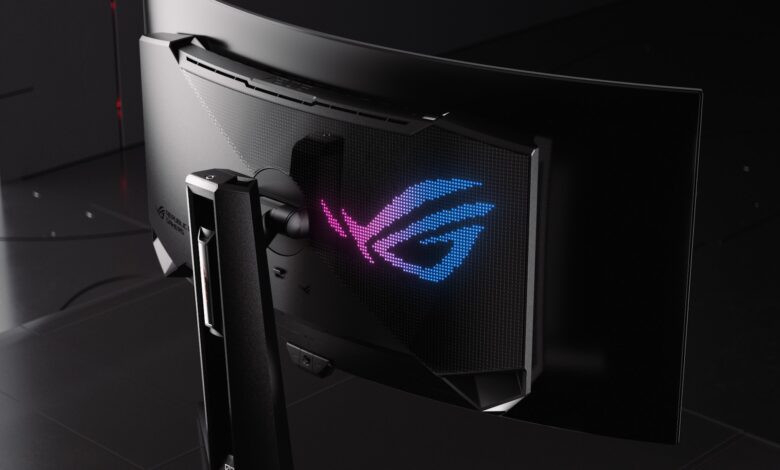
ASUS has begun selling the ROG Swift OLED PG34WCDN in the United States, bringing one of the most closely watched curved ultrawide gaming monitors into the retail market. The model stands out because it pairs a 360Hz refresh rate with Samsung Display’s latest OLED panel technology.
The real shift is not just speed. ASUS is also using a fifth-generation QD-OLED panel with an RGB stripe sub-pixel layout, a design intended to sharpen text and reduce the visual artifacts that have long made some OLED monitors less comfortable for everyday desktop use.
A panel built to improve readability
The PG34WCDN uses a 34-inch curved panel with an 1800R radius and a resolution of 3440 x 1440 pixels. That ultrawide format gives it enough screen space for gaming, multitasking, and media consumption without sacrificing the immersive feel that buyers expect at this size.
According to ASUS, the RGB stripe arrangement is meant to reduce color fringing around letters and icons. That matters because one of the most common complaints about OLED displays has been the visible color edges that can appear around text.
For users who split time between games and productivity, the change is likely the most meaningful part of the new panel. Reading documents, browsing the web, and handling general desktop tasks should feel more natural if the colored halos at the edge of text are reduced.
Brightness and protection have also been upgraded
Samsung Display has also added a new coating that ASUS refers to as BlackShield. The company says it improves black depth by up to 40 percent and makes the screen 2.5 times more scratch-resistant than earlier QD-OLED monitors.
ASUS says that coating is part of the panel maker’s standard hardware rather than an ASUS-exclusive feature. In terms of output, the monitor can reach 500 nits in full-screen use and peak at 1,300 nits for HDR content.
Those figures place it among the brighter OLED ultrawide options available today. In practice, that should help HDR movies and supported games look more vivid while preserving the deep blacks that remain one of OLED’s biggest strengths.
Connectivity is aimed at demanding setups
ASUS includes DisplayPort 2.1 UHBR20 support, giving the monitor full-bandwidth input for its 360Hz signal without compression. That detail will matter most to buyers who want to push high refresh-rate gaming without compromise.
There is also a USB-C port with 90W power delivery, making it easier to charge a gaming laptop or other device while using the monitor as a primary display. Combined with the curved 34-inch panel, the package is clearly aimed at users who want a single screen for both work and play.
Price and market position
In the US, the ROG Swift OLED PG34WCDN is priced at $1,299, or around Rp 21.4 million, and is available through Amazon and Newegg. That makes it the first monitor with Samsung Display’s fifth-generation QD-OLED panel that consumers can actually buy.
MSI’s MPG 341CQR QD-OLED X36 uses the same panel but is listed at $899.99 and has not yet reached stores. Other models, including the Gigabyte MO34WQC36, Acer Predator X34 F3, and HP OMEN 34-inch OLED, are also still awaiting launch.
For now, ASUS has the advantage of being first to market with a panel that could redefine expectations for OLED gaming monitors. The combination of 360Hz performance, RGB stripe clarity, and high HDR brightness makes the PG34WCDN one of the most notable ultrawide displays to arrive in the US so far.