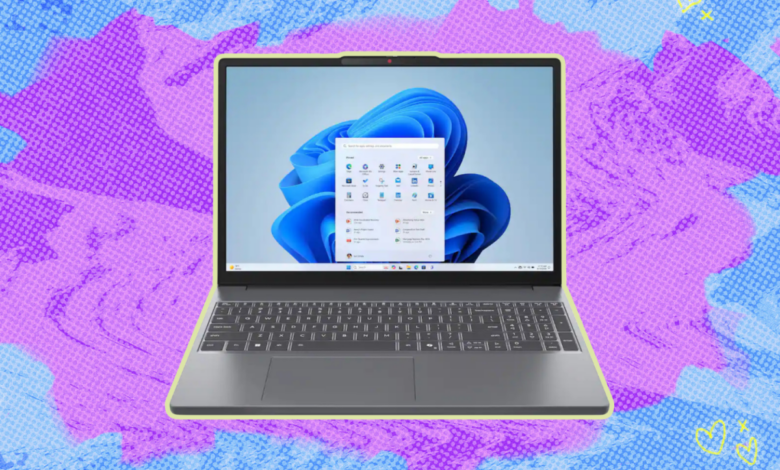
At nearly the same price, the MacBook Air M5 and Lenovo IdeaPad Slim 3 take very different routes to the same buyer. One focuses on raw performance, while the other leans on an OLED display, upgrade flexibility, and a slightly larger battery.
For everyday productivity, that difference matters more than the spec sheet on paper. The real question is which laptop handles multitasking, office work, and heavier workloads with less friction.
Performance is where the gap opens widest
MacBook Air M5 uses Apple’s M5 chip with a 10-core CPU, while Lenovo IdeaPad Slim 3 relies on Intel Core Ultra 5 322. The Intel chip is part of the Panther Lake family and is positioned as an upgrade over previous generations.
The benchmark numbers, however, make the contrast difficult to ignore. In Cinebench 2024 single-core testing, Apple M5 scored 206, compared with 113 for Intel Core Ultra 5 322.
The multi-core result shows an even larger gap. MacBook Air M5 posted 1170 in Cinebench 2024, while the Lenovo machine reached 560.
Geekbench 6 tells the same story. Apple M5 recorded 4248 in single-core and 17502 in multi-core, while Intel Core Ultra 5 322 managed 2559 and 7939.
| Benchmark | MacBook Air M5 | Lenovo IdeaPad Slim 3 |
|---|---|---|
| Cinebench 2024 Single-Core | 206 | 113 |
| Cinebench 2024 Multi-Core | 1170 | 560 |
| Geekbench 6 Single-Core | 4248 | 2559 |
| Geekbench 6 Multi-Core | 17502 | 7939 |
That translates into a major lead for Apple in percentage terms as well, with the M5 ahead by 82 percent in Cinebench single-core and 109 percent in multi-core. In Geekbench 6, the margin rises to 66 percent and 120 percent respectively.
For users who care most about responsiveness, heavy multitasking, and faster handling of demanding work, the MacBook Air M5 is clearly the stronger productivity machine.
Lenovo fights back with display and flexibility
The IdeaPad Slim 3 does not lose ground everywhere. Its 15.3-inch OLED panel, 1920×1200 resolution, 16:10 aspect ratio, 60Hz refresh rate, Dolby Vision support, and 600-nit peak brightness make it the more attractive screen for visual content.
By comparison, MacBook Air M5 uses a 13.6-inch Liquid Retina IPS display with 2560×1664 resolution, 16:10 aspect ratio, 60Hz refresh rate, and 500-nit peak brightness. Apple’s panel is described as color accurate and sufficiently bright.
OLED gives the Lenovo stronger contrast and deeper blacks, which makes it better suited for entertainment and visual playback. That advantage matters less, though, when productivity is the main priority.
Lenovo also has a practical edge in long-term ownership. Its 16GB DDR5 memory can be upgraded, and its 512GB PCIe Gen 4 SSD can be replaced, giving users more room to extend the life of the laptop.
Portability, battery life, and audio round out the comparison
Both laptops use aluminum bodies, but the MacBook Air M5 is built as a unibody and is described as more rigid, with less chassis flex. It is also smaller, thinner, and lighter than the Lenovo, which makes it easier to carry around.
Battery capacity slightly favors Lenovo at 60Wh, compared with 53.8Wh on the MacBook Air M5. Apple claims up to 18 hours of video playback, while Lenovo claims up to 21 hours.
In mixed real-world use, the MacBook Air M5 is said to last around 13 to 15 hours. The IdeaPad Slim 3 is reported to stretch a little further, at roughly 15 to 16 hours.
Audio is another area where Apple pulls ahead. The MacBook Air M5 uses a quad-speaker system that is louder, clearer, and fuller than the dual-speaker setup on the IdeaPad Slim 3.
With all of that combined, Lenovo IdeaPad Slim 3 still stands out for its OLED panel, Dolby Vision support, bigger battery, and upgrade-friendly design. But when the buying decision is centered on productivity at a nearly identical price, the MacBook Air M5 is the more compelling choice because its performance lead is simply too large to ignore.