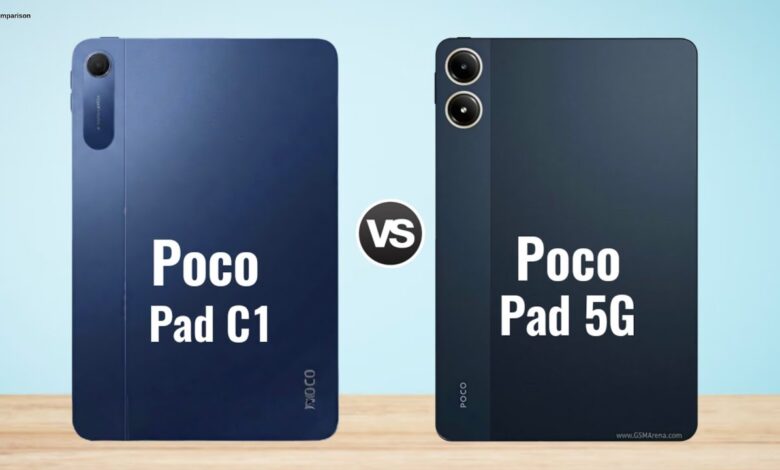
Poco Pad C1 is edging closer to an Indonesia launch after clearing TKDN certification. That makes the budget tablet look ready to enter a market that values aggressive pricing and standout specifications.
Its most attention-grabbing combination is simple: a compact metal build, a 2K display with a 120Hz refresh rate, and storage that uses UFS instead of the more common eMMC found in entry-level tablets.
A compact tablet with a more premium feel
Poco Pad C1 uses a metal body and a design that stays straightforward rather than flashy. The device is built around a 9.7-inch screen, making it easier to handle than many larger tablets.
With a thickness of 7.4 mm and a weight of 406 grams, the tablet is positioned as a practical option for daily use. That size also makes it more convenient for travel, light productivity, and younger users who need a device for study and entertainment.
The display is the main attraction
The panel is where Poco Pad C1 tries to separate itself from other low-cost tablets. It uses an IPS LCD panel with 2K resolution and a 120Hz refresh rate, which should make scrolling and animations feel smoother.
The screen also reaches 600 nits of brightness, improving visibility in outdoor conditions. Poco has added TÜV certification for Low Blue Light and Flicker Free protection to help reduce eye fatigue during longer sessions.
Snapdragon 6s Gen 2 handles everyday tasks
Under the hood, Poco Pad C1 is powered by the Snapdragon 6s 4G Gen 2 built on a 6nm process and clocked up to 2.9 GHz. The tablet is said to score around 420,000 points in AnTuTu, which places it in a modest performance tier.
Poco has also moved to UFS 2.2 storage, a welcome step up from eMMC. Memory options include 4GB and 6GB of RAM, while internal storage ranges from 64GB to 128GB.
Best suited for light work and casual entertainment
The specifications point to a device that is better suited for everyday computing than demanding games. Browsing, documents, social media, online classes, and casual games all fit comfortably within its intended use.
Heavy 3D gaming is not its focus, so buyers looking for a tablet centered on gaming performance may need to look elsewhere. Poco Pad C1 is instead shaping up as a versatile affordable tablet with a few features that feel unusually complete for its segment.
Android 16 and HyperOS 3 come preinstalled
Another unusual point for a budget tablet is that Poco Pad C1 ships with Android 16 out of the box. The software layer is HyperOS 3, giving it a more current platform than many entry-level rivals.
The feature set is also practical. It includes dual stereo speakers, a 3.5mm audio jack, a MicroSD slot supporting up to 2 TB, and a 7,600 mAh battery with 18W charging through USB-C.
Cameras are basic, with one important omission
Camera hardware is kept modest, with an 8 MP f/2.0 rear camera and a 5 MP f/2.2 front camera. Both are limited to 1080p video recording at 30 FPS.
One drawback that may matter to some buyers is the lack of a gyroscope sensor. That omission can reduce GPS or map accuracy in vehicle navigation use cases.
Pricing may decide how far it can go
In global markets, Poco Pad C1 starts at 139 to 179 USD, or roughly Rp2.4 million to Rp3.1 million. Its hardware is also said to be very similar to the Redmi Pad 2 9.7-inch that has just launched.
If Poco brings it officially to Indonesia, pricing will likely be the key factor. With TKDN already cleared, the next question is whether Poco can set a price low enough to pressure rivals in the budget tablet segment.