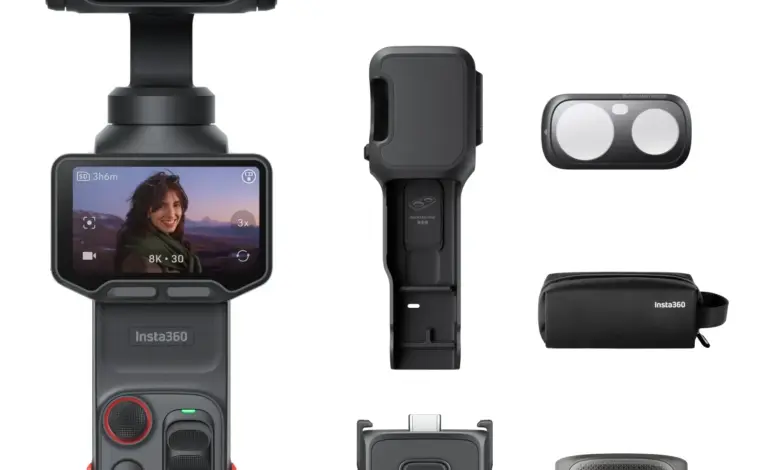
Insta360 has brought the Luna Ultra to Indonesia with a starting price of Rp13,999,000. The camera gimbal enters the premium segment with a dual Leica lens system, up to 8K Dolby Vision recording, and a compact form factor aimed directly at portable camera rivals.
The device stands out because it is Insta360’s first camera gimbal. That makes its launch a notable expansion for the company into a category long associated with DJI’s pocket-sized gimbal products.
Two Leica lenses define the pitch
The main selling point is the combination of a Leica Summicron Lens and a latest-generation 1-inch sensor. Insta360 says the setup is designed to deliver sharp detail across different lighting conditions while supporting video capture up to 8K Dolby Vision.
For longer-range shooting, the Luna Ultra also includes a professional telephoto lens. It supports up to 12x zoom and 6x lossless zoom, giving users more flexibility when they want to move from wide scenes to distant subjects without changing lenses.
This approach gives the Luna Ultra a different identity from many pocket gimbals that rely on a single main camera. It positions the device as a compact production tool rather than just a simple handheld recorder.
Premium pricing and bundle options
In Indonesia, Insta360 is offering two sales packages for buyers. The Standard Bundle is priced at Rp13,999,000, while the Creator Bundle costs Rp17,799,000.
The Creator Bundle includes a Battery Handle, Wide-Angle Lens, Insta360 Mic Pro Transmitter, and Carry Bag. Those additions are aimed at users who want a more complete kit for content production from day one.
Buyers can also choose between Cosmic Black and Stellar White. The color options keep the presentation simple while still matching the product’s premium positioning.
Built for creators who need more control
The Luna Ultra is not limited to video capture. It can also produce panorama photos at up to 200MP and UltraPhoto at 37MP, expanding its role for creators who need both stills and motion.
For color work, the device offers three Leica color profiles and six cinematic profiles. It also supports 10-bit I-Log, which is compatible with the ACES workflow for more flexible color grading.
That combination is meant to help creators adapt the look of their content without relying on external gear. It also gives the Luna Ultra broader appeal among vloggers, travelers, and mobile-focused production users.
Stabilization, display, and remote use
At around 235 grams, the Luna Ultra remains relatively light for a device with this feature set. Insta360 combines 3-axis mechanical stabilization with Electronic Image Stabilization, or EIS, to keep footage steady during movement.
The camera also uses a detachable 2-inch OLED screen. The display can function as both a monitor and a remote control, and users can operate the camera from up to 20 meters away in HD resolution.
Screen orientation can be switched between portrait and landscape as needed. That flexibility makes the device easier to adapt for different content formats on mobile platforms.
AI processing and battery life
Under the hood, the Luna Ultra is powered by a Triple AI Chip setup. It consists of one 4nm flagship chipset and two dedicated imaging chips.
That hardware supports PureVideo up to 4K 60fps, which is designed to produce cleaner video even in low-light conditions. Insta360 also adds smart tracking, group tracking, and AI-assisted editing to simplify the workflow.
For storage, the camera includes 47GB of internal memory and a microSD slot supporting up to 1TB. Power comes from a 1,550mAh battery, which is claimed to last up to four hours of recording.
Insta360’s first camera gimbal arrives as a direct challenge in a space that has been closely associated with DJI. With Leica optics, 8K Dolby Vision, AI features, and a compact body, the Luna Ultra is clearly built to compete for creators who want more from a pocket-sized shooting device.