


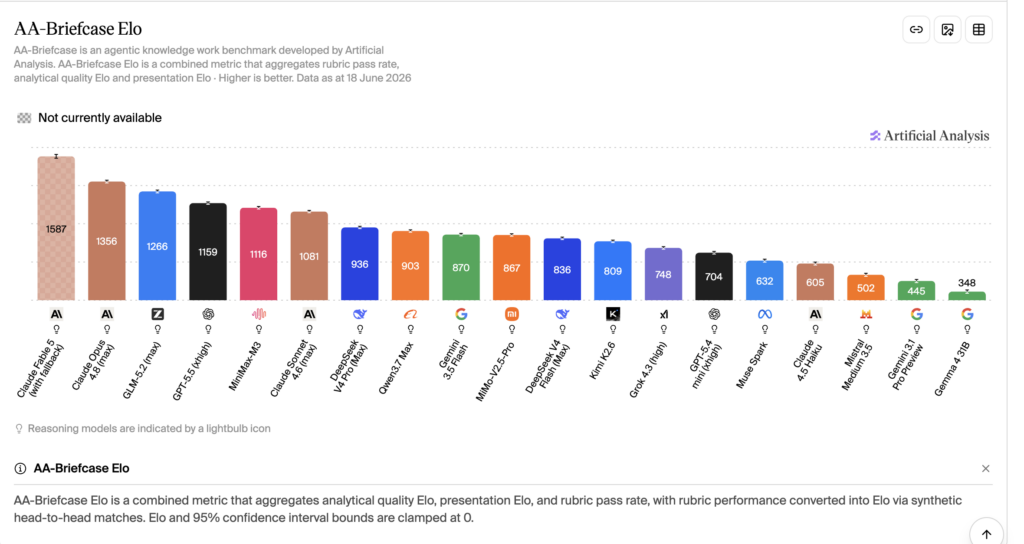
GLM-5.2 from Zhipu AI has emerged as a serious contender in AI-assisted web design after reaching the top of a closely watched creative coding benchmark. The model now sits above Claude Fable 5 on the HTML single-round non-agent leaderboard, a result that could reshape how development teams choose their tools.
The result matters because it is not based on automated scoring alone. Design Arena uses blind voting on AI-generated designs, which means the ranking reflects how people judge visual quality, usability, and the overall finished experience.
A ranking shift that reaches beyond the leaderboard
Design Arena announced on 19 June that GLM-5.2 had taken the #1 position in the category. The model also moved ahead of Opus 4.6 and 4.7, adding more weight to its rise on the platform.
Compared with GLM-5.1, the newer model climbed five positions and reached an Elo score of about 1360 in the code category. That jump suggests the improvement is not marginal, but strong enough to alter how the model performs in practical design tasks.
Its edge is visible in the kinds of pages it generates. Design Arena says GLM-5.2 tends to produce cleaner layouts, stronger typography, better visual hierarchy, image use from CDNs, and smoother animation that makes the result feel more polished.
Why developers may pay attention
The model also appears to work well with widely used front-end tools. Design Arena noted strong compatibility with Chart.js and Three.js, two libraries that are often used for data visualization and interactive elements.
Another notable detail is the way GLM-5.2 handles design stacks. It uses Tailwind CSS in 91% of its generated designs and Font Awesome in 51% of sessions, while Fable 5 uses Tailwind CSS in about 57% of sessions.
That difference may help explain why GLM-5.2 often produces interfaces that look more consistent and practical at a glance. In a field where visual clarity matters as much as raw code output, those habits can influence which model a team prefers.
Human voting gives the benchmark extra weight
Design Arena describes its benchmark as a large crowdsourced arena for creative coding, where people cast blind votes on designs made by AI models. The approach gives the leaderboard a different kind of credibility from synthetic tests that rely only on automatic metrics.
For web design, this matters because visual taste, readability, spacing, and usability are often easier to judge from human preference than from machine scoring. Design Arena says it has collected millions of votes from creators, which helps frame the ranking as relevant to real-world use.
Pricing may be the bigger surprise
Performance is only part of GLM-5.2’s appeal. Its API pricing is said to be around $1.40 per one million input tokens and $4.40 for output, making it far less expensive than Fable 5.
Fable 5 is reported at roughly $10 for input and $50 for output, a gap that could matter for teams running heavy workloads or repeated design iterations. That pricing difference may be enough to push some developers to test GLM-5.2 even if they already rely on a more established model.
The model also comes as open weights under the MIT license, which gives teams the option to run it locally rather than depending entirely on a proprietary service. It additionally offers a 1 million token context window, which is useful for longer projects and more complex instructions.
Taken together, the benchmark result, lower cost, and open-weight release put GLM-5.2 in a strong position among models aimed at creative coding. Claude Fable 5 remains a major player, but the combination of quality and affordability now gives Zhipu AI’s model a profile that is hard for developers to ignore.