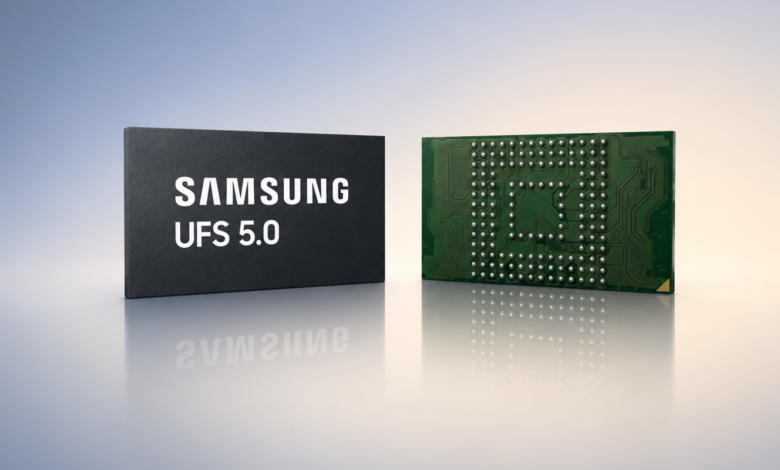
Samsung has introduced UFS 5.0, a new internal storage standard designed to raise smartphone performance as mobile devices take on heavier workloads. The company is positioning it as an important foundation for phones that rely on fast response times, on-device AI, and better power efficiency.
The headline numbers are striking. Samsung says UFS 5.0 can reach read speeds of about 10.8 GB/s and write speeds of 9.5 GB/s, well above UFS 4.1, which is listed at around 4.3 GB/s for read and 4.1 GB/s for write.
Built for faster everyday use
Those higher speeds should make phones feel more responsive in routine tasks. Opening apps, switching menus, and accessing large files could all happen with less delay and smoother movement.
The upgrade also matters for heavier workloads that are becoming more common on smartphones. Tasks that move large amounts of data should benefit because storage is less likely to become the main bottleneck.
Designed for on-device AI
Samsung is also framing UFS 5.0 as a response to the rising demand for AI features on mobile devices. Use cases such as image recognition, language processing, and AI-based photo editing all depend heavily on fast internal storage.
With quicker data access, on-device AI processes can run more smoothly and efficiently. That means smart features may feel more immediate, with less lag during complex tasks.
Stability and efficiency remain part of the upgrade
Beyond speed, Samsung says the chip architecture has been improved to maintain stability under heavy loads. The goal is to keep performance consistent in real-world scenarios that push storage hard.
The company also added clock-gating and multi-voltage technology to help reduce total power consumption. For users, that could translate into better battery life during demanding use, which matters because high performance often comes with higher energy costs.
Smaller size, wider device potential
Physically, the UFS 5.0 chip is smaller, measuring about 7.5 mm x 13 mm x 0.9 mm. Samsung says the module is around 16.7% smaller than UFS 4.1.
That slimmer footprint could broaden where the technology is used. It may fit thinner devices, including ultra-slim smartphones and XR headsets.
Mass production is scheduled later
Samsung is also preparing mass production of UFS 5.0, which is scheduled to begin in the fourth quarter of 2026. That move signals the technology is moving from development toward commercial use.
If adoption widens, UFS 5.0 could become a key storage standard in future flagship devices. Phones that handle large data loads and advanced AI features may see the biggest gain in responsiveness.