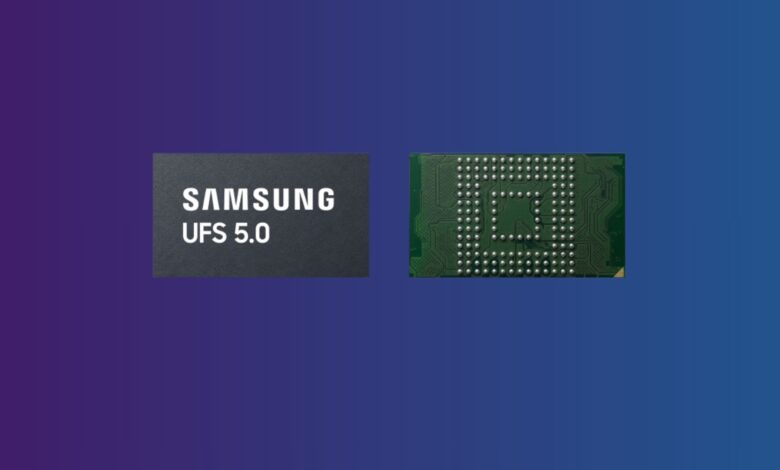
Samsung has introduced UFS 5.0 as a storage chip built for the next wave of on-device AI. The move reflects a wider shift in mobile computing, where phones, tablets, and XR headsets are expected to handle more AI tasks locally instead of relying entirely on the cloud.
The main issue is no longer just speed on paper. As AI models grow larger and more demanding, storage has become a critical part of how quickly data can move between the chip, memory, and processing units inside a device.
Storage is becoming an AI bottleneck
Samsung says storage now plays a central role in AI-era computing. Jangseok Choi, Head of Memory Product Planning at Samsung Electronics, has said the storage layer is crucial as AI workloads move closer to the device.
That shift matters because on-device AI depends on fast reads and writes, not only on the performance of the processor itself. When a chatbot runs offline or a large language model is executed locally, storage throughput can shape response time and overall smoothness.
UFS 5.0 is based on the latest JEDEC UFS interface standard and uses two data lanes to raise bandwidth substantially over the previous generation. Samsung says sequential read speed reaches up to 10.8 GB/s, while sequential write speed reaches 9.5 GB/s.
Samsung describes that level of performance as the highest currently available in mobile storage. The company also says it is more than twice as fast as UFS 4.1.
Faster, but also more efficient
Higher performance often comes with higher power use, but Samsung says UFS 5.0 is built to improve efficiency as well. The company claims power efficiency is up to 40% better, helped by techniques such as clock gating and multi-voltage operation.
That focus on efficiency matters for AI-heavy mobile devices, which can move large amounts of data continuously and still need to preserve battery life. In practical terms, it gives handset makers more room to support sustained local AI use without making the device drain too quickly.
Samsung has also made the chip smaller. The module measures 7.5 mm × 13 mm × 0.9 mm, which is about 16.7% smaller than the UFS 4.1 solution.
A smaller module gives manufacturers more flexibility in internal layout. It can help with thinner phone designs, larger batteries, or better thermal systems, all of which matter as AI workloads become more common.
Built for flagship phones and XR devices
Samsung is aiming UFS 5.0 at the next generation of mobile devices. Its target markets include smartphones, tablets, and XR headsets that are expected to rely increasingly on local AI processing.
The chip’s release also lines up with the industry’s effort to reduce bottlenecks when large data sets are moved around inside a device. In AI use cases, slow storage can delay model loading, affect responsiveness, and limit the experience of smart features on the device.
Samsung has also pointed to broader signs that local storage demand is rising, including experiments in device modification such as research that turned old Pixel phones into low-cost data centers. While that example sits outside the consumer mainstream, it highlights how much pressure modern storage faces when devices are asked to process data locally.
In that environment, storage is no longer a passive component. It has become one of the defining factors alongside CPU, GPU, and NPU performance.
Production plans and capacity
Samsung plans to begin mass production of UFS 5.0 in the fourth quarter. The chip will also be available in capacities of up to 1 TB per chip.
That capacity is relevant for devices that need to store AI models, high-resolution video, applications, and user data in one package. Such requirements are becoming more common in flagship smartphones and immersive computing devices.
JEDEC develops the UFS standard with major memory industry players, and the format has steadily moved closer to PC-class SSD speeds over time. UFS 5.0 signals that mobile competition is now extending beyond cameras and main chipsets into the storage layer itself.
For users, that could mean faster local AI features, less waiting for data-heavy tasks, and better battery behavior when devices are under sustained load. For manufacturers, it gives them a new foundation for building thinner, faster, and more capable devices around AI.