


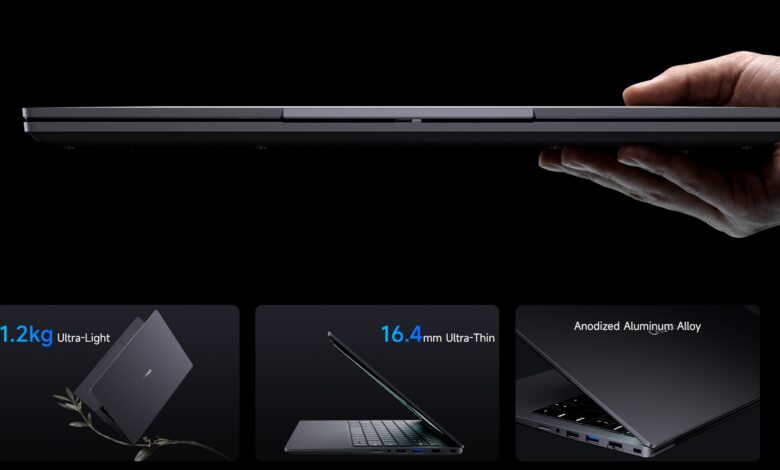
Chuwi is pushing the UniBook into the market with a sharp price cut that places it well below its expected retail level. The laptop is available for pre-order at $449, while the company says the standard price will rise to $619 later.
That pricing makes the UniBook notable not just as an affordable Windows laptop, but also as one of the first systems to use Intel’s Wildcat Lake architecture. For buyers watching the entry-level segment, the combination of a new Intel platform, a 14-inch 16:10 display, and a user-replaceable SSD stands out immediately.
What the UniBook offers
At the center of the machine is the Intel Core 3 304, a Series 3 processor built on Intel’s 18A process. It uses five cores, five threads, and a 15W TDP, putting it squarely in the lightweight everyday-computing category.
The chip also includes a dedicated NPU rated at 15 TOPS. Its integrated graphics add another 9 TOPS, but the total still falls short of the 40 TOPS threshold Microsoft uses for Copilot Plus PC certification.
In practical terms, that means the UniBook is not aimed at heavier local AI workloads. Its appeal is more about offering current-generation Intel hardware at an aggressive entry price than about chasing high-end AI credentials.
Storage can be upgraded, memory cannot
One of the more useful details is the storage configuration. Chuwi ships the UniBook with a 256GB PCIe 3.0 SSD, but the internal M.2 slot can be replaced later with a faster PCIe 4.0 drive.
That kind of flexibility is rare enough in this price range to matter. For users who expect to outgrow the factory storage quickly, the ability to swap the SSD is a real advantage.
Memory tells a different story. The UniBook comes with 8GB of LPDDR5-6400 RAM, and it is soldered in place, which means it cannot be upgraded after purchase.
That limitation is more significant on Windows 11, where 8GB can feel tight once browser tabs and multiple apps start piling up. Chuwi’s pricing strategy clearly leans on selective compromises, and fixed memory is the most obvious one.
Display, design, and portability
The UniBook uses a 14-inch IPS panel with a 1920 x 1200 resolution. The 16:10 aspect ratio gives it extra vertical space, which is useful for reading documents and working on the web.
Chuwi also lists 100% sRGB coverage and a 300-nit peak brightness rating, with a standard 60Hz refresh rate. Those are solid specifications for a budget-oriented laptop rather than premium-class claims.
The chassis is made from aluminum, which helps the UniBook feel more substantial than many low-cost notebooks. At 1.2 kg and 16.4 mm thick, it remains compact enough for commuting or frequent travel.
Ports and connectivity are unusually generous
Chuwi has also packed in a broad set of ports. The UniBook includes two full-featured USB-C ports that support 65W Power Delivery charging and 4K display output.
It is joined by two USB-A 3.2 Gen 1 ports, one USB-A 2.0 port, and HDMI 1.4b for external monitors. There is also Gigabit Ethernet, a microSD card slot, and a 3.5 mm audio jack.
For wireless use, the laptop supports Wi-Fi 6 and Bluetooth 5.2. Power comes from a 53.38Wh battery, which rounds out a configuration that looks practical rather than flashy.
Why the UniBook stands out
The UniBook’s strongest selling points are easy to identify: a low pre-order price, a new Intel platform, a replaceable SSD, and a well-equipped port layout. That mix gives it a broader utility profile than many other budget notebooks.
At the same time, the soldered 8GB RAM limits how far the machine can stretch over time. Buyers looking for a low-cost laptop for everyday tasks may still find the UniBook appealing, but the memory ceiling is a real trade-off that cannot be ignored.
Chuwi says the pre-order price runs until 2 July 2026, and shipping is scheduled to begin on 20 July. For shoppers seeking an early entry into Intel’s Wildcat Lake era without paying premium prices, the UniBook is positioned as a straightforward but constrained option.