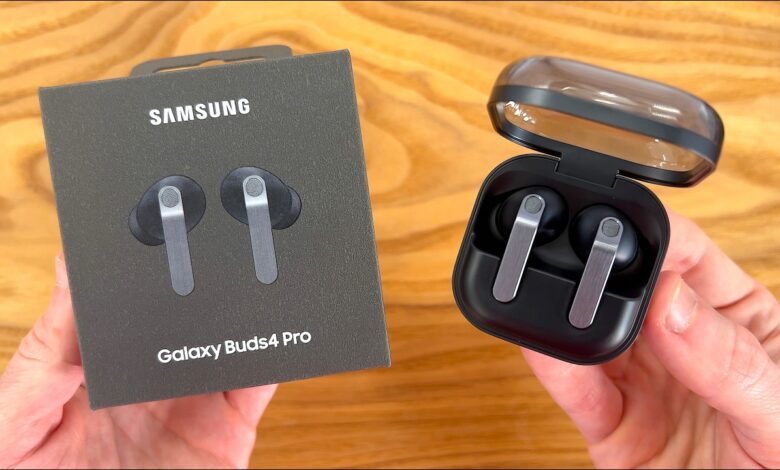
Phone calls often fall apart in crowded streets, train stations, or any place where background noise drowns out the speaker. Samsung is aiming to solve that problem with the Galaxy Buds4 Pro, which relies on more than passive noise control.
Instead of simply blocking sound, the earbuds combine sensor data, on-device AI, and real-time audio processing to keep the user’s voice intelligible. The goal is straightforward: preserve vocal clarity even when the surrounding environment is chaotic.
Sensor fusion that tracks where the voice is coming from
Conventional earbuds usually depend on one or two external microphones. That setup can struggle to separate a person’s voice from horns, traffic, or nearby conversations.
The Galaxy Buds4 Pro takes a more environment-aware approach through Sensor Fusion. Samsung says the system combines two external microphones, one internal microphone, and a Voice Pickup Unit, or VPU.
The two external microphones help determine the direction of the user’s voice. The internal microphone monitors how sound resonates inside the ear canal, while the VPU detects physical vibrations in the jaw and head when the wearer speaks.
By cross-checking those three data points, the earbuds can better isolate human speech from outside noise. That makes the voice not only audible, but also cleaner against a noisy backdrop.
AI processing built directly into the earbuds
Samsung has also embedded a Deep Neural Network, or DNN, into the device. The model is designed to imitate how the human brain processes sound.
What stands out is that the DNN does not rely on a large external processor. Samsung compressed the model so it can run directly on the earbuds through on-device processing.
That optimization cuts initial computational load by up to 10 percent. Samsung also says the AI model was reduced to 30 percent of its original size without sacrificing quality.
The system adapts to changing surroundings in real time. Its algorithm analyzes past, present, and future sound patterns instantly so it can react to abrupt shifts in noise.
Samsung says the vocal data resolution reaches 16 times higher than the previous generation. High tones, sharp consonants, and even the breath at the end of words are meant to sound more natural.
Staying stable when the fit shifts
The technology also addresses fit leakage, which happens when earbuds move slightly as the user chews or walks. Once a gap appears, outside noise can enter and reduce call clarity.
The Galaxy Buds4 Pro detects that leakage automatically. It then adjusts audio parameters dynamically so sound quality remains steady.
That matters because real-world comfort is rarely perfect. Even a small shift in the earbuds can reduce noise isolation enough to affect a call.
Best results inside the Samsung Galaxy ecosystem
Samsung says call quality reaches its peak when the Galaxy Buds4 Pro is paired with a Samsung Galaxy phone. In that setup, the device activates Super Wideband, or SWB, connectivity.
SWB transmits audio data up to the 16 kHz band. Samsung describes the result as a thick, professional radio-like voice.
Tested in genuinely harsh environments
Samsung says the technology was not tested only in a lab. Evaluations were also carried out in shopping centers, crowded cafes, and while driving with the car windows open.
Laboratory simulations also included giant wind generators to test how well the system handles wind noise. Those tests suggest the Galaxy Buds4 Pro is built around one priority: keeping the user’s voice clear in the hardest listening conditions.