


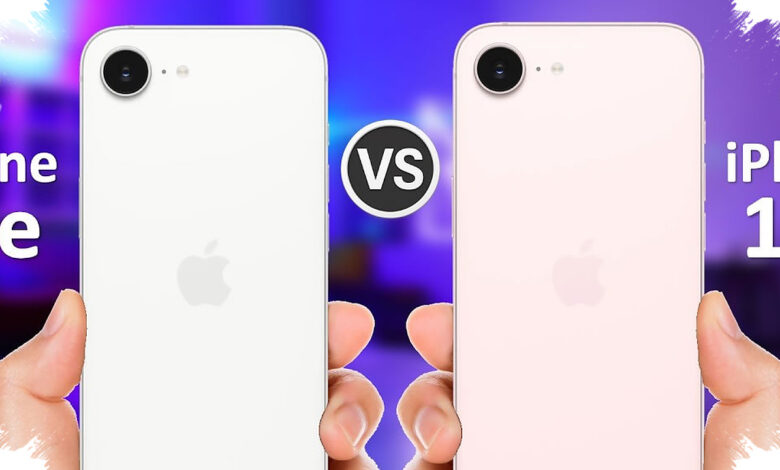
Apple has made the iPhone 17e a far more complete entry in its “e” lineup, and the biggest changes are easy to spot. The phone now starts with 256 GB of storage, adds MagSafe support, and moves to the A19 chip.
Those three changes shift the appeal of the device beyond a basic budget-friendly iPhone. For buyers who want more room, faster performance, and easier accessory use, the iPhone 17e is clearly designed to feel more future-ready than the iPhone 16e.
Storage becomes the most obvious upgrade
The storage gap is one of the clearest differences between the two models. The iPhone 16e still starts at 128 GB, while the iPhone 17e begins at 256 GB and goes up to 512 GB.
That change matters for everyday use because app sizes keep growing and video files take up more space. Users who record 4K video or keep large libraries of photos and files should feel the benefit immediately.
| Model | Starting Storage | Maximum Storage |
|---|---|---|
| iPhone 16e | 128 GB | Not stated |
| iPhone 17e | 256 GB | 512 GB |
A19 chip brings a stronger performance story
Apple also replaces the A18 found in the iPhone 16e with the A19 on the iPhone 17e. The newer chip is built for faster processing and better power efficiency.
That should help people who juggle many apps, play games, or use AI-based features. The iPhone 16e remains capable, but the iPhone 17e is positioned as the more comfortable choice for heavier workloads.
| Model | Chipset | Main Benefit |
|---|---|---|
| iPhone 16e | A18 | Competitive everyday performance |
| iPhone 17e | A19 | Faster processing and better efficiency |
MagSafe finally makes the experience easier
Another important change is the addition of MagSafe support, which the iPhone 16e does not offer. The older model relies on standard Qi wireless charging at up to 7.5W.
With the iPhone 17e, Apple adds MagSafe and Qi2 support up to 15W through USB-C. That brings more convenience for magnetic chargers, magnetic wallets, and car mounts.
The display size stays the same, but durability improves
Both phones keep a 6.1-inch display, so there is no change in screen size. The iPhone 17e, however, uses Ceramic Shield 2, which is claimed to be more scratch-resistant than the previous generation.
There is a small trade-off in weight. The iPhone 17e weighs 169 grams, just 2 grams more than the iPhone 16e, although the difference should be difficult to notice in hand.
The camera hardware is familiar, but the software adds flexibility
Apple keeps the camera hardware largely unchanged between the two models. Both phones use a 48 MP Fusion rear camera and a 12 MP front camera.
The iPhone 17e does introduce a newer Portrait mode that lets users change the focus point after the shot is taken. That gives editing more flexibility without requiring a retake.
| Feature | iPhone 16e | iPhone 17e |
|---|---|---|
| Rear Camera | 48 MP Fusion | 48 MP Fusion |
| Front Camera | 12 MP | 12 MP |
| Display Size | 6.1 inches | 6.1 inches |
| Weight | 167 grams | 169 grams |
Price keeps the two phones in different lanes
Price may still be the deciding factor for many buyers. The iPhone 16e starts at around Rp8 jutaan, while the iPhone 17e starts at around Rp13 jutaan because it launches with 256 GB and several upgrades already included.
That gap makes the two phones serve different audiences. The iPhone 16e remains the more affordable option, while the iPhone 17e is aimed at users willing to pay more for storage, performance, and modern features such as MagSafe.
| Model | Starting Price | Main Positioning |
|---|---|---|
| iPhone 16e | Around Rp8 jutaan | More affordable choice |
| iPhone 17e | Around Rp13 jutaan | More complete and future-ready package |
For buyers choosing between the two, the decision comes down to priorities. If the goal is the lowest possible entry price, the iPhone 16e still makes sense, but the iPhone 17e offers a much stronger overall package for longer-term use.