


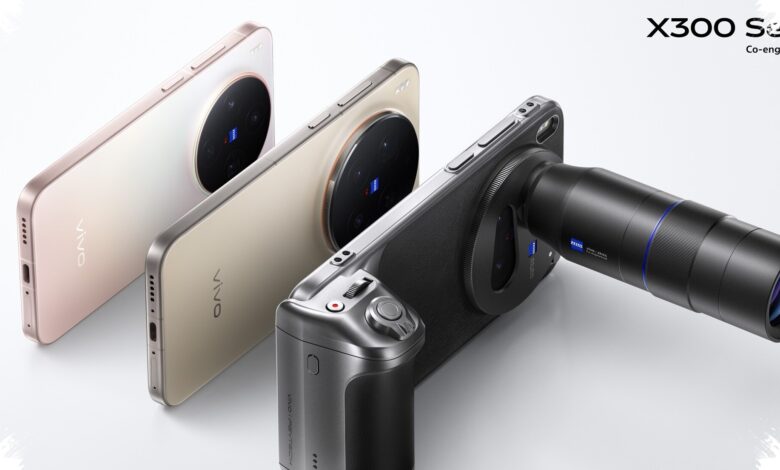
Vivo has positioned the X300 Ultra as a more ambitious flagship than the X300 Pro, but the upgrade path is not as straightforward as it first appears. With a price gap of about $500, the Ultra asks buyers to decide whether its sharper display, faster chipset, and stronger camera system are worth the extra spend.
The clearest answer depends on what matters most. For users who want a complete premium phone without stretching the budget too far, the X300 Pro remains compelling. For buyers chasing the most advanced screen, the highest-end processing power, and a more aggressive imaging setup, the X300 Ultra makes a stronger case.
Display and performance are the most visible step up
The X300 Pro comes with a 6.78-inch LTPO AMOLED display, a 120Hz refresh rate, and a 1260 × 2800 resolution. The X300 Ultra moves to a larger 6.82-inch LTPO AMOLED panel with a 144Hz refresh rate and a sharper 1440 × 3168 resolution.
Both phones reach the same 4,500 nits of peak brightness, so the difference is less about raw output and more about refinement. On paper, the Ultra should feel smoother in gaming and more detailed when viewing high-resolution content.
Performance follows the same pattern. Vivo pairs the X300 Pro with the MediaTek Dimensity 9500, while the X300 Ultra uses the Snapdragon 8 Elite Gen 5.
That chip choice gives the Ultra the advantage in CPU, GPU, and AI-heavy tasks. Memory and storage remain close between the two, with both models going up to 16GB of RAM and 1TB of UFS 4.1 storage.
The camera hardware is where the Ultra pulls away
The biggest reason to look at the Ultra is its imaging system. The X300 Pro uses a 50MP main camera, a 200MP periscope lens, and a 50MP ultrawide camera.
The X300 Ultra raises the stakes with a 200MP main camera, a 200MP periscope camera, and a 50MP ultrawide. Vivo also gives the Ultra a gimbal OIS setup on the main camera, which adds another layer of stabilization-focused appeal.
Both phones support 3.7x optical zoom on the telephoto lens. The Ultra goes further by adding optional 200mm and 400mm zoom lenses, making it the more serious option for long-range shooting.
Video recording is strong on both devices, with support for 8K, 4K at 120fps, and Dolby Vision. The Ultra adds HDR10+ and a more advanced imaging pipeline, which further widens the gap for creators who care about video processing.
The front camera is also shared at 50MP with autofocus and 4K video support. Even so, the Ultra adds gyro-EIS and HDR, making it more attractive for selfie video and vlogging.
| Key Area | Vivo X300 Pro | Vivo X300 Ultra |
|---|---|---|
| Display | 6.78-inch LTPO AMOLED, 120Hz, 1260 × 2800 | 6.82-inch LTPO AMOLED, 144Hz, 1440 × 3168 |
| Chipset | MediaTek Dimensity 9500 | Snapdragon 8 Elite Gen 5 |
| Main Camera | 50MP | 200MP with gimbal OIS |
| Battery | 6,510mAh, 90W wired, 40W wireless | 6,600mAh, 100W wired, 40W wireless |
Battery, connectivity, and software favor practicality
The battery upgrade is modest. The X300 Pro carries a 6,510mAh battery with 90W wired charging and 40W wireless charging, while the Ultra increases capacity slightly to 6,600mAh and raises wired charging to 100W.
That difference matters, but it is not dramatic enough to be the main reason for most buyers to spend much more. For everyday use, the jump is incremental rather than transformational.
Connectivity is broadly similar, with both phones offering Wi‑Fi 7, Bluetooth 5.4, and USB-C 3.2. The Ultra adds DisplayPort support over USB-C and extra Bluetooth codec support, which makes it more flexible for external display use.
Satelite support is another small but notable split. The X300 Pro is listed with optional satellite connectivity, while the X300 Ultra adds Emergency SOS via satellite on the 1TB model.
The Pro still looks like the safer flagship buy
There are several areas where the Ultra does not separate itself as much as its higher price suggests. Both models use glass on the front and back, an aluminum frame, and IP68/IP69 protection.
That means the durability story is essentially the same, and buyers are not paying extra for a radically different build. The X300 Pro remains a full flagship in terms of materials and resistance.
Software support also gives the Pro a practical advantage. Vivo X300 Pro is listed with Android 16 and OriginOS 6, plus confirmation of 5 major Android updates, while the Ultra listing only mentions Android 16 and OriginOS 6.
For buyers thinking about long-term use, that detail may matter more than the extra hardware on the Ultra. It makes the Pro look especially well-rounded for users who want a premium phone without chasing every top-tier spec.
Pricing is where the decision becomes clear. The Vivo X300 Pro is priced at around $1,000 or ₹1,10,000, while the Vivo X300 Ultra sits at about $1,500 or ₹1,60,000.
At that difference, the X300 Ultra does deliver a better display, a faster chipset, a far more ambitious main camera, extra zoom options, and some useful connectivity upgrades. Still, the X300 Pro remains difficult to dismiss because it already offers strong video capability, matched storage options, similar durability, and a far more approachable price for most flagship shoppers.