


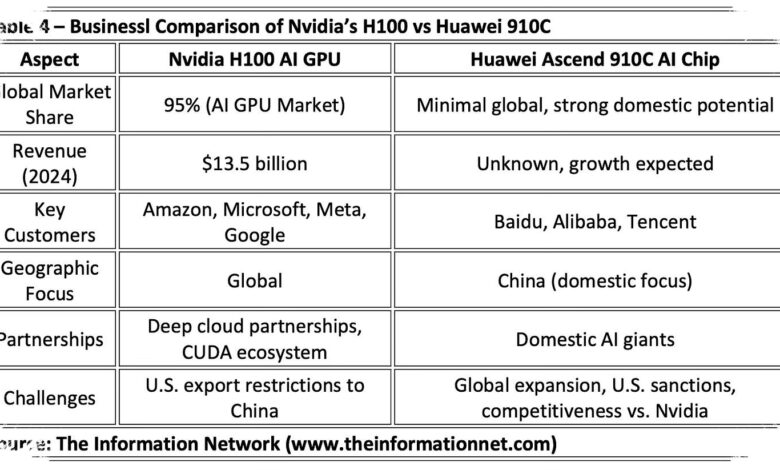
Huawei is moving into a stronger position in China’s AI chip market at a time when Nvidia is facing mounting pressure from US export restrictions. The shift highlights how government policy and domestic supply chains are now shaping competition as much as raw chip performance.
According to projections cited by technology media from research firm BrainSten, Huawei could hold about 50 percent of China’s AI chip market, while Nvidia’s share may fall sharply to around 8 percent. Nvidia still had roughly 40 percent of the market in 2025, making the projected change a major reversal.
Domestic demand is doing part of the work
China’s demand for AI chips continues to rise, and that growth is helping local suppliers gain more room. Beijing has also been prioritizing domestically made semiconductors, which gives companies such as Huawei a stronger path to expand distribution inside the country.
That support is more than a sales opportunity. It also reinforces Huawei’s role as an important part of China’s national AI ecosystem, where local technology is increasingly being positioned as the safer and more strategic choice.
Nvidia’s access has narrowed
The main pressure on Nvidia comes from export controls imposed by the United States over recent years. Those rules limit the sale of advanced AI chips to China on trade and national security grounds, reducing Nvidia’s ability to compete freely in one of the world’s biggest technology markets.
Nvidia did receive permission to resume sales of its S200 AI chip series, but China’s response to that easing was described as lukewarm. As a result, the company’s prospects in the market remain constrained despite the partial policy softening.
Technology strength is no longer enough on its own
For years, Nvidia has been seen as the global leader in AI chips, especially for data centers, high-performance computing, and generative AI development. The China case now shows that technical leadership alone may not be enough to preserve market dominance.
Geopolitics is increasingly reshaping the semiconductor industry. Government policy, supply chain control, and the ability to build a local ecosystem are becoming as important as innovation itself.
For global chipmakers, that means strategy must now adapt to a more fragmented market. For Huawei, the same shift creates an opening to accelerate expansion and strengthen its position in China’s fast-growing AI sector.
| Company | 2025 Market Share | Projected Market Share |
|---|---|---|
| Nvidia | About 40% | About 8% |
| Huawei | Not stated | About 50% |
The projected shift underlines a broader reality in China’s AI race: access and policy can move faster than product advantage. If the forecast holds, Huawei will emerge as the clear leader in a market where Nvidia once held a far stronger position.