


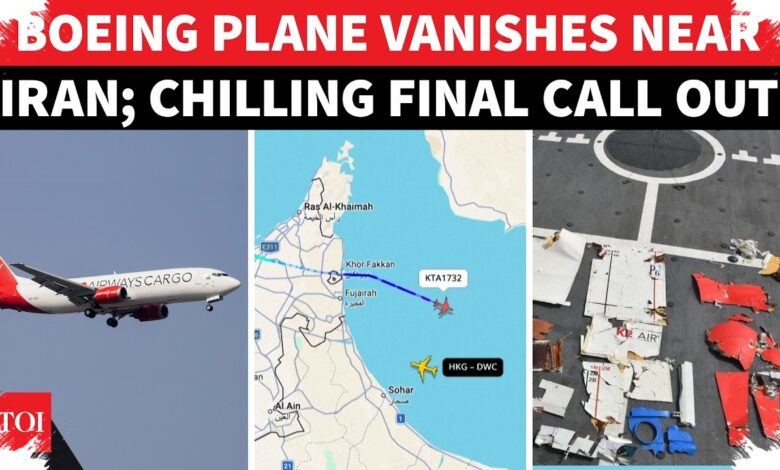
Fragments from the K2 Airways Boeing 737 cargo aircraft registered AP-BOI have been recovered in the Arabian Sea after roughly 12 hours of search and rescue operations. The find marks a major step in the investigation, but it still does not explain why the aircraft went down.
Investigators are now focusing on the recovery of the wreckage and the analysis of the black boxes, which contain flight data and cockpit voice recordings. Aviation specialists say it remains too early to reach a final conclusion until those technical records are examined.
The wreckage was found off the coast of Pakistan, near the city of Omara, about 360 kilometers west of Karachi. The aircraft was operating KTA1732, a cargo flight from Sharjah in the United Arab Emirates to Karachi, Pakistan.
What happened in the final minutes
During the flight, when the aircraft was at an altitude of about 35,000 feet, the crew reportedly told air traffic control that the navigation system was experiencing a malfunction. Soon after that report, the aircraft showed an unusual change in altitude for about three minutes before disappearing from radar.
Flight tracking data from Flightradar24 indicates that the aircraft descended, then climbed again, before finally entering a steep dive. The recorded descent rate was about 22,400 feet per minute, far above the normal profile for a jet in cruise flight.
For investigators, that unusual altitude pattern is one of the most important early clues. Aviation safety analyst Anthony Brickhouse said the sequence will be examined alongside physical evidence from the crash site.
Five theories under review
Mark Stephens, a former Delta Air Lines pilot who has flown the Boeing 737, said five possibilities deserve close attention in the investigation. He stressed that these are not conclusions, but areas that must be tested with technical data and evidence from the scene.
| Possible cause | Why it matters | Investigative focus |
|---|---|---|
| Flight control system damage | Could disrupt how the aircraft responds to pilot inputs | System performance and control behavior |
| Cargo misload | Could affect center of gravity and in-flight stability | Load distribution and balance |
| Engine trouble | Could reduce performance and increase crew workload | Engine condition and power output |
| Human error | Could involve decisions in the air or on the ground | Operational choices and procedures |
| Sabotage | Cannot be ruled out without forensic proof | Forensic findings and black box analysis |
The first theory is flight control system damage. If such a system were compromised, the aircraft’s response to pilot commands could be affected and may trigger an abnormal change in altitude.
The second theory is cargo misload. On a freighter aircraft, weight distribution is critical because it influences the center of gravity and the aircraft’s stability during flight.
The third theory is engine trouble. A problem with one or more engines can reduce performance and place additional pressure on the crew, especially if it happens while the aircraft is cruising at altitude.
The fourth theory is human error, whether in the air or on the ground. That category can include operational decisions, technical handling, or a cargo-loading procedure that did not go as intended.
The fifth theory is sabotage, which experts say cannot yet be fully dismissed. However, that possibility will require strong proof from forensic examination and black box data before any conclusion can be made.
Not connected to Boeing 737 Max issues
This accident is confirmed to be unrelated to the problems that affected the Boeing 737 Max. The aircraft that crashed was a Boeing 737-400, an older generation that began operating in 1999 as a passenger jet before being converted into a freighter in 2011.
That distinction matters because the 737-400 and 737 Max are different variants. The MCAS system that drew global attention after two fatal 737 Max crashes in 2018 and 2019 is not linked to the aircraft involved in this case.
K2 Airways began operating the aircraft in 2024 under a lease arrangement. According to the airline’s official site, the Boeing 737 was the only aircraft in its fleet.
The incident has once again drawn attention to Pakistan’s aviation safety record, which has included several major accidents over the past two decades. Pakistani authorities are continuing the investigation to establish what happened to AP-BOI in the Arabian Sea.