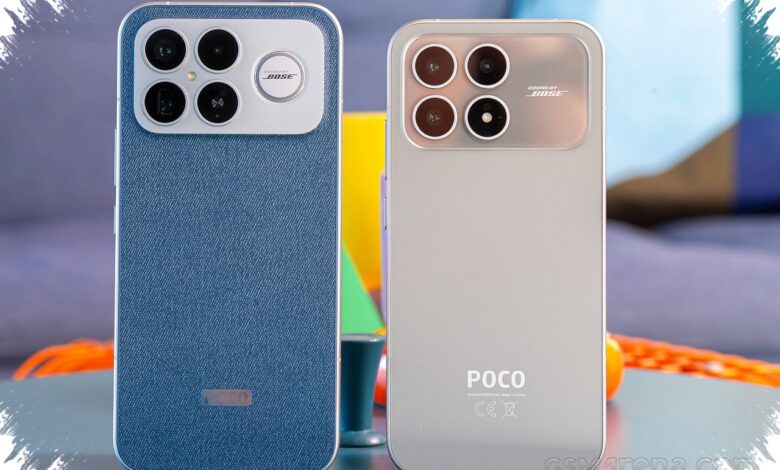
At first glance, Poco F8 Ultra and Xiaomi 17T Pro appear to chase the same flagship buyer. Both start from Rp 12 jutaan, both use AMOLED panels, both rely on 3 nm chips, both carry a 50 MP periscope telephoto camera, and both support 100-watt wired charging.
That shared formula ends quickly once the details come into focus. Poco F8 Ultra leans into a louder identity with a Bose subwoofer, a sharper display, and Snapdragon 8 Elite Gen 5, while Xiaomi 17T Pro pushes battery capacity, a faster refresh rate, and Leica-tuned camera branding.
Design Sets the Tone Before the Specs Do
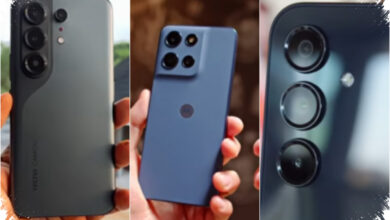
Poco F8 Ultra uses a large rectangular camera module that houses three cameras and an additional Bose subwoofer compartment. That section is designed to handle low tones and bass, and it is claimed to widen the speaker’s sound range.
Xiaomi 17T Pro goes for a simpler look with a rounded-square camera module at the upper left side of the back panel. It carries three Leica cameras and a flash, but no subwoofer chamber, which gives it a cleaner appearance.
| Model | Dimensions | Weight | Design Highlight |
|---|---|---|---|
| Poco F8 Ultra | 163.3 x 77.8 x 7.9 mm | 218 grams | Large module, Bose subwoofer |
| Xiaomi 17T Pro | 162.2 x 77.5 x 8.25 mm | 219 grams | Simpler module, triple Leica cameras |
Display Trade-Offs Decide the Flavor
Poco F8 Ultra is fitted with a 6.9-inch AMOLED display with 2K resolution at 1,156 x 2,510 pixels, a 120 Hz refresh rate, and peak brightness of up to 3,500 nits. Xiaomi 17T Pro uses a slightly smaller 6.83-inch AMOLED display with 1.5K resolution at 2,772 x 1,280 pixels, a 144 Hz refresh rate, and peak brightness of up to 3,500 nits.
Both phones use Corning Gorilla Glass 7i. The difference is straightforward: Poco focuses on sharper resolution, while Xiaomi responds with a higher refresh rate.
| Model | Display Size | Resolution | Refresh Rate |
|---|---|---|---|
| Poco F8 Ultra | 6.9 inches | 2K | 120 Hz |
| Xiaomi 17T Pro | 6.83 inches | 1.5K | 144 Hz |
Performance and Cooling Follow Different Priorities
Poco F8 Ultra runs on Snapdragon 8 Elite Gen 5 built on a 3 nm process, paired with 16 GB LPDDR5X RAM and 512 GB UFS 4.1 storage. Xiaomi 17T Pro uses MediaTek Dimensity 9500 on a 3 nm process, with 12 GB LPDDR5X RAM and 256 GB or 512 GB UFS 4.1 storage.
For thermal control, Poco F8 Ultra brings a dual-channel IceLoop System. Xiaomi 17T Pro uses a similar setup called 3D IceLoop, and both run Android 16 with HyperOS 3.
Cameras Stay Close, But Leica Gives Xiaomi a Distinct Identity
Both phones are built around 50 MP main cameras and 50 MP periscope telephoto units with up to 5x optical zoom. Poco F8 Ultra adds a 50 MP ultrawide camera, while Xiaomi 17T Pro uses a Leica 12 MP ultrawide lens.
The front camera is matched at 32 MP on both models. Xiaomi 17T Pro stands out more in visual identity thanks to its Leica Summilux lens branding, which gives the camera system a more defined premium character.
| Model | Main Camera | Telephoto Camera | Front Camera |
|---|---|---|---|
| Poco F8 Ultra | 50 MP | 50 MP, 5x optical zoom | 32 MP |
| Xiaomi 17T Pro | Leica 50 MP | Leica 50 MP, 5x optical zoom | 32 MP |
Battery, AI, and Connectivity Round Out the Comparison
Poco F8 Ultra carries a 6,500 mAh battery, while Xiaomi 17T Pro goes bigger with 7,000 mAh. Both support 100-watt wired fast charging, so the larger battery does not come at the cost of charging speed.
On the AI side, both phones support AI Writing, AI Speech Recognition, AI Interpreter, Circle to Search, and Google Gemini. Poco F8 Ultra goes further with AI Search, AI Erase Pro, AI Image Expansion, AI Film, and AI Image Enhancement.
Connectivity is also well covered on both models with 5G, Dual SIM, WiFi 7, Bluetooth 6.0, NFC, and USB Type-C. That places them firmly in the modern flagship category for daily use and productivity.
Price Differences Stay Narrow in Indonesia
In Indonesia, the Poco F8 Ultra 16 GB/512 GB is priced at Rp 12.999.000. That is the same price as the Xiaomi 17T Pro 12 GB/512 GB variant.
The Xiaomi 17T Pro 12 GB/256 GB version is sold at Rp 11.999.000, making it Rp 1 million cheaper. The choice therefore comes down to what matters more: storage capacity, camera identity, display preference, or a more distinctive design direction.