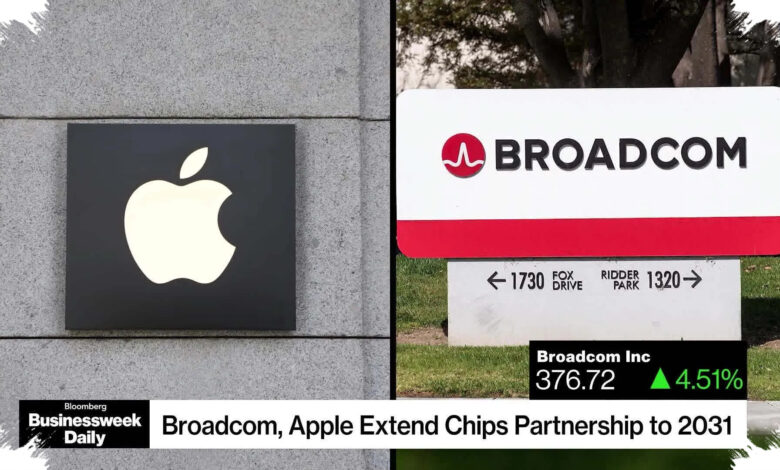
Apple’s push toward more in-house silicon is not ending its relationship with Broadcom anytime soon. The two companies have extended their technology partnership through 2031, keeping Broadcom firmly involved in Apple’s wireless and networking supply chain.
The move shows how Apple is balancing two goals at once. It is developing more of its own chips, but it is also keeping a long-standing supplier in place to protect continuity in critical components.
Broadcom’s role remains broad
Broadcom confirmed the extension in an 8-K filing with the US Securities and Exchange Commission. In that filing, the company said Apple agreed to expand their long-term technology collaboration, including a renewed multi-year agreement for the development and supply of custom application-specific integrated circuit, or ASIC, silicon chips.
Those ASIC chips are expected to be used in future Apple devices. Broadcom said the agreement also provides long-term demand visibility for its chip business, while Apple gains supply assurance for network-related needs over the next five years.
| Area of Cooperation | Broadcom’s Role | Impact on Apple |
|---|---|---|
| RF chips and networking modules | Supplying wireless connectivity components | Supports device-to-device wireless communication |
| Custom ASIC silicon chips | Developing and supplying custom chips | Used in future generations of devices |
| Mid-term networking demand | Securing demand through 2031 | More stable chip supply amid global supply chain uncertainty |
Apple has not fully broken away
Broadcom has long supplied RF chips and networking modules for Apple products. These parts help enable wireless connectivity features across devices, including communication between Apple devices.
Even with Apple’s own modem efforts, the company still depends on Broadcom for some components inside its in-house solutions. Apple has already launched the C1 modem in the iPhone 16e and the C1X in the iPhone Air, but the shift has not removed Broadcom from the picture.
Apple is also developing its own N1 chip, which combines Wi-Fi and Bluetooth components for the iPhone, iPad, and Mac. That effort has changed the relationship between the two companies over time, but it has not ended it.
AI servers add a new dimension
According to Bloomberg, the custom ASIC chips being developed with Broadcom and Apple are also intended to support more advanced AI servers. Apple is reportedly targeting deployment of those servers in 2027.
That direction matters because ASIC chips are increasingly important in systems built to handle AI workloads. As a result, the partnership now reaches beyond consumer devices and into larger-scale computing infrastructure.
TheElec reported that Broadcom’s shipments to Apple account for nearly 20 percent of Broadcom’s total annual revenue. That dependence helps explain why the extension matters for both companies, especially while the global supply chain remains uncertain.
For Apple, the deal reinforces a dual strategy. The company continues to build more of its own chips while keeping Broadcom as a key supplier for wireless connectivity and networking stability.