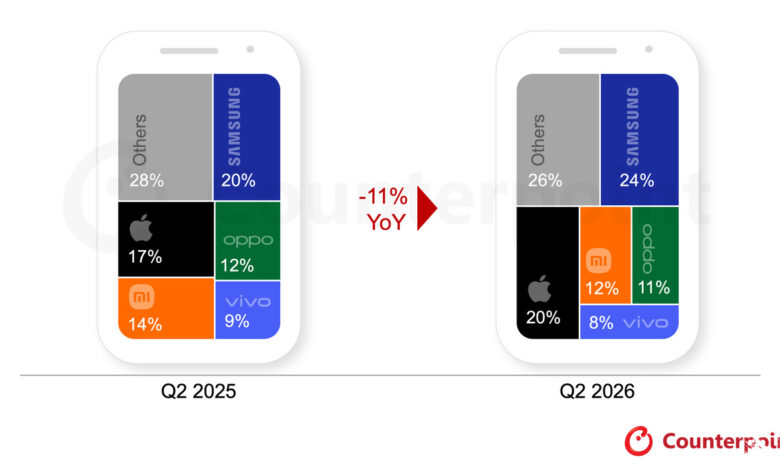
India’s smartphone market contracted sharply in the second quarter, but Apple moved in the opposite direction. iPhone shipments rose from 3.1 million to 3.5 million units while total market shipments fell 13% year on year.
Apple was the only brand among India’s five largest smartphone vendors to record annual shipment growth in the quarter. Its market share reached 10%, highlighting a markedly different result from vivo, Samsung, Oppo, and Xiaomi.
Inventory Strategy Supported Apple
Omdia attributed Apple’s growth to the inventory build-up of the iPhone 17 ahead of an expected price increase for its successor. That approach increased the number of Apple devices entering the Indian market despite weaker overall demand.
The April-to-June period saw 33.9 million smartphones shipped across India, according to Omdia data. Rising memory prices were identified as a major factor, making devices less affordable for consumers in the mass-market segment.
| Brand | Q2 Shipments | Market Share | Annual Change |
|---|---|---|---|
| vivo | 6.3 million | 18% | Down 23% |
| Samsung | 5.9 million | 17% | Down 5% |
| Oppo | 4.6 million | 14% | Down 400,000 units |
| Xiaomi | 4.5 million | 13% | Down from 5 million units |
| Apple | 3.5 million | 10% | Up from 3.1 million units |
Leaders Also Faced Lower Volumes
vivo retained first place with 6.3 million shipments and an 18% market share. However, that result was down from 8.1 million units and a 21% share in the corresponding earlier period.
The Y11 5G, Y21 5G, and V70 FE helped support vivo’s sales during the quarter. Even so, its 23% annual decline underscored the scale of the market-wide slowdown.
Samsung followed closely with 5.9 million units and a 17% share. Its shipment volume fell 5%, but its share increased from 16%, narrowing the gap with vivo.
The Galaxy A07 and Galaxy A17 contributed to Samsung’s shipment volume. Their performance helped the company remain competitive as affordability became a greater concern for mainstream buyers.
Share Gains Did Not Require Shipment Growth
Oppo shipped 4.6 million smartphones, about 400,000 fewer units than in the previous period. Nevertheless, its share increased from 13% to 14%.
The F33 series, Reno15 family, and Find X9 line supported Oppo’s sales. The result showed how a vendor could gain share when the overall market declines faster than its own shipments.
Xiaomi shipped 4.5 million units and maintained a 13% share, down from 5 million units previously. Redmi 15a, Redmi 15C, Redmi A7 4G, and Redmi A7 Pro 4G were among the devices supporting its volume.
The different outcomes among the leading brands demonstrate that lower shipments did not automatically result in lower market share. Samsung and Oppo both expanded their portions of the market despite reduced unit volumes.
Pressure Expected for the Full Year
GSMArena reported that Omdia expects India’s smartphone shipments to decline by a double-digit percentage for the full year. Macroeconomic pressure and persistently high device prices are expected to constrain consumer demand.
Affordability is likely to remain the central challenge for India’s mass-market smartphone segment. Brands will need to balance shipment volumes, product inventory, and market share in a market where price sensitivity is increasing.