


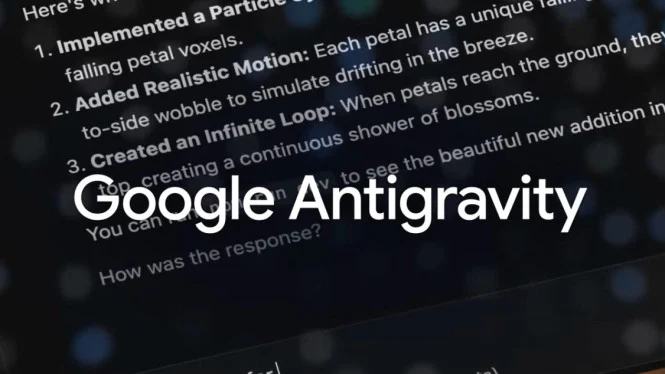
Google has launched Antigravity, a groundbreaking AI-driven coding platform powered by the latest Gemini 3 Pro model. Unlike traditional coding assistants such as GitHub Copilot or Amazon CodeWhisperer, Antigravity acts as an autonomous coding agent. It independently designs, writes, tests, debug, and improves software within a single integrated environment.
What sets Antigravity apart is not only its advanced capabilities but also its transparency. Google introduced the “Artifact” concept, a visual trace of the AI’s work process. This allows developers to understand, verify, and intervene in the AI’s decisions without wading through complex technical logs.
Antigravity as a Fully Autonomous Coding Agent
Previous AI tools have mostly served as pair programming partners. Antigravity, however, functions as a full coworker. It integrates multiple development tools into one ecosystem, including:
- Code editor
- Terminal
- Internal browser
- Runtime environment
All these components operate synchronously under the control of Gemini 3 Pro, a multimodal AI model that is faster, more concise, and better at comprehending technical context.
Instead of writing commands step-by-step, developers only need to provide high-level prompts. For example, “Build a to-do list app with user authentication, save data to Firebase, and show notifications near deadlines.” Within minutes, Antigravity automatically:
- Creates a detailed task plan
- Searches external documentation via internal browser
- Writes the code structure
- Runs unit tests
- Iteratively fixes errors
- Generates a final report
All these steps are documented in Artifact, providing a transparent workflow.
Artifact: The Transparent AI Worklog
Artifact combines visual and narrative elements to show how and why the AI made its coding decisions. Each Artifact includes:
- Structured task breakdown
- Screenshots of references from browsing
- Debugging records with error logs and solutions
- Step-by-step code changes with clear differences
- List of external sources such as documentation and forums
This transparency tackles the main criticism of generative AI: its “black box” nature. Developers can audit AI-generated code rather than blindly trusting it. Users can also add comments directly to Artifact, like requesting a different library for compatibility reasons. The agent adjusts plans accordingly without losing context or restarting its work.
Two User Interfaces for Different Needs
Antigravity provides two main modes tailored for diverse users:
-
Editor Mode: An intelligent IDE with an agent panel on the side. Developers can manually code, ask the agent to optimize functions, request real-time explanations, and simulate execution. This suits individual programmers or small teams focused on one project.
- Manager Mode: A futuristic dashboard to control many agents simultaneously. Users can assign different agents to frontend, backend, database, or testing modules. They monitor progress, prioritize tasks, and merge results automatically. For instance, separate agents can build a React interface, a REST API in Node.js, and automated tests in parallel without manual intervention.
Continuous Learning and Personalization
Google revealed that Antigravity continuously learns from each project by saving:
- Successful architectural patterns
- Effective debugging solutions
- User preferences such as coding style and preferred libraries
This data remains private within the user’s or team’s context. Over time, Antigravity becomes increasingly personalized and efficient in matching individual workflows.
Availability and Access
Antigravity is now publicly available in beta and free of charge. It supports:
- Windows, macOS, and Linux platforms
- Access via Google’s official site or Google Cloud integration
- Requirement of a Google account and stable internet connection
Google assures that user data will not be used for global model training without explicit consent.
Implications for Software Development
Antigravity signals a paradigm shift in software engineering:
- From writing code manually to managing AI coding agents
- From manual debugging to auditing transparent AI worklogs
- From solo work to coordinating multi-agent collaboration
This promises easier onboarding for beginners, exponential productivity gains for experts, and reduced development cycles for companies—from months to days. However, challenges remain, such as ensuring code security, long-term architecture quality, and accountability for critical bugs. Google tackles these with Artifact transparency and full human oversight, emphasizing AI as a tool, not a replacement.
Antigravity represents Google’s vision for human-AI collaboration in software development. By combining Gemini 3 Pro’s power, an integrated dev environment, and clear AI work traces, Google is redefining the role of developers in the AI era. This AI coding platform is ready to be tested now. Soon, coding may shift from manual typing to directing a team of AI agents to turn ideas into reality within minutes.