


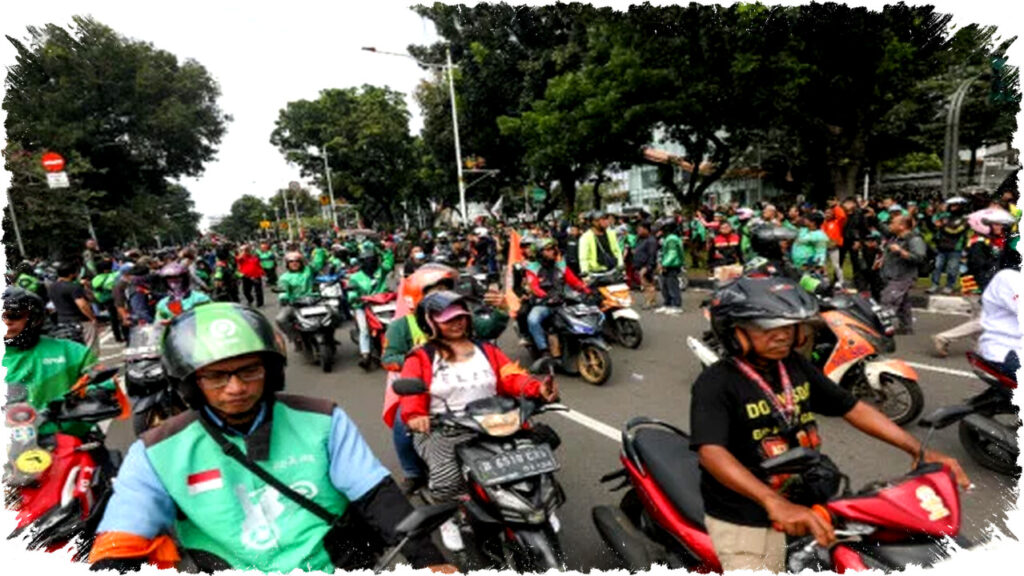
The ongoing struggle of online motorcycle taxi drivers (ojol) in Indonesia highlights a critical labor issue: the demand for proper holiday allowances and official recognition as workers. The Indonesian Transport Workers Union (SPAI) has stepped forward to challenge current practices by pushing the Ministry of Manpower (Kemnaker) to mandate the payment of a formal Religious Holiday Allowance (THR) for all platform drivers, rather than the voluntary and non-binding Holiday Bonus (BHR) that has been offered so far.
SPAI’s demand is unequivocal: ojol drivers deserve a THR equivalent to one provincial minimum wage (UMP) without conditions. This stance arises from the belief that the existing bonus schemes are discriminatory and fail to reflect the true nature of the employment relationship between drivers and platform companies.
Reevaluating the Status of Ojol Drivers
At the heart of the dispute lies a fundamental question about employment status. Kemnaker has thus far resisted imposing a mandatory THR on platforms, citing the classification of drivers as “partners” rather than employees. However, SPAI disputes this. According to Lily Pujiati, chairperson of SPAI, the conditions of work for ojol drivers clearly satisfy the three criteria of a working relationship as defined under Indonesian Labour Law (UU No. 13/2003): performance of work, receipt of wages, and subordination or obedience to company directives.
Drivers execute delivery or passenger transport tasks, earn wages, and are subject to orders and penalties if they fail to comply or meet targets. This strongly indicates an employer-employee relationship rather than an independent contractor or partner status. SPAI thus calls for official recognition of drivers as workers to guarantee proper labor rights.
The Problem with the Current Holiday Bonus Scheme
The existing Holiday Bonus (BHR) scheme, currently under consideration for continuation by Kemnaker, is voluntary and often manipulated by platforms to avoid fair compensation. Drivers must satisfy stringent criteria such as working a minimum of 200 hours online, completing at least 25 working days, and maintaining a 90% order completion rating to qualify. These parameters are difficult to meet given the platforms’ pricing policies.
Promotional incentives like “Bike Hemat” or “Gacor Berbayar” reduce the fares drivers receive, limiting earnings and affecting order availability. Non-subscribing drivers often struggle to secure orders, while subscribing drivers incur costs around 20,000 Indonesian Rupiah (approximately $1.25) per day. This undermines driver income further and makes the bonus criteria unrealistic.
SPAI’s Specific Demand for THR
To protect ojol drivers’ welfare, SPAI insists on the following:
- The implementation of a mandatory Religious Holiday Allowance equivalent to one provincial minimum wage (UMP).
- Elimination of discriminative and restrictive conditions such as minimum working hours or high completion ratings.
- Obligatory payment of THR by all major platforms, including Gojek, Grab, Maxim, Shopee Food, InDrive, Lalamove, Deliveree, and Borzo.
This approach aims to put an end to the current bonus system’s inconsistencies and to formally acknowledge the drivers’ labor rights equivalent to formal employees.
Legal Framework and Government Responsibility
Indonesian labor law recognizes the right to THR for all workers, and the guidelines established by Kemnaker in previous years were limited to advisory notices encouraging BHR payments. For example, a 2025 ministry circular suggested bonus payments proportional to 20% of drivers’ average net monthly income over the past 12 months. SPAI sees this as insufficient and not in line with the law’s requirements for a fixed THR.
The union stresses the government’s obligation to enforce compliance strictly and to sanction platforms that fail to fulfill these rights. Recognizing drivers as workers and guaranteeing a proper THR is seen as a critical step toward social protection and fair treatment in the gig economy.
Broader Implications for Gig Economy Workers
The ojol case signals broader challenges for platform-based workers who often operate in a gray space without full labor protections. The exploitative nature of flexible work arrangements masks precarious employment conditions, insufficient income security, and absence of social benefits.
Adequate THR payments and formal employment status for ojol drivers could set a precedent for other gig economy sectors. It would demonstrate a commitment by government and companies to the dignity and rights of workers, balancing productivity demands with welfare considerations.
Summary of Key Points
| Aspect | Current Situation | SPAI’s Demand |
|---|---|---|
| Employment Status | Considered partners | Recognized as workers under labor law |
| Yearly Holiday Payment | Voluntary Holiday Bonus (BHR) | Mandatory THR equivalent to 1x UMP |
| Eligibility Criteria | High thresholds (200 hours, 25 days, 90% rating) | No discriminatory requirements |
| Platform Examples | Gojek, Grab, Maxim, Shopee Food, etc. | Same platforms must comply |
| Government Role | Advisory, no binding regulation | Enforce mandatory THR, sanction violators |
The struggle of ojol drivers reminds stakeholders that flexible work models require updated regulations ensuring fair income and rights protection. The call for THR and employment status recognition is not only a fight for monetary compensation but a demand for dignity and security in an evolving labor landscape.