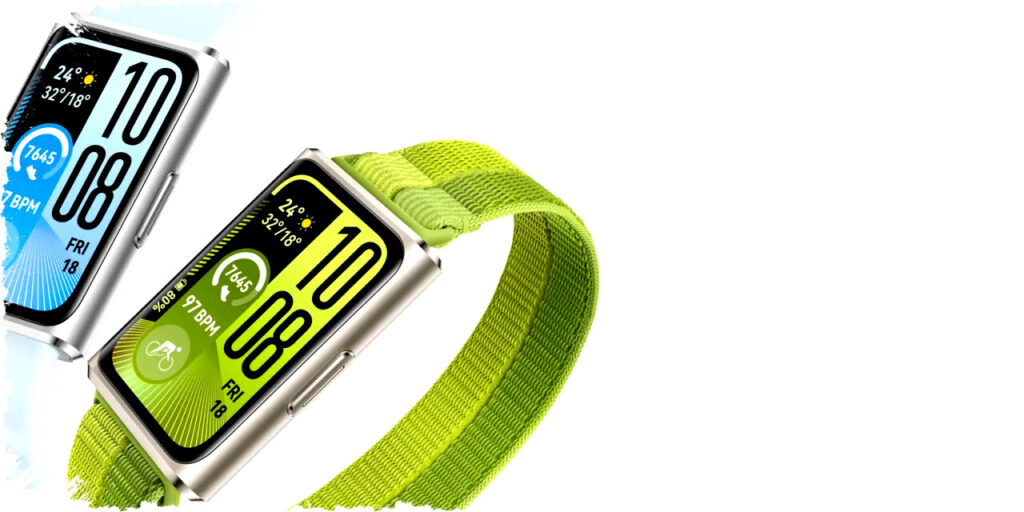
Huawei has introduced two new smartbands: the Band 11 and Band 11 Pro. These devices cater to different user needs, marking a shift in Huawei’s wearable lineup from a single model release to a segmented approach. The Band 11 is designed for everyday use with essential features, while the Band 11 Pro targets active users seeking advanced sports tracking capabilities.
Design and Dimensions: Lightweight vs. More Robust
The Huawei Band 11 sports compact dimensions of 42.6 x 28.2 mm with a thickness of 8.99 mm, weighing roughly 16 to 17 grams without the strap. It features a minimalist look suited for users preferring subtle accessories. The Band 11 comes in a range of colors including Beige, Green, White, Purple, and Black. The first three use aluminum alloy cases, while White and Black variants utilize lighter polymer materials.
In contrast, the Band 11 Pro measures slightly larger at 43.5 x 28.2 mm with the same thickness and weighs approximately 18 grams without the strap. This weight difference adds a more solid feel on the wrist. The Pro is offered in Green and Black color options, both employing aluminium alloy casings. Its fluoro rubber strap is softer and more skin-friendly compared to the regular band’s strap.
Display: Same Technology, Different Brightness Levels
Both smartbands feature a 1.62-inch AMOLED display with a resolution of 286 x 482 pixels and a pixel density of 347 ppi. This ensures sharp and clear visuals on both devices. However, the Pro model delivers a maximum brightness of 2,000 nits, double that of the regular Band 11 which reaches 1,000 nits. The higher brightness significantly improves outdoor readability under direct sunlight, enhancing usability during outdoor activities. Despite this difference, the Band 11’s screen remains sufficiently bright for everyday indoor or mild outdoor use.
Users can customize their experience with over 100 available watch faces, including options to adjust widgets and colors per individual preference. Both devices offer smooth and responsive screen navigation, facilitating easy access to various functionalities and data.
Health Features: Identical Sensors, Comprehensive Monitoring
Huawei equipped both smartbands with the same sensor suite. This includes a 9-axis IMU sensor, optical heart rate sensor, and ambient light sensor. Together, these facilitate real-time heart rate monitoring, blood oxygen (SpO2) measurement, and stress level tracking. The health functions extend to detailed sleep analysis, providing not just duration but also qualitative insights and improvement suggestions. Features such as sleep score, timeline overview, and bedtime reminders are included to help users manage their sleep health better.
Sports and Fitness Tracking: The Key Difference
Where these two models significantly diverge is in sports functionality. The Band 11 is ideal for casual workouts like walking, jogging, or light exercises. It provides basic metrics such as exercise duration, heart rate data, and calorie estimates.
The Band 11 Pro supports over 100 workout modes covering indoor and outdoor activities. Its standout feature is the built-in GNSS positioning system. This allows for highly accurate route tracking during outdoor workouts such as running, cycling, or hiking. GNSS enhances data reliability, making the Pro suitable for fitness enthusiasts who demand precise activity mapping.
Connectivity and Water Resistance
Both bands include Bluetooth 6.0 and BLE connectivity, compatible with Android 9 or higher and iOS 13 or later. Notifications from calls, messages, and activity reminders are delivered directly to the smartbands when paired with a smartphone.
Each device holds a 5 ATM water resistance rating, making them safe for swimming or use in rainy conditions. This durability adds practicality for daily wear and a range of activities.
Battery Life and Charging
Huawei claims both smartbands offer up to 14 days of battery life under certain conditions. Typical daily use is expected to last about 8 days, dropping to around 3 days when Always On Display mode is active. Charging is handled via a magnetic 5V/1A charger, simplifying power replenishment without complicated cables.
Pricing and Market Positioning
In Indonesia, the Band 11 is priced at approximately $41 USD, while the Band 11 Pro retails for around $62 USD. The $21 price difference reflects the additional features and hardware improvements on the Pro model.
Summary of Key Differences
| Feature | Huawei Band 11 | Huawei Band 11 Pro |
|---|---|---|
| Dimensions (mm) | 42.6 x 28.2 x 8.99 | 43.5 x 28.2 x 8.99 |
| Weight (without strap) | 16–17 grams | Approximately 18 grams |
| Color Options | Beige, Green, White, Purple, Black | Green, Black |
| Case Material | Aluminum alloy & polymer | Aluminum alloy |
| Display Brightness | 1,000 nits | 2,000 nits |
| Health Sensors | Optical HR, SpO2, 9-axis IMU | Optical HR, SpO2, 9-axis IMU |
| Workout Modes | Basic (walking, running) | 100+ workout modes including GNSS tracking |
| Water Resistance | 5 ATM | 5 ATM |
| Battery Life | Up to 14 days (8 days typical) | Up to 14 days (8 days typical) |
| Price | ~$41 USD | ~$62 USD |
The Huawei Band 11 suits users seeking a lightweight, straightforward smartband for essential health tracking and casual fitness. On the other hand, the Band 11 Pro is tailored for more active users who want enhanced sports features and better outdoor screen visibility. Huawei’s dual-offering strategy clearly aims to separate basic daily monitoring needs from advanced workout demands.
Both smartbands support the core health functions Huawei is known for. However, the inclusion of GNSS and superior display brightness on the Pro emphasizes its role as a fitness companion. Choosing between them depends primarily on your activity level and feature requirements. Users focused mainly on health and light activity will find the Band 11 adequate. Meanwhile, those who prioritize outdoor sports tracking and a brighter screen in sunlight will benefit more from the Band 11 Pro.